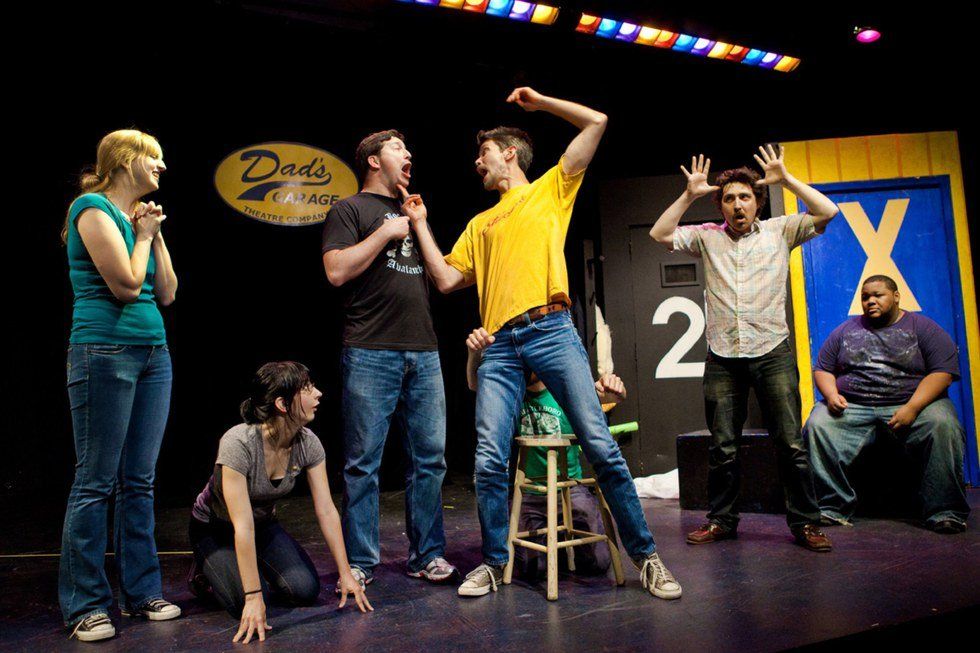
I took improv classes from some professionals who studied in places like “The Second City” where legends like Bill Murray, Amy Pohler, Stephen Colbert, Tina Fey and Steve Carell learned their craft. I've been in a few shows, and ever since I was a freshman I've been a part of Wright State's very own Troupe. We do short-form improv, similar to the things you'd see in "Whose Line Is It Anyways" but I've had some experience in long-form improv where a scene can go on for an hour. I love improv. Nothing on earth will give you the same boost of confidence like saying the right thing at the right time and hearing an audience laugh. The Blackbox Theater in Downtown Dayton is where I was taught and it's a great place to go if you want to see or learn from the professionals at work.
But as a member of Troupe for going on four years now, I see many a wide-eyed freshman come in and attempt improvised comedy like a limbless cow tries to swim. You aren't going to come into improvisation an expert, it's going to take some practice and cringy moments in front of people who aren't going to laugh. But here's some fundamentals on how professionals improvise entire shows. These are things that I wish I understood when I first started learning.
#1: It's a team sport.
If you try to go out and be “the funny guy” you're going to make an ass out of yourself. You've probably heard that the first rule of improv is “yes and.” This means that you have to cooperate with whoever you're on stage with. Essentially, everything that someone says in context to an improvised scene is true. If someone bursts into a scene and shouts, “your head is on fire!” then your only option is to act like your head is on fire.
Similar to death and taxes, you don't get to say “no” in a scene. You can't say, “My head isn't on fire! What are you thinking?” That immediately stops the scene and someone has to come up with something else on top of providing some sort of reason why someone would assume your head is on fire when it isn't.
An improvised scene is like an enormous weight that you and whoever you're working with have to carry. You can't carry it yourself, and if you try to be the star you're only going to get crushed under the weight. Your job isn't to be funny, your job is to help your team come up with amusing situations that hold a lot of potential to be funny.
This means communication. This is the biggest part of improv. If you want the scene to take place on a pirate ship, you're going to have to communicate to both the audience and your other improvisers that this scene is taking place on a pirate ship. You might come out pretending to have a peg leg and speaking with a piratey “arrr” and pretend to steer a mighty vessel in the ocean. You might come out calling for Captain Scratchyface to tell him that the ship is off course. Whatever you have to do to make that empty stage a pirate ship in the mind of the audience and to your fellow improvisers, you do it.
And the rest of your improvisers will, in turn, add to the scene. You're there to create a scene with people, not to stand around telling jokes. Improvisation is not stand-up comedy.
#2: It's not about making stuff up.
Most improv shows will begin with a one-word suggestion from the audience. This suggestion amounts to absolutely nothing. It is a stepping stone into something much bigger. It's a minor ingredient that you add to a great recipe. All that the suggestion does is spark an idea on where to begin. And where it goes is dependent on you and everyone else on stage.
If you just stand there on stage trying to come up with something as fast as you can you're going to be there for awhile. You are not making stuff up, you are working with the materials given to you. The rule is this- “if that is true, what else is true.”
What this refers to is that you have to find a thread of logic on whatever scene is being acted out. If your head is supposed to be on fire, you have several directions you can work with that. Why is your head on fire? What can you do with a head on fire? How do you try to put out the flames? Do you panic, or are you kind of okay about your new fire-head? And after you've added that element, what else can be built on top of that?
It's like stacking a bunch of blocks on top of each other. The point is to evolve the scene and see where it can go. That means taking what you're given and molding it into something that will progress the scene.
#3: Don't try to be funny.
Just don't. Like I said for step 1, if you try to be “the funny guy” you're going to make yourself look like a jackass and nobody will laugh. Often times, the humor in an improv show will come from the absurd extremes that come from the logic following the scene.
On one show I was in, everyone was supposed to be a rodeo clown. Nobody had any one-liners or jokes, but it was one of the most hilarious shows I've ever had the pleasure of being in. The humor came from whatever drama we could put our rodeo clown characters into. Everybody portrayed a well-defined character with personalities and goals. It became hilarious when those traits would clash and the overall conflict became more and more ridiculous.
The show started with a rodeo clown welcoming another person into the world of rodeo clowning. Naturally, that meant that there were many rodeo clowns who took their jobs very seriously. My character was a jerk rodeo clown who had no respect for anybody who thinks they can put on face paint and become a genuine rodeo clown. As the story progressed, we discovered that the lead clown had impregnated the only female clown- who was married to a different clown. The show became a story about a bunch of rodeo clowns trying to figure out who knocked up the only female clown while she and the lead clown had to hide their affair all while under the pressure of an upcoming rodeo that we had to be prepared for. Naturally, it ended with my character taking the blame and ending up stuck inside a barrel. The pregnant clown entered the final scene and asked why my character was beaten up and stuck inside a barrel.
“Because he knocked you up!” one of the clowns replied.
“He didn't knock me- uhh... yeah, it was him!” she said.
Lights out. The show ended on that line and the audience laughed like crazy. The story had ended, and the crazy logic had reached its climax. It was glorious.
#4: Just go with it.
I've been in some weird shows before. I'm talking shows that were absolutely bonkers. One show had me as the owner of some sort of horror-zoo where there were no animals. Instead, I was convinced from a mad woman that eating the meat of a certain animal would make me act exactly like said animal.
Remember, the first rule is “yes and.”
So naturally, I had to eat some bat meat and wave my arms around as if I had bat wings. Yes, it was awkward. No, nobody laughed. It didn't matter, the scene had to go on. There was no way I was going to get out of that show without pretending to be an animal. And the show only went crazier from there.
While a scene can change any time you like, you're going to find yourself in absurd situations. In one show, I had to be an extreme chess player. In another, I was infatuated with applesauce. Your job in these scenarios is to just roll with it. That is the fun of improv. It's challenging to add context to a scene where you're a pregnant clown at a rodeo, but if you can pull it off you are one hell of a performer.
The magic of improv is taking the tools you have available, using your team to build something out of it, and then just going along when it all comes crashing down. You'll have the time of your life.