
In 2012, according to census.gov only 65.1 percent of Americans reported that they were registered to vote. In addition to that, voter turnout in 2012 was only 57.5 percent. Voters and nonvoters alike have several reasons for not voting or for being apathetic about voting. According to Jonah Goldberg, of the latimes.com, one main reason Americans do not vote is because they do not always feel informed enough on the issues or candidates themselves.
Therefore, we are going to take a surface level look at how each candidate feels about the major issues America is facing. We will see that our first two candidates have contrary stances on most of the major issues. While the two third party candidates have a mixture of views and emphases of the two major parties in the U.S.
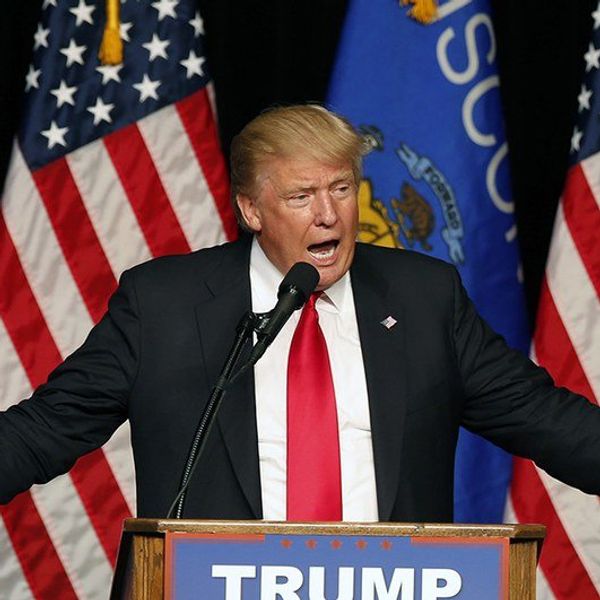
Donald Trump, Republican Party Nominee:
Donald Trump received the Republican Nomination in July 2016. He has never held an elected office before. Trump is a businessman mainly in the area of real estate. Trump, however, owns casinos, golf courses and other properties as well.
Regarding social issues Trump is conservative. He supports the pro-life movement but would want abortions to be allowed in cases of rape, incest and where the mother or child is in danger. But Trump also said he would want abortion banned at “some point" in the pregnancy (Life News). Trump does not support same-sex marriage and does not believe that same-sex couples should have the same rights to adopt children that heterosexual couples do (Politico).
In regards to immigration Trump has made his anti-immigration policies very clear to the American public. In June 2016, Donald Trump even wanted to go as far as banning immigrants from what he called “high risk" countries (Huffington Post). This would be in order to promote security and peace in the United States. Trump also believes illegal immigrants should pay out-of-state tuition at colleges and universities
When it comes to healthcare, Trump is more moderate than he his conservative, however he does not support the Affordable Care Act Obamacare. Trump does support the legalization of marijuana, for medical purposes only (Fox News).
Trump does not support the education standard of Common Core and believes education should be decided at the state level, as he said in the CNN Republican Presidential debate in March 2016. Trump also believes that the federal minimum wage should be raised. Per the Washington Post he would want the federal minimum wage raised to $10 per hour. Trump also supports voter identification laws in preventing voter fraud, saying “This voting system is out of control. You have people, in my opinion, that are voting many, many times. They don't want security; they don't want…" (Washington Post). Trump also supports hydraulic fracking to acquire oil and natural gas. He does not believe a police officer should be forced to wear a body camera. He believes the decision should be made at the department or personal level (The Guardian). Trump credits this view to a funding issue.
Hillary Clinton, Democratic Party Nominee:
Hillary Clinton has been part of America's political landscape since 1979 when she was the First Lady of Arkansas. In 1993 she became First Lady of the U.S. when her husband Bill won the presidential election. Then in 2000 she was elected to the United States Senate from New York and held this position until 2009 when Barack Obama appointed her as his Secretary of State. Hillary ran against Obama but lost the Democratic nomination to him in 2008. She served as Secretary until February of 2013, she expressed not wanting to serve a second term as Secretary of State.
On the topic of social issues, Hillary Clinton has strong liberal stances. Clinton is pro-choice saying in a press conference “I would attempt to organize as much as I could to be sure that we defended a woman's right to choose" (New York Times). Hillary has also asserted that she supports gay marriage and that same-sex couples should have equal adoption rights as heterosexual couples (Hillary Clinton.com).
Clinton not only believes illegal immigrants should not only be able to access government-subsidized but also be granted citizenship (MSNBC). Clinton also supports immigrants both legal and illegal. Stating in the Democratic Presidential Debate in Milwaukee, “I'm a strong supporter of comprehensive immigration reform;" Hillary supports equal rights for all immigrants for the U.S. (New York Times).
Hillary Clinton has always supported the movement for universal healthcare. In a debate with Bernie Sanders, Clinton stated she wanted to revise Obamacare by saying she will “...take it further." and “...reduce the cost" (Washington Post). However, like Trump, Clinton believes only medical marijuana should be legalized.
Clinton also supports more restrictions on guns, a higher federal minimum wage and hydraulic fracking. Hillary has always given a message of support for children throughout her political career. Clinton supports the Common Core education standard. In her closing remarks of a debate with Bernie Sanders Hillary asserted “So I am going to take on those economic barriers. I have a plan to create jobs and raise incomes. I'm going to take on the education barriers that often leave too many children behind even after they have completed schooling. I'm going to take on the health care barriers" (Washington Post).
Gary Johnson, Libertarian Party Nominee:
Gary Johnson served as the Governor of New Mexico from 1995 to 2003, as a Republican. Within the past 10 years Johnson has converted to the Libertarian Party. Both he and Ron Paul were seen as Republicans are seen as Libertarians but could not officially change affiliation because of the strong and seemingly impenetrable two party political system in the United States.
Gary Johnson's social views align with Hillary Clinton's, with the exception that with his support of same-sex marriage comes with the caveat of giving churches the right to refuse the marriage ceremony (I Side With.com).
Johnson is against illegal immigrants receiving health care subsidized by the government, on the basis that he does not support the government subsidizing health care at all (I Side With.com). He also has the view that illegal immigrants should pay out-of-state tuition (I Side With.com).
As stated above, Johnson does not support Obamacare because he is against government-subsidized health care. Johnson supports the legalization, taxation and regulation instead of criminalizing it (I Side With.com). Gary Johnson has also said that military spending should be decreased (Johnson Weld.com). Johnson does not support the Common Core Education standard stating that education should be handled at the state level and not be the federal government. Johnson strongly supports the stance that government should have a balanced budget and has done so in his own state as governor. He does not believe an ID should be required to vote. Johnson supports the Supreme Court decision in Citizens United v. The FEC. He said, “I would say, allow for unlimited campaign contribution but make it 100 percent…" (YouTube Interview). Johnson fully supports police wearing body cameras, saying it will protect the rights of both citizens and police officers (Libertarian Party.org).
This is a simple quick overview of some of the issues that are important to most voters. The above is not a comprehensive outline of each view of the candidates. But hopefully the uninformed voter may now have a better understanding of whom they will be voting for.