
For the past four months, I've been studying abroad in Athens, Greece. While every study abroad experience is different, living in the city of Athens presents its own peculiarities. There are certain adjustments to living in a foreign culture that are immediately apparent, like hearing a foreign language on the street or constantly converting euros to dollars in your head. Other adjustments arise gradually, turning into habits you didn't even realize you had. Here are some habits you may have picked up.
1. You stare

Or rather, you get used to everyone else staring at you. To the Greeks, if you find someone or something interesting then you have full social permission to publicly acknowledge that interest. For us nosy folks it's pretty much a dream come true.
2. You get better at mental math
You almost always have to pay in cash and there's no better way to get a cashier to like you than by paying in exact change. Your skills are put to the greatest test at group meals out on the town. Each person owes twelve euros, but three people only have twenties and you only have a fifty.
3. You get used to eating dinner around nine or ten

If you go out to eat then you grow accustomed to sitting there drinking and chatting for two or three hours undisturbed. Everything starts later here and the Greeks appreciate the importance of quality socializing. Plus, there's a good chance that you'll get a free shot with your check.
4. You accept the fact that no shopping will get done between the hours of 3:00 and 5:00 p.m.

Siesta hours are no joke here, so if you're planning on running some errands in between classes then you learn to plan accordingly. You also learn to find the few places that stay open during those hours and the days when things open back up afterwards. There are a lot of timetables running through your head.
5. You start to see the green crosses everywhere as beacons of hope

No, they're not selling weed, those are pharmacies and the bigger ones are equipped to treat nearly all of your over the counter medical needs. Are you feeling a little sniffly? Have bug bites got you down? Has WebMD convinced you that you're dying and you'd like a second opinion? Your local pharmacist has you covered.
6. You know and love your neighborhood animals

Athens has an abundance of free roaming cats and dogs and everyone helps to take care of them. Chances are that you met the cats by your apartment a long time ago and you've been trying to get them to love you ever since. You look forward to seeing the dogs who live in the Ancient Agora and know which dogs to pet on your walk to the Acropolis. Maybe you'll even save some of your lunch to share with them next time that you pass by.
7. You stop using maps

Or at least, you try to stop using maps. Instead, you rely on your orientation to the Acropolis to get around. And if you ever get hopelessly turned about you know that you're only a simple, "Συγνώμη, που είναι," from being pointed in the right direction.
8. You learn to factor an extra twenty to thirty minutes into your shower routine

Your apartment is probably several decades old and that's how long it takes your water heater to warm up. In the morning this means waking up half an hour earlier. At night this means staying up half an hour later. Either way, there's no worse feeling than realizing that you forgot to turn on the water heater when all that you want to do is take a nice, hot shower.
9. You understand that the yia-yias of Athens are a force to be reckoned with

These little old ladies will cut in front of you in line, yell at you for not wearing a jacket, and help you find your bus stop all in the same ten minutes. They've been around a lot longer than you, so, to them, you're still a baby in need of some loving guidance and maybe a more sensible pair of shoes.
10. You become friends with your local shop owners

Whether you're at the bakery, the coffee shop, or the souvlaki place, by your third visit the small talk grows into friendly conversation. Your daily greeting might even switch from the formal, "γεια σας," to the informal, "γεια σου."
11. You dread the rain

The abundance of marble on the sidewalks in Athens is beautiful and unique, but those sidewalks get super slippery when the rainy season sets in. Shoes with good traction and slow, deliberate steps are a necessity.
12. You pick up aggressive street crossing skills
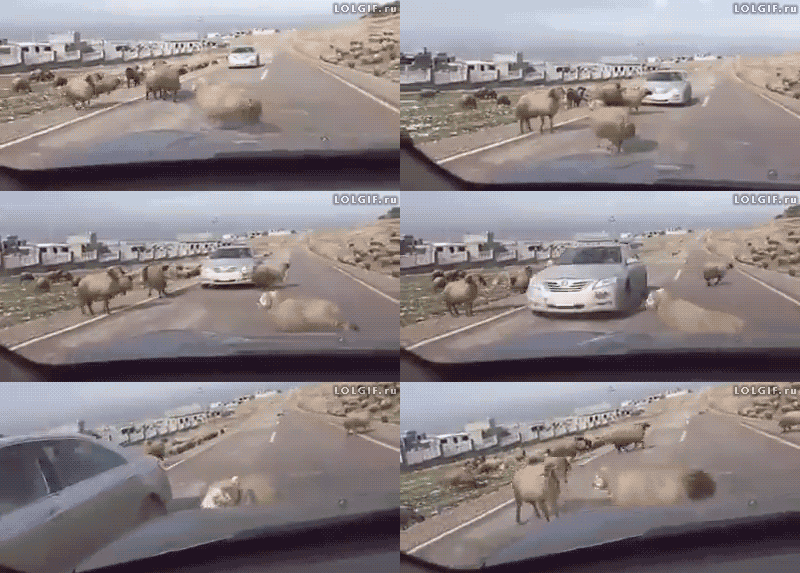
Greek drivers stop for no one, sometimes even when you're at the crosswalk and the little green walking man is signaling that it's your turn to cross. While you never jaywalk, you've seen enough Greeks do it that, if the situation were ever extremely dire, you could bob and weave around taxis and motorcycles like nobody's business.
13. You stop flushing your toilet paper

The plumbing in Athens is too old to handle that amount of traffic and you've read enough "please don't flush the toilet paper" signs to forget that there was ever a time when you did. Frankly, tossing toilet paper into the pot is beginning to sound like a luxury.
14. You learn to distinguish between a riot and a demonstration

Political activism manifests itself a little differently in Greece and it's not uncommon for there to be multiple demonstrations in the same day. While very few of them ever turn violent, earning the label "riot," you learn to exercise a little more caution around the areas where the demonstrations are taking place
15. You get used to seeing large groups of policemen everywhere
Whether they're milling around their large blue bus in front of a government building, sipping cappuccinos on a street corner, or prepping for crowd control before a demonstration, there's a good chance that it'll look like they're not really doing anything.
16. You learn that there are a lot of different ways to live in this world

In the short amount of time that you've lived in Athens you've assumed new habits that are unique to the part of the world in which you find yourself. While a lot of them won't be applicable when you return back home, they've helped you appreciate the small peculiarities in your own culture as well. This one little glimpse into how other people live gives you a whole new appreciation for the multitude of ways that humans have come to coexist.