


It is pretty common for us to see society today as worse than the past. One reason for this is the nostalgia effect, where we view the past through rose-colored glasses. Another reason is that bad news is more attention-getting and it dominates the headlines; we react more strongly to things that seem threatening than we do to positive things. So, when we compare the past to the present to figure out the future, we tend to think, "Things were great but they are only getting worse."
Fortunately, some good ol' statistics can break us out of our skewed perceptions. Here are a few trends pointing out why society, at least in the United States, is improving:
1. Charitable giving has hit a record high.
In 2014, Americans gave $358.38 billion to charitable organizations. They gave more money than any year in the past, even when adjusted for inflation.
2. Crime rates have fallen by half since the early 90s.

From 1991 to 2014, the total crime rate in the United States has consistently declined. It dropped from 14.9 million to 9.5 million total crimes, a 49.6 percent decrease as a percentage of the population.
3. Teenagers are smoking, drinking and having sex less than ever.

As I described in a previous article, the rates of drinking, smoking, and sexual behavior among American teenagers have decreased consistently over the last 20 years. On a related note...
4. Teen pregnancy is at an all-time low.
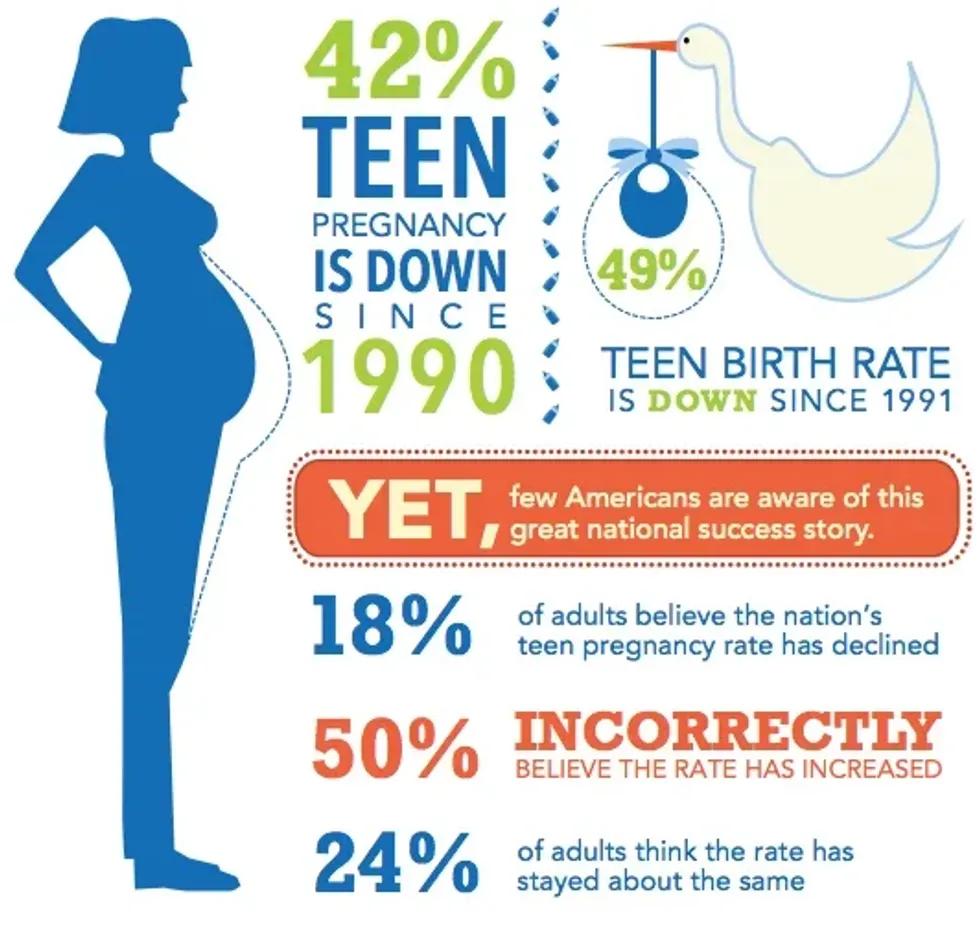
The teenage pregnancy rate fell from 116.9 to 57.4 pregnancies per 1,000 teen girls between 1990 and 2010. That means fewer teenage parents and fewer abortions.
5. High school graduation rates have hit an all-time high.
 For the 2013-2014 school year, the U.S. high school graduation rate reached 82 percent, up from 71 percent in 1995-1996. It seems like students are becoming more involved in their education in general, especially since...
6. People are reading more than ever before.
 According to a Gallup survey, more than twice as many people reported reading a book in 2005 than in 1957. So, contrary to popular belief, the rise of television and computers has not destroyed the grand tradition of reading. One potential reason is that...
7. Americans have much more leisure time nowadays than they did in the past.

The average American has much more time to do what they love nowadays than back in the 60's. American men spent about 7.9 more hours per week on leisure activities in 2003 than in 1965, and American women spent about six more hours.
8. Poverty rates among American elderly have fallen since the 60s.
 The percentage of Americans over the age of 65 living below the poverty line has dropped to less than 10 percent in recent years, after a high of 30 percent in 1967. And even for those who are living in poverty...
9. Today's poverty is radically different from poverty 60 years ago.
 Today, the typical household of an American family under the poverty line includes air conditioning, two televisions, a DVD player, a microwave and a video game system. In the 50s, impoverished families had few, if any, of those things and were highly undernourished. Annual per capita caloric consumption bottomed out in the 1950s, but today, over 92 percent of poor households always have enough food to eat.
Also, consider what Steven Olson's parents told him when he asked them what life was like for them during the 1940's and 1950's:
“So you didn’t have electricity, running water, your parents rented out your bedroom to strangers just to make ends meet, you lived in a damp dark basement where the bugs ate holes in your clothes, and you didn’t consider that poverty?”
“No,” they replied together.
“So you considered yourselves middle class?”
“Yes, I suppose. We struggled sometimes, but we had what we needed. We were like most other people. No one had much money, it’s fair to say we were middle of the road,” my dad said.
10. Socially acceptable racism is on its way out.
 Up until 50 years ago, African-Americans were commonly believed to be inferior to white Americans to the extent that they were denied the right to vote. The millions of members of the Ku Klux Klan used to terrorize those who believed in equality, but KKK membership has shrunk to below 5,000 members in 2015. Also, in 1958, only four percent of Americans approved of marriage between black and white people, but that number rose to 87 percent by 2013 and continues to increase. Racism may not be dead yet, but we have come a long way since the days of slavery.
So we don't have to see doom and gloom when we look forward. We can be confident that, just as today has improved on decades past, tomorrow will be even better. Societal progress marches on.
For more information on this subject, check out some of the following resources:
The Motley Fool: "50 Reasons We're Living Through the Greatest Period in World History"
Think Progress: "5 Reasons Why 2013 Was The Best Year In Human History"
Boston Fed: "Ten Reasons Why Today Might Be Better Than The 'Good Old Days'"
Stephanie Coontz: "The American Family: Where We Are Today"