


"You didn't _______ as a kid?! You had no childhood!" We've all heard this said at least a few times throughout our teenage and adult lives when talking to our peers about what we did for fun as children. This may seem like a harmless thing to say, and chances are we've all said it (or something similar) at least once.
Although the person saying this is usually just trying to show how important something was to them as a kid, it implies that there is one and only one "correct" way to grow up, when this couldn't be farther from the truth. There are infinite factors that can affect what a child does/watches/plays with, so it's pretty insane to expect everyone to have had the same childhood experiences as you did.
An important thing to note, and perhaps one of the most obvious, is the influence of one's parents. Our earliest experiences play a massive role in how we develop as adolescents and eventually adults; this is majorly affected by how our parents choose to raise us. As a 3-year-old child, you don't have total say in what you do for fun. At that age, you tend to play with whatever you're given, although kids this young do show some preferences for certain toys or activities over others.
Regardless, if a parent doesn't give a child a certain toy, chances are they won't play with it; if they do, it probably won't be a major part of their childhood. This concept continues into the tween and teen years; some parents don't allow their kids to play video games or watch certain TV shows while others do. At this age, it's easier to get around these rules by going to friends' houses, but you still don't get the same experience with it as your friends do.
If, as children, we learn to enjoy certain activities based on how we were raised, why would it make sense to shame someone for not having the same parents and general upbringing as you did? It is virtually impossible for two unrelated people to have played all the same games, listened to all the same music, and watched the same movies.
Our parents were a major factor in determining these things, but so are our hometown, sibling situation, the generation we're a part of, our family's socioeconomic status, the list goes on and on. There's no way that you can know every detail about a person's past, especially when your friendship with them is relatively new. So why do we get so surprised when we find out our friends didn't value an important part of our own childhood as much as we did?
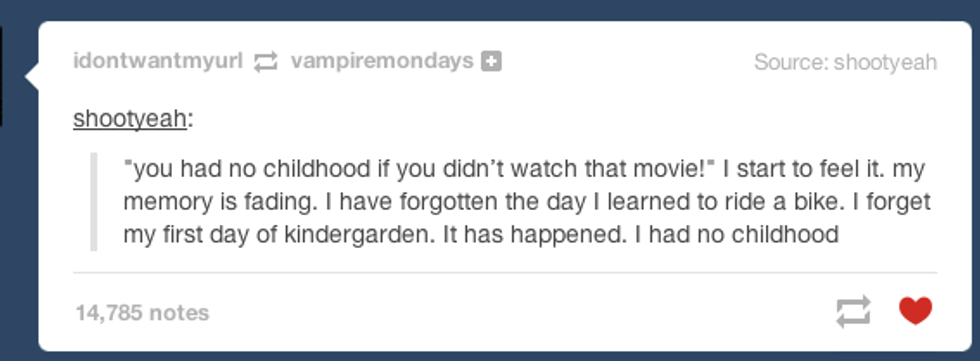
Why do we determine the validity of someone’s childhood based on what games they played or movies they watched? A person not having your exact experience growing up does in no way mean that they had an awful or "uncultured" childhood.
As with many other things in life, different does not mean worse; it just means different. One child may have loved watching Spongebob while another would have preferred to go see a symphony orchestra perform any day of the week. This doesn’t mean that one had a better childhood than the other, or that one is a better person than the other, but rather that they simply liked different things growing up. Whether this is due to parental influence or otherwise, this is the case more often than not.

So why is this such a bad thing? Why do some seem to mock people or get personally offended when others don’t understand their references? Perhaps it is because that part of their childhood was so important to them that it comes as a bit of a shock to realize that other people didn’t feel the same way about it. Or maybe some just can’t believe that a person could make it to early adulthood without ever having done the activity, especially if it’s one that is popular among the general public. Whatever the reason, sometimes society needs a reminder that having different experiences as kids isn’t the worst thing in the world. In fact, it’s pretty crucial when these children eventually become adults.
Our different experiences growing up are a big part of what makes society so diverse, and this diversity creates endless opportunities to learn about others and their cultures. After all, if everyone were the same, life would get very boring very quickly.
I suggest that the next time you meet an 18-year-old who hasn’t seen more than 5 minutes of any Star Wars movie (I was one of them until 3 months ago, and now I absolutely love Star Wars!), for example, don’t make them feel ashamed and guilty for not having watched the series. Instead, use these differences as opportunities to share the important parts of your childhood with others while simultaneously learning about theirs.

















