One thing I am undoubtedly sure of is that the beloved world of Harry Potter is timeless. The world of Harry Potter has always been one set in a time without any real glimpse into advancing technology, which allows it to focus on bigger themes like abuse, fear, and depression without being limited by the politics or technology of the time period. This appeal of timelessness drew me to the series and I'm not ashamed to say I have revisited Harry countless times. However, with the release of Rowling's semi-adaption of the novella Fantastic Beasts and Where to Find Them, I wondered if she would be able to bring the magic to life once more.
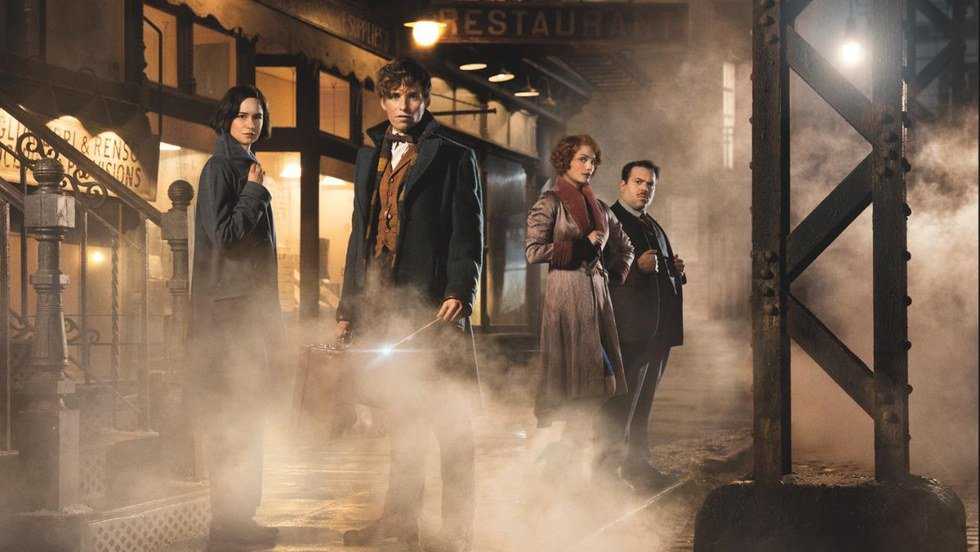
Fantastic Beasts and Where to Find Them, Rowling's first screenplay, describes the journey of one English wizard, Newt Scamander, who comes to the United States in the 1920s looking for a new creature to take home with him. However, along the way the briefcase containing all his magical creatures breaks loose, and he is forced to go around the city chasing them with the help of a rejected auror, Tina, and a non-magical (Muggle/No-Maj) American, Kowalski, to prevent the creatures from being killed or wreaking havoc. During their adventure, Scamander and his friends realize there is a much more sinister power lurking between the two worlds of magic and muggles, a child increasingly oppressed by their magic-hating mother, who threatens to erupt and expose the wizarding world for good.
Eddie Redmayne, otherwise known as Newt Scamander in the film, is both an Oscar and Golden Globes winner for The Theory of Everything, as well as a nominee for many other roles, notably The Danish Girl. With every role he takes on, I'm reminded how deeply he throws himself into his work and as an audience, we reap the rewards. Yet, as phenomenal as I continue to see Redmayne be, I was disappointed in the character he was chosen to play. An actor as talented as Redmayne, surrounded by the talented likes of Colin Farrell (Graves) and Ezra Miller (Credence), could easily have pulled off a meatier role and added more depth to the character in the process, but whether this was a personal choice or pitiful characterization, I found Scamander to be one of the least interesting characters onscreen. In fact, all of the protagonists of the film excluding Dan Fogler as Kowalski were, at times, plain and even unlikable.
While Alison Sudol (Queenie) was beautiful, sweet, and charming, she seemed nothing more than a Marilyn Monroe-esque blonde throughout the film, and had it not been for her endearing interactions with Kowalski, I would probably have thought she was here simply for looks. As Queenie's sister is Katherine Waterston as Tina, an ex-auror who seems brash but "has a heart of gold." She was smart, but once again, it felt as though the movie played into an overrused trope by making the strong, academic, independent woman seemingly uninterested in romance. As a reader, I have always admired Rowling's female characters, as they always came across as three-dimensional and did not fall into stereotypical roles. Personally, I find this to be a fault of lack of time, as the novels themselves always gave more depth to characters than the movies could find time to deal with. But, as Fantastic Beasts has nothing outside a novella of sorts, as a viewer I'm left wondering what characters could have been had the film been another written series instead.
Unlike the one-dimensional protagonists within Fantastic Beasts, the performances of Colin Farrell and Ezra Miller were absolutely astounding. Personally, I have always found Rowling's greatest strength to be writing about darkness, as she can characterize the effects of abuse, neglect, oppression, and depression in a way that is accessible for everyone, yet remains true to itself. Fittingly, once the film found its footing and could tap into the darkness Rowling can write so well, the film began to develop an identity and shape its argument, namely how detrimental the effects of oppression are on youth who cannot control their desires (or in this case, powers). The argument acts as a thinly veiled metaphor for extreme individuals who abuse, neglect, and oppress their child for having homosexual desires. While Rowling's metaphor is quite obvious, the use of the metaphor in the film, to control, reject, and oppress individuals who demonstrate magical ability, is beautifully done and plays on the hostility between those in the wizarding community and No-Majs.
Colin Farrell as Graves, a man trying to find the oppressed and abused child with great magical beings is not afraid to go through whoever it takes in order to attain this power, using Ezra Miller's Credence in the process. Miller portrays an abused teenager who grows up in a foster home obsessed with exposing and destroying wizards. His mother brings reminiscences of the Salem Witch Trials and, like the metaphor, a certain level of homophobic or racist-like beliefs, that are hell-bent on ridding the world of this satanic evil. Both Miller and Farrell's portrayals are nothing short of magical themselves, with Miller's raw anger and fear illuminating the selfish and abusive nature Farrell plays well. Together, they demonstrate opposing powers, one out of fear the other out of a lust for power, and every scene they share emphasizes the growing urgency between them beautifully. For everything the protagonists lack in depth or intrigue, Miller and Farrell make up for exponentially.
While the protagonists lack the magical chemistry the more trouble characters of Fantastic Beasts possess, the music, imagination, and heart of the original series doesn't disappoint. There is still something within this film that will appeal to everyone, whether you need a good laugh or joy to fill this troubled year, or you find yourself struggling with inner demons that only Rowling is able to explain. Fantastic Beasts and Where to Find Them offers glimmers of hope throughout the film that seem to say, although the first film struggles to say all it wants to say, the next four films will only get better from here. This is not Harry Potter, it's different and in some cases, darker, but I can say that for every fault it has, there are double the smiles and surprises to make up for it and keep you coming back for more.