

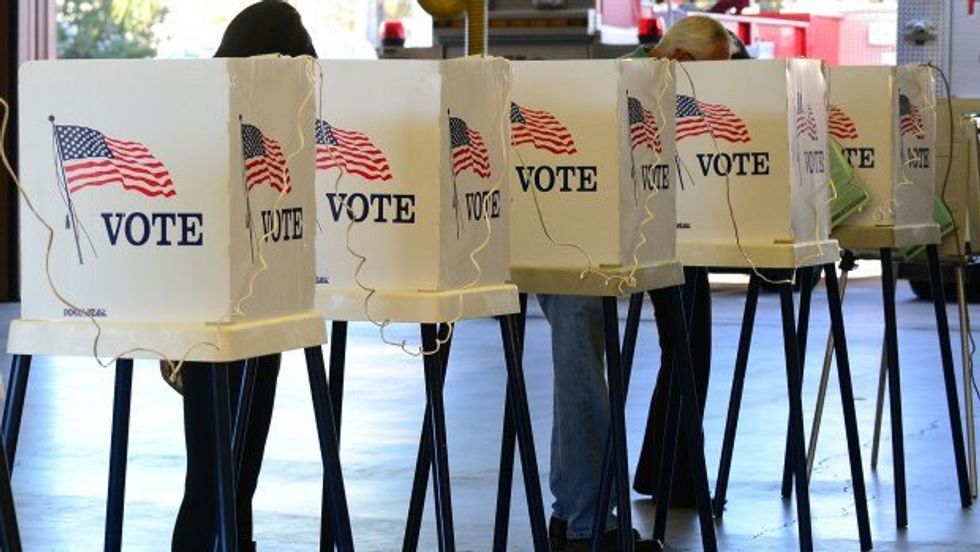
Leading up to and following the New York State primary elections, there has been a lot of talk surrounding the issue of people being turned away at the voting polls for reasons they could not have previously anticipated.
The morning of the election, I noticed a whole bunch of articles and warnings popping up on my Facebook news feed regarding something that was "Seriously Wrong with New York State Voter Registration." The rules of New York State have created "closed primaries," which means that you cannot vote in a primary unless you are registered as a Democrat or Republican. Historically, this practice was meant to deter voters who are "not serious" about their support for a certain candidate. But in this election, it has been proven wrong. Nearly half of registered independents in New York changed their party affiliation before the October deadline in order to be able to vote in the primary.
But starting this past Tuesday morning, Democratic voters who had waited in line for hours made it to the front of the polls only to learn that their party affiliation has been changed to "independent" without their consent or notification. An emergency class-action lawsuit was implemented immediately, and angry voters took to a Facebook group titled “Voters whose registration was changed without their knowledge in NY” to share their horror stories. New Yorker, Shelly Berry, called her county board of elections to learn of an incident that did not occur, involving her changing her party affiliation after the last election in 2014. She posted in the group:
"Today I went to the board of elections to find out why my voter registration was switched from Democrat to unaffiliated without my knowledge or consent. The man there said I had applied to be changed to no party affiliation in 2012. I said that was absolutely false and never sent in such a form. I had him print the 2012 form and then had him print two additional forms, two of which I know I filled out myself. Both forms I filled out myself had “Democrat” checked. The one from 2012 is a FRAUDULENT form which is NOT in my handwriting and has a forged, completely wrong-looking signature on it."
As I did more reading on this topic, I noticed that it seemed to be happening to students at my college as well. By Tuesday afternoon, I had heard of at least 10 students that were denied their right to vote. The most common issues I was hearing included party and address changes.
The proctors of the election seemed to be blaming it all on the fact that most of us had registered recently and stated that there are more likely to be errors with newer voter registration records. In some cases, including my own, some invalid and unlawful measures were taken in order to suppress angry students who were told they couldn't vote this time around.
My issue involved my voter registration containing my home address, therefore my polling place was in my home county, back on Long Island. Though I was able to understand why I couldn't cast my vote, I was told that if I changed my address online and returned in an hour, I could vote. Instead of going online and doing what I was told was legal, I did some research to discover that it was not.
Efforts to open the New York primaries to independents who had been denied their right to vote were included in the aforementioned lawsuit. There had been word of a provisional ballot system in New York, stemming from the complications on Tuesday.
SUNY New Paltz student, Lorenzo Galante, traveled to Poughkeepsie as a last resort on the day of the election. Here he was told that provisional ballots did not exist. Even though there were issues with him being registered as independent, there was nothing he could do. When asked if he could register on the spot, the County Board of Elections had told him that they couldn't find any voter registration forms.
Throughout the day I had also heard of students who were asked to sign an affidavit with their preferred party and candidate, to be sent to their county board of elections.
Again, not only is this invalid, it is illegal. None of us are really sure what's worse: being told we can't vote for unjust reasons or being told that our vote is going to count when it isn't.

















