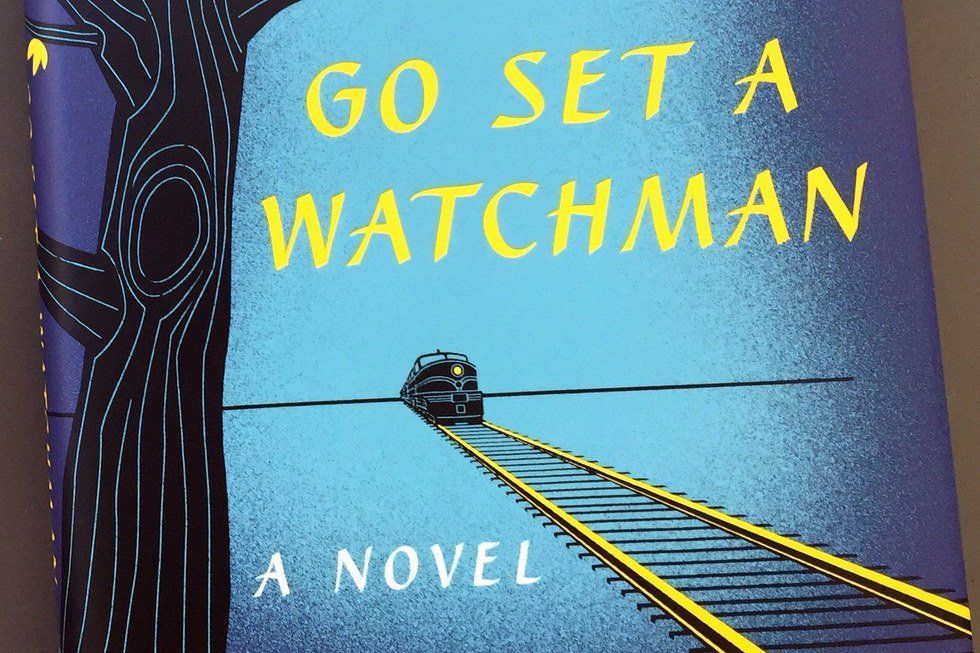
July 14th marks a year since the publication of "Go Set a Watchman." A year has passed since the literary world was turned upside down by the incredulous cries that Atticus Finch was racist. Four seasons have come and gone since readers everywhere mourned Jem Finch. It has been nearly 365 days since I excitedly returned to Maycomb.
"Go Set a Watchman" has been nothing but controversial since its publication was announced. I remember the day the announcement was made quite vividly. I was in drama rehearsals when I first heard the news. I got four texts within the hour asking how I felt about it. Truthfully, I did not know how to feel. I was thrilled to have the opportunity to read more of Harper Lee’s words. I was anxious to see what Scout was up to and like as an adult. I was ecstatic to have the chance to revisit such a beloved cast of characters. In a way, it felt as if I was returning home. On the flip side, there was considerable outrage over the sudden publication. Speculation was running rampant that old and frail Harper Lee was being taken advantage of, and that this erroneously-considered sequel would never have seen the light of day had her sister still been her caretaker. Some fans even called for the boycott of the novel. I made up my mind fairly quickly that that was not an option for me. I had to read it. I had to know what happened. Reading it would be the only way to see for myself if there was a credible reason for its sudden publication. As it turns out, there was.
When the novel arrived on July 14th, I decided to go against my natural inclination and read it slowly, taking my time with it. I wanted to stroll through Maycomb, not run through it. What was the point of the return if I didn’t take the time to smell Mrs. Henry Lafayette Dubose’s camellias along the way? I finished the novel in about three days. I liked it a great deal, but in some weird way, I just wasn’t sure about the book. It was compelling and interesting, but I just didn’t know how I felt about it. It was strange. It was like returning home from a long trip and finding every piece of furniture in your home strategically moved to a different location. I found myself tripping over chairs and stools that definitely had not been there previously. Atticus had won Tom Robinson an acquittal. Mrs. Henry Lafayette Dubose was referenced as though still alive. Jem was gone. Dill was nowhere to be found. I still loved Scout, but now she wasn’t Scout anymore; she was fully Jean Louise. She had shed her childhood moniker when she separated herself from Atticus. I detested Henry Clinton. Uncle Jack was a completely different incarnation than the young, carefree character we encountered in "To Kill a Mockingbird." Everything was different. Everything had changed. It made me uneasy and uncomfortable. It was only after the fact that I realized that was the entire point.
"Go Set a Watchman" is the story of twenty-six year old Jean Louise Finch returning to Maycomb for her yearly visit from New York and having her snug world shattered from under her feet. She witnesses Atticus attending a seemingly racist meeting and suddenly finds her life thrown into utter chaos and disarray. She reflects on her childhood and begins to see the townsfolk in new, harsher and unflattering light. She becomes physically ill and finds herself retching over the fence in her childhood backyard. Eventually, she realizes the whole affair, while uncomfortable, was necessary for her growth as an individual. Atticus wanted this to happen. He was not suddenly a raging bigot; he just needed Jean Louise to see him as a mere mortal so she would feel the need to form her own opinions and beliefs. Essentially, the novel is a reminder that nothing in this world is permanent or infallible. Everything changes or falters eventually. Our parents and heroes will inevitably disappoint us at times, and not everything is as it seems. At the end of the day, we only have our own conscience to which we answer. We must be steadfast enough in our own personal convictions to be unwavering and relentless. Our conscience is the only permanent thing we can possibly have. It is the only thing we can control.
The novel has really grown on me in the past year. At first unsure of where I stood with it, I now hold it in the highest possible esteem. The theme is relevant and important. Knowing how Scout’s story plays out and she fully transitions into Jean Louise, I feel as though this novel is an equally important part of her journey. Will it ever be as beloved as "To Kill a Mockingbird"? Probably not. Is it any less good or important? Absolutely not. I once somewhat jokingly called "Go Set a Watchman" Lee’s magnum opus in an essay. Now, I am not so sure that was a joke. It’s the completion of the story started in "Mockingbird." I have always felt unsatisfied at the end of "To Kill a Mockingbird." The novel is breathtaking and life-changing unlike anything else ever written, but every time I close it, I feel as though there is still more to be said. Maybe that is because of my intense adoration for the work. Maybe because I love it so much, I just want more time with the characters. Whatever the reason, "Watchman" helped quench that feeling. I now feel so much more satisfied. I feel as though the story has been brought to its conclusion. Jean Louise has come of age. She is her own person. It just feels right.
Though initially touted as a sequel, it is now common knowledge that "Go Set a Watchman" was actually Harper Lee’s first draft. It is fascinating to see how the editing process occurred, and how this work was transformed into something entirely different like "Mockingbird." It is not difficult to see why the editor requested Lee focus more on Scout’s childhood. The anecdotes of her summer days spent with Jem and Dill are some of the best and brightest passages in the book. It is also interesting to see what facts Lee changed or added later in the editing process. She obviously changed Tom Robinson’s acquittal. Mrs. Henry Lafayette Dubose dies during Jean Louise’s childhood, according to "TKaM." In "Watchman," there is no hint of romance or mischievous history between Uncle Jack and Miss Maudie. Aunt Alexandra is decidedly more bearable. Despite these slight changes, the novel does come across as more of a sequel than anything else. It is impossible to imagine this story without the events of "To Kill a Mockingbird" as a precursor. Atticus’s apparent betrayal of the values he worked so hard to instill in his children would have no real impact if we did not already know and love his character so. Jean Louise’s loyalty to Henry Clinton would seem strange if we did not know of her unwavering loyalty and commitment to Jem. Jem’s death would not make sense without knowing of his mother’s heart condition. Calpurnia’s use of her company manners would not be as heartrending if we did not know of the magnitude of her relationship with young Scout. In short, just as "Mockingbird" feels incomplete without "Watchman," "Watchman" certainly feels incomplete without "Mockingbird."
Much of Lee’s writing style is similar and apparent throughout "Watchman." She plants one symbol early on in the novel (Jean Louise hitting her head on the steering wheel being symbolic of her struggling to grow past some of her childhood tendencies and ingrained beliefs, much like the symbol of the mockingbird being innocent and too often a martyr in "TKaM") which she employs again as she brings the novel to completion. Her sentence structure and diction is as witty and quick as it ever was. While everything else in the novel seems to be a conscientious choice to remind the reader that nothing is permanent or enduring, Lee’s compelling writing style remains and endures.
Almost all of my initial issues with the novel I have come to realize are actually virtues and not vices. I did not like not knowing what Jean Louise’s job was, but now I understand why that detail is omitted. She is not meant to be seen as a fully-functioning adult until the conclusion of the novel. Giving her a vocation would make her seem more grown up than she is supposed to prior to her setting her own watchman. Plus, it gives the reader the chance to imagine Jean Louise in any field they see fit. I hated Henry Clinton, but now I understand that he is a necessary foil and a catalyst in Scout’s change.
As for the novel’s publication, it makes sense since a central theme of the book in unchecked governmental power and the Supreme Court overstepping the boundaries of its authority. Our current Supreme Court makes sweeping federal decisions more often than any previous Court, except perhaps the one in existence at the time Lee wrote "Watchman." This novel is as relevant today as it was when Lee penned it.
For someone who grew up loving "To Kill a Mockingbird" but has long since outgrown young Scout’s plight of seeing humanity at its worst for the first time, "Go Set a Watchman" offers a similar chance at connecting with our beloved protagonist. As someone who abhors change with a passion but finds myself constantly having to deal with it, it is nice to see Jean Louise going through a similar hardship.
"Go Set a Watchman" may not be perfect, but it offers plenty of wisdom, quotable lines, character insight and feelings. Reading is supposed to challenge and change you. It is supposed to make you think, and it is supposed to make you feel. No book has ever done that quite like "Watchman". It is the only book to ever make me cry. It is the only book that I have ever had to put down to mull over my thoughts. It is the only book that has left me completely and utterly perplexed. It is the only book that has ever continued to grow on me over so much time. Lee’s words have a knack for affecting me like no other. I cannot quite explain it, but something about "Go Set a Watchman" is just special. It is a book about developing your own conscience, but it will make you conscious of so much more that just that.