Originally hailing from a suburb roughly 20 minutes out of Baltimore, I've developed a habit of just telling people I meet at school that I'm from Baltimore. Consequently, the question that always arises first is, "Oh, no way! Were you there for the Baltimore Riots?"
This has become one of my favorite questions to answer as I was ironically on my first detour out of the country when the riots broke out. I walked into the lobby of my hotel in Heidelberg, Germany and saw--on the television hanging over the front desk--my hometown in chaos. In our hotel room that night, we watched coverage of the riots as I checked in on friends who lived in/near the Inner Harbor to make sure everyone was safe and sound. My favorite activity of the evening, though, was scrolling through my Twitter feed.
You see, I'm one of those people who loves to get angry. I am admittedly drawn to social media fights because I like feeling my blood boil over something that I likely have no personal connection to. This pastime was at an all-time high during high school basketball season, during which I would read my feed post-game and let out patronizing snorts at things that people would say in defense of their school. Yes, I am so superior.
My God complex aside, the nights of the riots were highly confusing for me because I didn't know how I felt about them. I consider myself a relatively liberal-minded person, and the thought of harboring any type of racism within myself made me queasy, yet here I was, thinking that maybe, just maybe, #AllLivesMatter made sense.
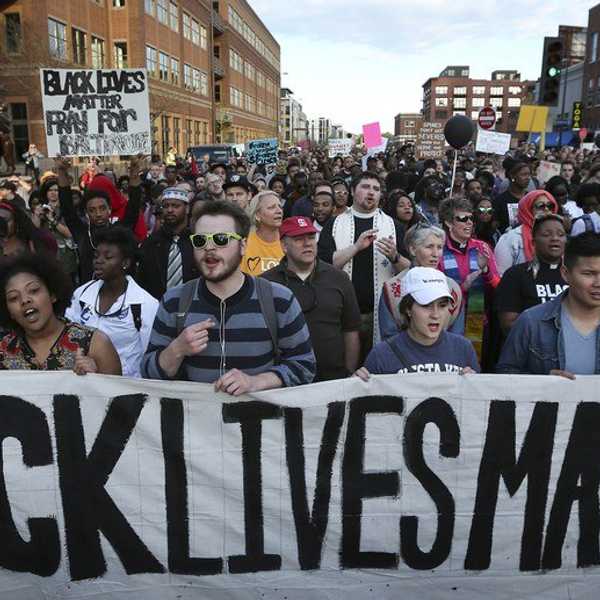
I saw tweets supporting the violence and didn't understand. How could protests that radical have any support at all from the public? These people had every right to be infuriated, I knew that, but how could me wanting Baltimore to not be riddled with broken windows and injured civilians make me a racist?
Now, having done more research on the topic and not just basing my opinion on my preconception of "racism", I realize that those thoughts are wherein the problem of modern-day racism lies. By supporting the #AllLivesMatter trend, I was subconsciously contributing to the erasure of the struggle that people of color face every day.
Racism, contrary to my prior belief, is not just a matter of surface value.
An example of this, which I learned from my online sexuality guru Laci Greene, is the ever-deceitful practice of "redlining". Redlining entails basic policies set back in the mid-1900's that provided "reasonable" segregation of neighborhoods in order to "preserve" civil peace. The government gave out thousands of dollars in home loans to white residents but refused to give these same loans to black residents, restricting them to impoverished areas which, in turn, brought about the idea of "ghettos". This further inconvenienced the African-American community in the long run in terms of education because of lower property taxes and ergo, worse-off school systems. These policies have affected the social structure within the black community and have made such a deep impact that the effects are still evident to this day. Racism has been imbedded so deeply into our culture that it's no longer enough to simply look at outright violence towards people of color. In order to fully understand racism, we have to understand the details of institutional racism (USNews.com).
Institutional racism is attitudes, ideas, opinions, and implications that cause discriminatory actions towards a certain race. This can manifest itself in terms of employment opportunities, educational benefits, judicial rulings, and other practices. This was the problem with the death of Freddie Gray (CNN.com), one of the primary cases brought to light by the protesters in Baltimore. It would be easy to write off Gray's death as an accident because of the unclear circumstances, but the fine print makes the core issue obvious. If it had been a white man in the back of that truck, the appropriate protocol for securing him in the back would have been carried out and no one would have died that day.
I admit to the former uneducated opinions I held on modern racism in America. The idea of white privilege insulted me because the last thing I wanted to be considered as was one who was ignorant towards the plights of others. I believe now that #AllLivesMatter needs to be squashed immediately. It is an explicit example of the effort to direct attention away from even the smallest possibility that we, the white community, still contribute to a racist society. It may not be overt nor conspicuous, but it is still there. Through proper research and willingness to acknowledge our wrong ways of thinking, white people can make strides towards a more understanding viewpoint on why people of color are so (understandably) furious with the fact that we still think we are living in a post-racist society. So, read up, kids. You can learn a lot when you just admit to yourself that you were wrong.