How To Write A Novel In Your Free Time | The Odyssey Online
Start writing a post
Politics and Activism

How To Write A Novel In Your Free Time

And in your busy times. And all the times in between.

24
How To Write A Novel In Your Free Time

If you’ve never written a novel before, doing so probably seems pretty impressive. Though, contrary to popular belief, pulling off writing a novel with any substance at all doesn’t actually require much experience or talent. The real recipe is this: lots of time, a fair amount of attention, a pinch of imagination, and at least one working hand.

English B.A. aside, all I've got in the way of credentials are a novel in the works and one life-long, agonizing, irritating, time-consuming, and positively masochistic passion for writing. Nevertheless, I’m going to share with you some trade secrets for writing a chapters-long manuscript. Of course, given that the last time I finished a novel manuscript I was still listening to the Jonas Brothers and was still occasionally picking Starburst from my braces, you don’t have to believe this is an effective formula until my current endeavor is a 50,000-word PDF sitting in some publisher’s junk email. But I’ll give it to you anyway: How to Write a Novel in Your Free Time.

Step 1: ACQUIRE FREE TIME

Preferably something regular. I’ll be honest, I wasn’t too good at consistently finding free time while I was in college, because of papers and exams and field trips and dates and crawls and public parties and study breaks and guest lectures and shopping shuttle rides and practically any other reason you can think of. But it can be done. Now’s a good time to start, while you’re putting off holiday gift shopping. If you need a crutch during the semester, take a creative writing class to give you an excuse to sit down and throw words together. Because without conquering step 1, you might find the other steps a bit more difficult.

Step 2: ACTIVELY PROCRASTINATE WRITING

It’s not counterintuitive; it’s actually better, especially for first-time novelists. The key to writing a novel that makes sense isn’t to just sit down and crank one out, but it’s to figure out what the hell is going on in it first. I have participated in National Novel Writing Month for the last five years, ever since I first learned what it was, and I love the month of November all the more for it. And yet, in all that time, I’ve not actually completed a full novel manuscript. Usually due to all of those distraction factors I previously mentioned, my planning (read: procrastinating-while-brainstorming) doesn’t begin until sometime in mid-October, and by then I have waited too long to begin. A good story requires thought, to say the least; and a thought-out story requires one very obvious thing: time. One thing I do love about being a writer is that I never have to be bored. I let my working story play like ticker tape in the back of my mind, when I have a free moment to think. Slowly, surely, facts step forward; connections emerge. Small ones, mind you. But big ideas rarely come in fully fleshed out; they are built upon an amalgamation of smaller ideas. Eventually, they come together to create whole worlds and themes and plot arcs. Some assembly is required. And coming up with all of that takes—you guessed it—time.

Step 3: RUN SOME RECON

People want to read a story that’s tangible. That means you’ve taken the time as the author to round out your characters, setting, and plot as well as to consider the consequences of the decisions you make in these areas. To investigate these dimensions of your story, you’ve got to do a little recon and amass some information on the characters, places, and events you’re dealing with. This ties directly into your active procrastination mode—take time to think about what your book needs. If your character is a self-interested Jewish salesman from New York, is his name more likely to be Cruz or Stein? If he’s a teenage blues music player from Georgia, where would he dream of going to school? What kind of gifts does his family get him for Christmas? If they support him, maybe a B.B. King CD. If they disapprove, maybe a pair of basketball shoes or an engineering textbook. I’m not talking about creating stereotypes; I’m talking about character facts. For instance, if Jacob Stein grew up with a single mother but has chosen to take the name of his estranged, non-Jewish father, then maybe his name is Cruz, after all.

Think about what your story needs in order to come together; that means what plays into your world and that world from your character’s point of view. It could be anything—for instance, I just discovered that my main character’s good friend and boss has celiac disease and is therefore gluten free. It could be something that significantly affects the plot—this character is also quite pregnant and about to go on maternity leave; or something amusing—the thorn in my main character’s side, the bane of her professional existence, is the baby’s father; or something that accomplishes both—and he is about to go on paternity leave. Those lightbulb moments when you think some new detail would be funny or useful or effective—chase them. The more you know, the better you write, the more you find out, the easier it is to write more, the closer you get to arriving at a full, somewhat understandable first draft.

Step 4: KEEP TRACK

Building a story requires patience, but it also requires you to pay attention—in recon mode and in recording mode. We’ve all had that moment when you're listening to someone talk and have something in mind to say but must wait your turn, only to find when that turn comes that your train of thought has slipped away from you! Ideas are food for your story, and when it comes to ideas for my story, I prefer the buffet, so losing track of even one idea before it comes time to write can feel like a catastrophic loss. Fortunately, when you’re brainstorming, you don’t have to waste time on politeness; interrupt what you’re doing and write that thought down!—on a napkin or in your phone or in the back of your linguistics notebook or whatever you have—because you never know how valuable that idea can be to you later on.
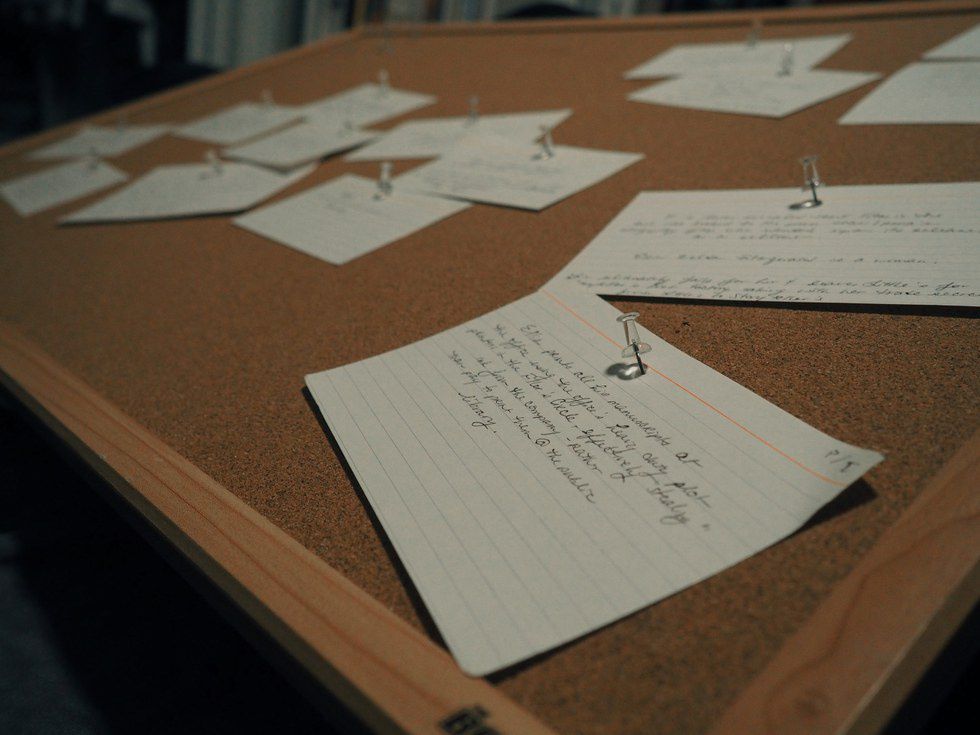
I’ve started storyboarding—as in piecing together my story on a cork board. This is what my actual storyboard looks like right now: Every time I think of a detail, I write it down and label it with a defining letter—C for character, P for plot, I for general background information on a setting or situation—and I tack it to the board. The relationships between these facts can be worked out immediately or later on, but just keeping track of them makes me more familiar with the fictional world I’m trying to bring to life.

Step 5: DON’T STOP YOURSELF

This is my greatest impediment, personally. Even once you’ve done steps 1-4 (though these should really be ongoing), don’t expect to be perfect on the first try. And I mean, don’t necessarily expect to start with the prologue and write through to the epilogue in order and with complete cohesion. I can tell you 99 percent of books are not written that way, I’ve come to realize (and the authors of the last 1 percent are not-so-secretly hated by all of the rest of us who toil and sweat over our keyboards). Write what you can, and do it as often as you can. It doesn't have to go in order, and it doesn't even have to make sense at first. Anyway, your first draft is often a discovery draft. If you can’t come up with anything, you have your trusty storyboard; connect two points on your storyboard and write a page about them. Repeat steps 1-4. Discover more. Write everything down. Just don’t stop yourself, because if you’re going to dedicate time towards writing a novel manuscript, it should at least be an enjoyable activity for you. And you never know what’s going to come out of that page, or the next, or the next.

Report this Content
This article has not been reviewed by Odyssey HQ and solely reflects the ideas and opinions of the creator.
Entertainment

Every Girl Needs To Listen To 'She Used To Be Mine' By Sara Bareilles

These powerful lyrics remind us how much good is inside each of us and that sometimes we are too blinded by our imperfections to see the other side of the coin, to see all of that good.

1179493
Every Girl Needs To Listen To 'She Used To Be Mine' By Sara Bareilles

The song was sent to me late in the middle of the night. I was still awake enough to plug in my headphones and listen to it immediately. I always did this when my best friend sent me songs, never wasting a moment. She had sent a message with this one too, telling me it reminded her so much of both of us and what we have each been through in the past couple of months.

Keep Reading...Show less
Zodiac wheel with signs and symbols surrounding a central sun against a starry sky.

What's your sign? It's one of the first questions some of us are asked when approached by someone in a bar, at a party or even when having lunch with some of our friends. Astrology, for centuries, has been one of the largest phenomenons out there. There's a reason why many magazines and newspapers have a horoscope page, and there's also a reason why almost every bookstore or library has a section dedicated completely to astrology. Many of us could just be curious about why some of us act differently than others and whom we will get along with best, and others may just want to see if their sign does, in fact, match their personality.

Keep Reading...Show less
Entertainment

20 Song Lyrics To Put A Spring Into Your Instagram Captions

"On an island in the sun, We'll be playing and having fun"

1071196
Person in front of neon musical instruments; glowing red and white lights.
Photo by Spencer Imbrock on Unsplash

Whenever I post a picture to Instagram, it takes me so long to come up with a caption. I want to be funny, clever, cute and direct all at the same time. It can be frustrating! So I just look for some online. I really like to find a song lyric that goes with my picture, I just feel like it gives the picture a certain vibe.

Here's a list of song lyrics that can go with any picture you want to post!

Keep Reading...Show less
Relationships

The Importance Of Being A Good Person

An open letter to the good-hearted people.

4292206
Chalk drawing of scales weighing "good" and "bad" on a blackboard.
WP content

Being a good person does not depend on your religion or status in life, your race or skin color, political views or culture. It depends on how good you treat others.

We are all born to do something great. Whether that be to grow up and become a doctor and save the lives of thousands of people, run a marathon, win the Noble Peace Prize, or be the greatest mother or father for your own future children one day. Regardless, we are all born with a purpose. But in between birth and death lies a path that life paves for us; a path that we must fill with something that gives our lives meaning.

Keep Reading...Show less
Facebook Comments