This past Saturday, I spent most of the day working on a project for my summer internship. My roommate wasn’t too pleased as I vigorously pounded away at my laptop keys late into the night. I had worked from the calm hours of the afternoon until music audibly took over our quaint Philadelphia street. As I hung my work hat up near midnight, I thought to myself: did I waste an entire summer Saturday doing (unpaid) work indoors?
I essentially ditched my best friend for an entire day. There was an intriguing and important aspect of my project that I was itching to figure out, so I decided to strap up my work boots and plop myself in front of my mahogany desk for some back-breaking labor on my favorite text editor.
Why did I do this?
The honest answer is that my internship doesn’t feel like work. My job is to experiment. My one sentence job description is that I am told what it is that we’re trying to do, and I have to come up with how we make it happen. I am solving a challenging problem, which is what I’ve come to love during my time in school. This is what fulfills my sense of purpose and compels me to "work" on a gorgeous Saturday.
Even so, there is a silver lining: I paid for my work at the cost of my leisure. I could have done anything with my day, including thrift shopping with my best friend and doing whatever shenanigans we could discover. I am on the East Coast for the first time in my life, living in a wonderful city with plenty in store for an eager 21-year-old. There were a ton of exciting options on the table, my laptop notwithstanding.
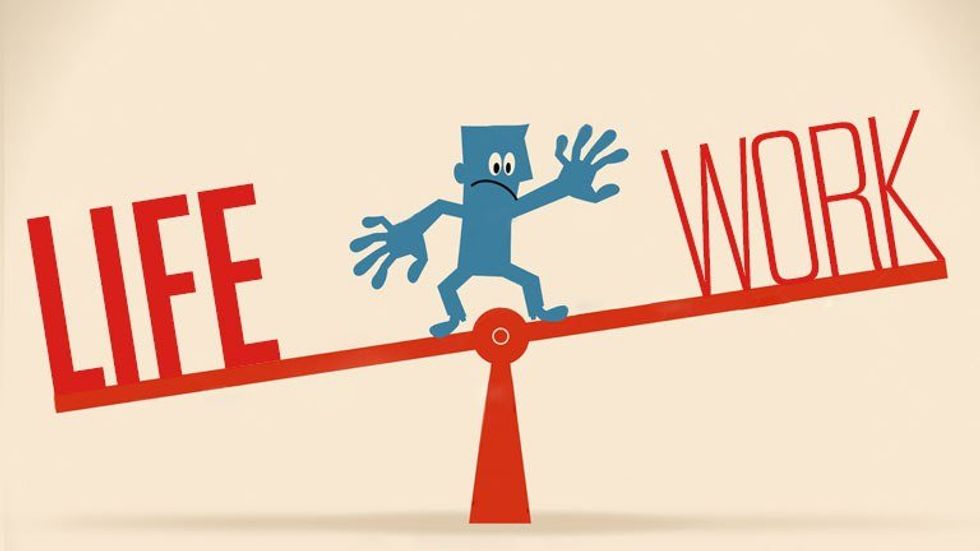
This is the first time that I’ve dealt with work-life balance. This hasn’t been an issue in college: there is no set time for studying, working on problem sets, and taking care of other academic duties. You set the time when you’re taking care of your responsibilities, be it noon on Monday or 3:00 a.m. on Thursday night. There is no "wrong" time to work.
In a work week, however, there is a clearer distinction between on and off. On one side of the line, you have your job, and on the other there is everything else, including leisure. That’s a lesson I still have to grapple with, and it’s due to the habits I’ve developed at Stanford, where the work never really stops.
The tradeoff exists – there is no denying that. Still, the balance has become more blurred as the type of work that we do and how we do it continues to change. More and more, our jobs are becoming increasingly rewarding as the employment landscape shifts into more glamorous industries. Similarly, we are exploring new avenues in the work schedule as our 21st century jobs allow us to do. I can afford to leave work an hour early to have 50 Cent sign my Vodka bottle because I can very easily code from home to make up for it.
In all honesty, I could have exerted a bit more effort into killing two birds with one stone. If I had taken 10 minutes to change and find a local coffee shop, I could have been as productive while simultaneously becoming more acquainted with Philadelphia, a city I’ve greatly enjoyed so far. The greater issue, though, is that it's difficult to pit my job against my free time because the difference in pleasure between the two isn't really all that much.
Fortunately, though, that's a great problem to have, and one that I think can only be tackled through practice.