
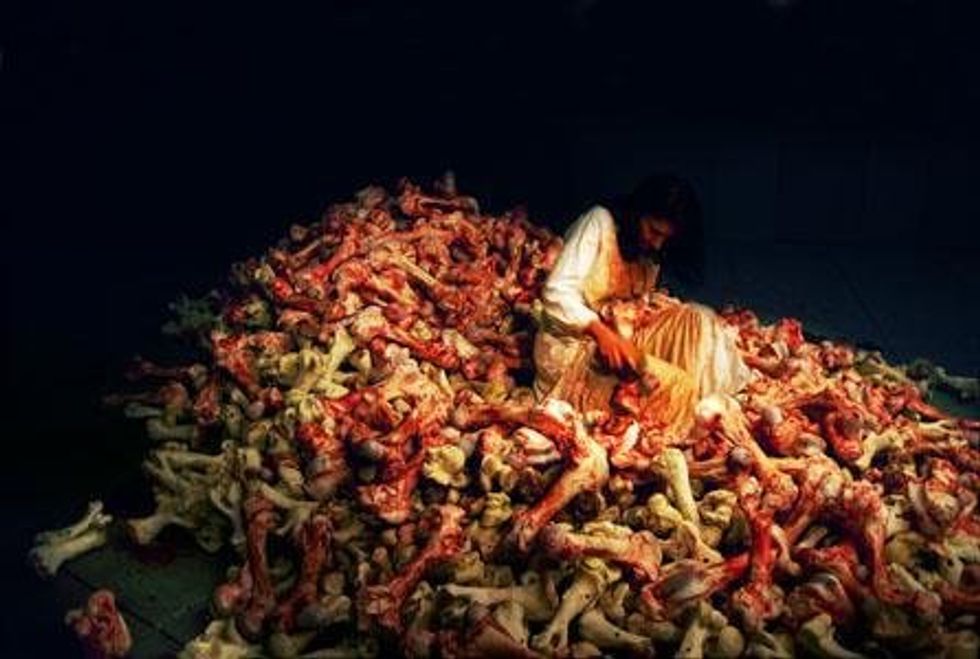
Would you ever leap across flames or play the Russian game with 20 knives? Would you ever ingest medication given to schizophrenic or catatonic patients? Or would you ever stand on an uncountable number of putrid cow bones, scrubbing them and washing them, for four consecutive days?
Well, Marina Abramović did.
The Yungoslavian performance artist became widely known for her extreme and violent pieces, such as "Rhythm 5" and "Rhythm 10." She shocked the press, she was called a masochist and an exhibitionist and “people thought that [she] was crazy,” recalls Abramović.
Perhaps one of her most dangerous artworks is "Rhythm 0." This performance differs radically from her previous pieces; performed at Studio Morra in Naples, it consisted of 72 objects, for pleasure or pain, that the audience “[could] use on [Abramović] as desired.” Abramović’s body was the 73rd object. The powerful performance artist objectified herself, she gave up any type of control, she became passive.
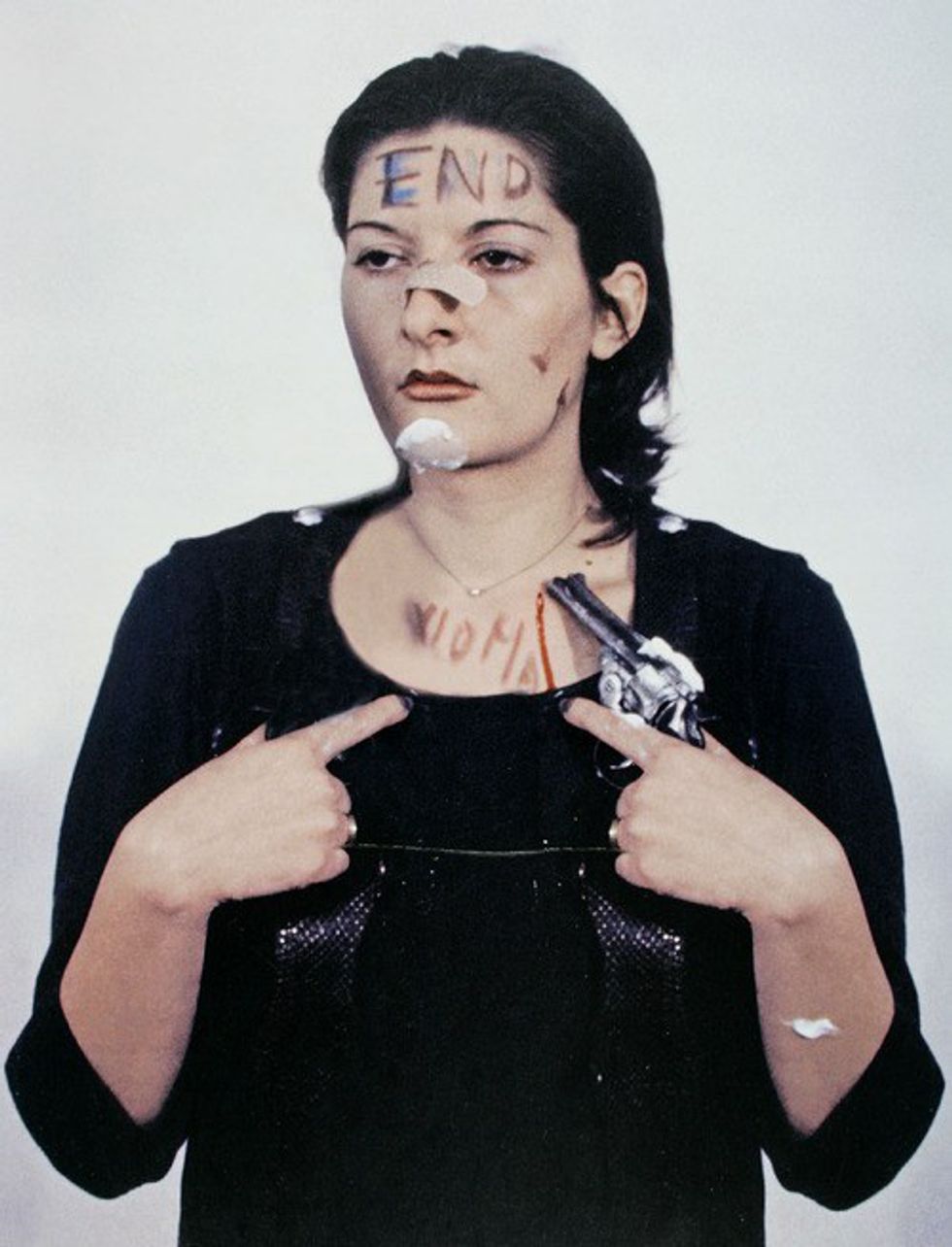
The result was extremely distressing; after a pacific start, the spectators begin to cut her clothes, write terrible words on her body, put thorns in her skin. A man even puts a loaded gun in her hand and tries to push her fingers on the trigger. Why didn’t Abramović leave when things started to get unpleasant? Why did she brutally carry on till the end of the performance?
Abramović is deeply concerned with danger. She claims that the first thing she thinks about while ideating a new performance is: “Am I afraid to do it or do I like it?” If she likes it, she is “not interested” in realizing it. What intrigues her are “ideas that deeply disturb [her] and that are difficult to realize, [...] the dangerous things.” (Marina Abramović) Yet, why should someone decide to put themselves in a situation of discomfort?
According to Abramović “danger is important because it brings time to the point of here and now, to the present.” "Hic et Nunc," here and now, is a renowned Latin expression used to indicate the finity of time and the importance of the present. Eckhart Tolle writes in his book “The Power of Now” that in life-threatening or extremely dangerous situations we are “forced into the Now.” Tolle maintains that pain and suffering spur from a common error that we make every day: the identification with our minds. According to Tolle, we are not our minds. We are something bigger, something deeper. Only by being fully conscious, fully present, only by realizing that there is no other time than the Now, we can achieve the complete identification with our Being. We become limitless. Perhaps Abramović shares Tolle’s view: Within the present, we have no boundaries, we can do everything. We are the ones who create our own limits.
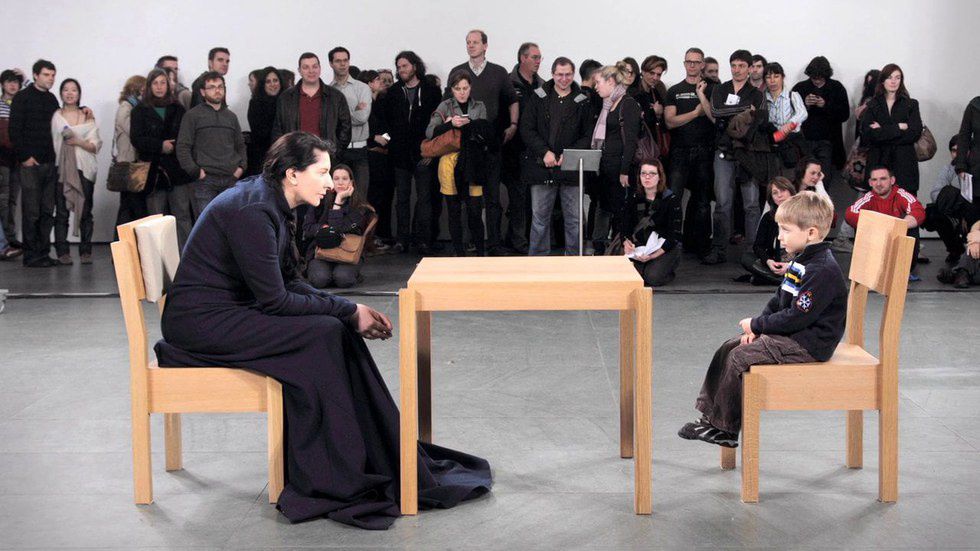
Abramović, through danger, achieves a total state of presence. She frees herself from every physical and mental obstacle that obstructs her and by doing so she is able to investigate all the possibilities of the mind. The fact that her 2010 performance at the MoMa was called "The Artist is Present" was not a coincidence. The introspective exhibition recreated her most famous performances, her 40-year-long journey that lead her to total "freedom." After experiencing vulnerability, self-imposed violence, sadism, after cutting, burning, freezing her body, after being passive, her mind has demolished every barrier her body created: She is limitless. This is why, at the end of her exhibit she is there, present, sitting on a chair and inviting the spectators to look into her eyes. She is offering herself to the audience: a human being free from mental and physical limits. What will they see? The woman she has become? Her life-changing experiences? Or maybe they will see the infinite possibilities that the human mind has and how she was able to reach them.