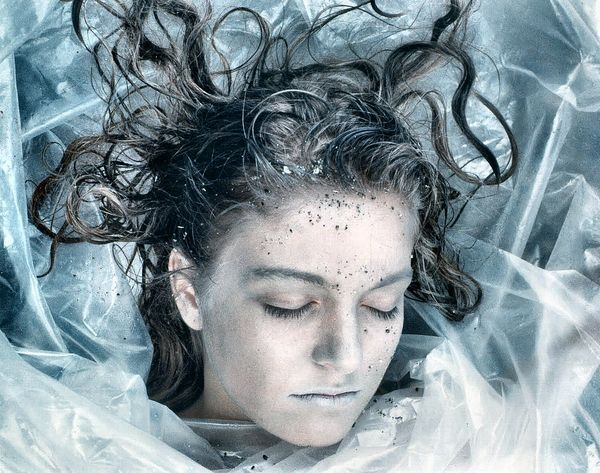
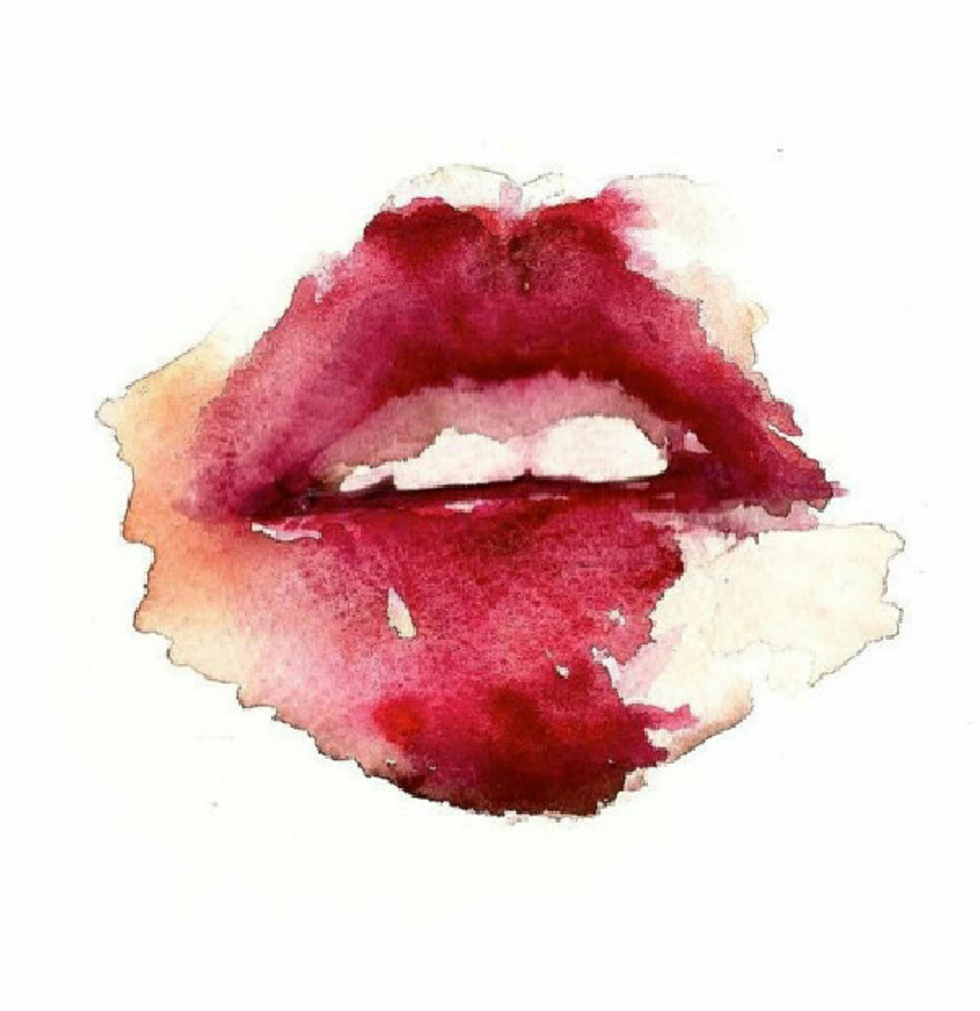
If you’re ever looking for proof that a picture’s worth a thousand words, enter Boulder Coffee in Rochester NY, order black decaf, and a tomato basil bagel, then looks to your left. Directly above the couch hands a 6-foot, tastefully twisted portrait of a woman; thick frames contain swirls of red and turquoise, centered on pursed lips and bulging eyes that remit an insidiously unsettling stare.
And that’s exactly how I would describe the thousands of words written by Joyce Carol Oates, insidiously unsettling. Just like her portrait, the author’s stories hang on the back of your mind, beautiful enough to notice from across the room, but containing traces of something ugly, something “off” that draws you in for a closer look.
Yet despite the social commentary found within all her short pieces, The Story of the Stabbing stands out as a disturbingly relatable dark tale. Oates narrates the voice of Rhonda, a young girl whose mother witnessed a violent act of road rage in downtown Manhattan. A delivery van driver had brushed a walker while weaving through traffic; the walker cursed at him, sparking the driver to get out of his vehicle, remove a knife from his pocket, and slit the man’s throat.
While her mother initially relays “The Stabbing” with a sense of troubled innocence, the story twists over time, curling and contorting under her growing taste for attention. Soon Rhonda’s father begins to share the story within his elite social circle, painting the van driver as an “exploited person of color” striking back against the upper class. He found that more exciting than simply explaining how Rhonda’s mother wasn’t close enough to discern either man’s race.
From preschool to college graduation, Rhonda had heard “The Stabbing” so many times, in so many forms, that each retelling stood more dissimilar to the original. West Street became West Broadway, winter became midsummer, and at some point, her father became a witness, boasting of his valiant attempts to combat “hostile gang members.” Although Rhonda was disgusted by the eagerness with which the story was both told and received, she weakly accepted whatever script her parents and friends felt like relaying.
In Oates' last paragraph, Rhonda finally confronts a party guest during his theatrical retelling of the distorted tale. She demands to hear what ended up happening to the two men, only to be met with the answer, “how the hell would I know, sweetheart? I wasn’t there.” (38).
And those words seem to resonate as Oates' final message. The ending to "The Stabbing" didn’t matter, never mattered, for everyone molded the story into what they wanted it to be; a tale of courage, proof of social unrest, an engaging brush with death or shocking news to fill dinnertime silence. It was irrelevant that the story had twisted, curled, and contorted into something unrecognizable, because truthfully, they liked it better that way.
This piece was unsettling for a reason I couldn’t quite pinpoint, like the sudden awareness of your own heartbeat; you know what's lying underneath, but you still wish you hadn’t heard it. Maybe it’s because, at some level, I found myself relating to all of the story’s characters. At times I’ve dramatized like Rhonda’s mother, stretched details like her father, and hungered like their eager guests for the satisfaction of shocking entertainment. And in the end I’m left with questions I still can’t answer. Why do we do this? Why do we mold memories and experiences into false versions of their original selves? What’s in it for us?
The world is filled with the unknown, spaces that remain dark regardless of the light shed upon them. Maybe, just maybe, people choose to fill these gaps with superficial details as a way of dealing with this darkness. After all, it’s easier to present stories in a way that benefits our own egos rather than experience the humbling effects of admitting uncertainty.
But the danger of these “innocent” retellings is that people start to believe them. Slowly but inevitably, we begin living within an artificial “known,” acting as if our fabricated perceptions are accurate measures of reality. We stop asking questions.
I wonder what would happen if we left things as they are. Maybe we’d grow small beneath the weight of the world’s complexity, but then again, maybe we’d be okay feeling small, comfortably present within the questions of an ambiguous life.
To be honest, I don’t know the answer just yet.
Do you?