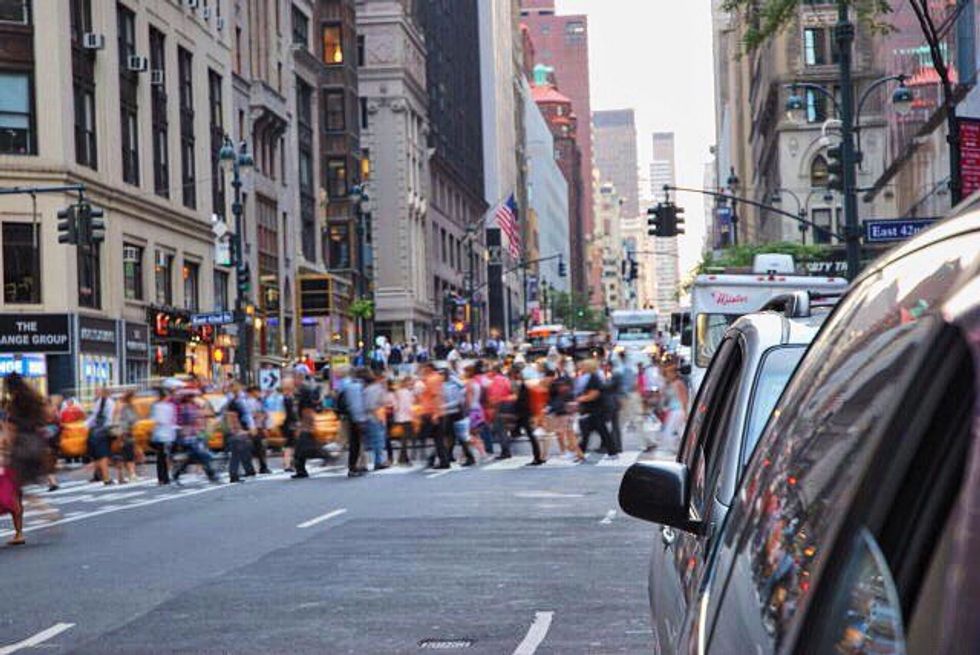
The term "majority" is ambiguous in nature and allows people way too much leeway in how they label other individuals. What -- or who -- really determines who the majority is? Doesn’t the majority change depending on the situation that it’s viewed in? But more importantly, what if you are classified as part of that majority and don’t necessarily want to be?
As the first month of 2016 comes to a dramatic close, we’re left to reflect on a multitude of controversial events in which a majority has been determined, and consequentially scrutinized because of a few individuals in the said majority.
Take, for example, the much-debated topic of police brutality. Whether you lean towards the ideology behind Black Lives Matter or Blue Lives Matter is superfluous in the grand scheme of the argument. What matters more is who we are labeling and filing away under an umbrella classification.
There are most definitely what I would deem to be bad cops in the world. Ones who use excessive force against harmless victims. Ones who look for the bad instead of enforcing the good, and ones who are simply not doing their job to serve justice, but rather to enforce the idea of “white supremacy” that we can no longer turn our backs to.
But how can we give those few bad cops the power to construe the ways we look at all cops; even the ones who are doing their rightful duty with the best intentions in mind? The answer is simple; we can’t.
Whether you agree with this point or not, the mere facts are hard to dispute. Out of the 765,000 full-time sworn personnel, it would be hard to believe that all of them exhibit the characteristics explained above to lead them to perform their duties poorly.
Regardless, all law enforcement personnel are taking the hit for here and there cases of police brutality. They are part of the majority, so, therefore, they are viewed based on a minority of the population that are performing these horrible acts against innocent victims.
Another example that talks to this point would be the classification of white students on a college campus. All across the country -- my small liberal arts college included -- demonstrations have been put together by a different race, religious, ethnic and sexual orientation groups in an attempt to make not only the other students of the college, but the administration, see the marginalization that occurs day in and day out against these groups.
The problems are seen, and all who they intended to hear their messages have received them. But for the few who are considered a part of the majority of “white students” who dismiss these problems and ignorantly turn their back create an unintended generalization about the majority, similar to the one that is established by the bad cops in my former example.
As a white, female student who recognizes the problems on college campuses and wants to help change them, it is offensive to be seen as naïve or uninformed just because a small number of people in the majority do choose to display these traits. And that in itself makes it hard to speak out as a white female attending my school, for fear of being shrugged off as simply another white student who cannot possibly sympathize with other groups of individuals that I physically, religiously or racially do not identify with.
Unfortunately, the few extremists of the majority speak for the entire group more than the actual majority of aware, informed and willing students ever will. In both cases, the terrible actions that are currently happening are not the things that are being contended.
Nobody is denying that there are police officers out there abusing their power, and similarly, nobody is claiming that there is not blatant marginalization of certain groups on college campuses.
The problem at hand is how we choose to classify the majority, or if that term is even relevant anymore. Can we just do away with the idea of creating a majority, and instead determine a person based on their actions on a case-by-case basis?
It is 2016; it’s time to stop blaming the majority for the mistakes of a small percentage of said majorities. Or better yet, get rid of the term majority altogether and judge each person individually, free from generalizations and assumptions.