
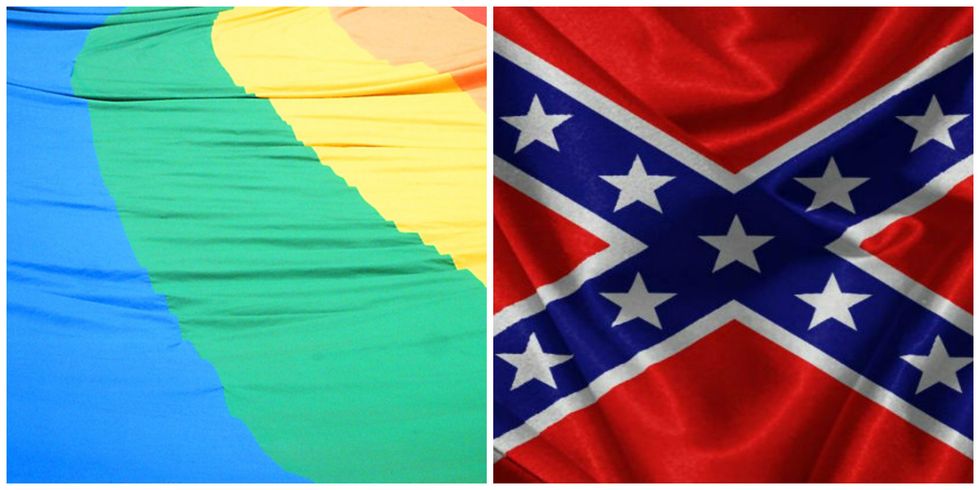
After the horrific June 17 shooting of nine African-Americans by Dylann Roof, the senate in South Carolina passed a bill that banned the Confederate flag from being flown over the State Capitol. The flag's legality was called to question when a picture of Roof posing with the flag was released and the debate was reignited.
Shortly after, on June 26, gay marriage was legalized in every state in the nation and so, as the Confederate flag fell, the Pride flag rose.
But, what does gay pride and Southern pride have to do with one another? Up until this point, the two have been unrelated for the most part. But the proximity of these two huge events has sparked an outcry from supporters of the Confederate flag who argue that if the Pride flag is legal, the Confederate flag should be, too.
However, there are a few problems with their argument:
According to this article printed in January of 2000 in The Columbia Spectator, the Confederate flag has been disputed before. In 1961, the flag was flown over the South Carolina state capitol to celebrate the 100-year anniversary of the Civil War and also to show blatant disapproval of the Civil Rights Movement that was going on at the same time. Then, in 2000, fresh protests over the issue led South Carolina lawmakers to back down from their historic opposition to civil rights and claim that the flag only symbolized Southern heritage rather than racism and white supremacy.
Supporters of the Confederate flag often claim "Heritage not Hate," and will say that the symbol we know as the Confederate flag wasn't the official flag of the Confederate army. The cross is known as the "Southern Cross" and each of its stars represent the 11 states that made up the Confederacy, plus Missouri and Kentucky. Originally, the cross was sewn into the upper left corner of a white banner, and this version of the flag was known as the "Stainless Banner." When the Stainless Banner began being misconstrued as a surrender flag, a red stripe was added to the right side and it became the "Blood-Stained Banner." But, even though these versions differ from the one we see today, the Southern Cross is still widely regarded as a racist and threatening symbol.
So it is clear why South Carolina governor, Nikki Haley, decided to remove the flag from government property. The symbol is directly tied to the Civil War and is extremely offensive to African-Americans. And while the flag does have heritage, the government cannot deny its ties to racism.
As for the Gay Pride flag, it was developed in 1978 by Gilbert Baker in San Francisco. In this interview with Baker, he states that the rainbow color of the flag represents that "sexuality is a human right, whatever color (it) may be." So, when Confederate supporters argue that the Pride flag should be banned as well, they seem to forget that the two flags embody completely opposite things. It would be hypocritical for the government to brandish a flag that symbolizes love and equality while also flying one that symbolizes racism and prejudice.
So, what does the debate between the Pride and Confederate flags really come down to? Though up until this point, the two causes seemed to be unrelated, there is one theme that ties them: religion. During the Civil War, the South used religion to justify the use of slavery and it became a very important part of Southern culture. That is why the Deep South is also known as The Bible Belt. When regarded through a religious context, the Pride flag is often seen as an abomination and the symbol of one of the many things outlawed by the Bible. So, it's almost natural that Southern culture is homophobic.
With the raising of the Pride Flag and the falling of their heritage-soaked Confederate Flag, conservative Christians took one blow after the other. Coincidentally, both movements were championed by their respective flags, which gave conservatives the chance to voice their opposition to gay marriage and simultaneously defend their "heritage" with one picture:

But there is a clear reason why one is flown and the other falls: the Southern Cross symbolizes prejudice and is offensive and threatening to African-Americans. On the other hand, the LGBT movement is about gaining the same rights as heterosexual individuals, just as the Civil Rights movement is about gaining equal rights for African-Americans. Besides conservative Christians, the Pride flag doesn't really offend anyone.
The fact is, when you see the Confederate flag (whether you're a supporter or not) you see racism, segregation, white supremacy, and the Civil War. To fly the Confederate flag is to wave all of these racially charged topics in the face of the African-American community while yelling, "The South will rise again! Yee Haw!" and the government just cannot do that. And while Southern heritage is all fine and dandy, people have to understand that even if the Confederate flag simply symbolizes heritage to you, it still symbolizes hate and racism to the rest of us.

















