
As an avid social media user, I've oftentimes seen posts that convey some sort of opinion or idealized vision of couples and relationships. There are many different accounts that post what most people know as "relationship goals," and it's hard not to scroll through social media without seeing some of these posts. However, the more and more I've become familiar with these different accounts and their content, the more I've become aware of their flaws and issues in portraying teen and adolescent relationships. Ultimately, social media can be quite dangerous in the illustration of relationships as it tends to normalize unhealthy behaviors.

However, the problems do not just stop there. Following the incident, and Jack's published apology, many people started tweeting #WeLoveYouGilinsky. This hashtag consisted of many young Twitter users both forgiving and justifying his behavior. While there are many things that I can say about this, this one person's tweet said it best:
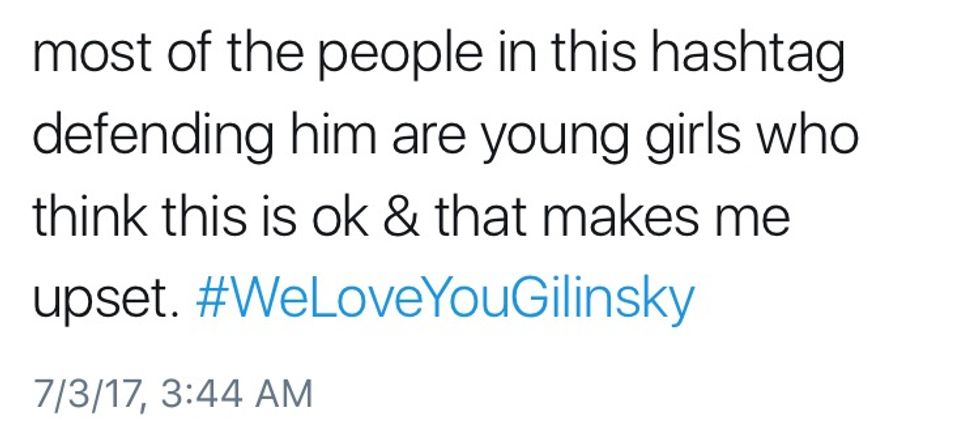
This tweet epitomizes the reality of social media on younger users. What Jack did was not a simple mistake; it was an active and conscious decision to hurt his partner. Such abrupt forgiveness fails to recognize that Jack's actions were not okay. While yes, all couples have their ups and downs, there is a line between simple arguments and verbal abuse, and his comments most definitely crossed it. The reality of the situation and something that many young fans of Gilinsky are failing to recognize is this: he only apologized because he got caught. As soon as his career and reputation were in jeopardy, he suddenly somehow realized how wrong his actions were...I see no coincidence there. Now, I also recognize that there are two sides to the situation. I'm sure his partner has had her fair share of comments, and I'm sure that there is fault to be put on both parties. However, the very creation of this hashtag is ignoring the presence of a toxic relationship, something that nearly a third of teens come to suffer.
Social media is slowly but surely normalizing abusive elements of romantic relationships, to an audience incapable of identifying those elements in the first place. Unfortunately, talks of dating and relationships usually don't happen until high school for many schools, and for many teens, this may be too late. According to a study by Teenage Research Unlimited, only half of kids ages 11-14 claim to know the warning signs of a bad/hurtful relationship. As stated by Katie Ray-Jones, president of the National Domestic Violence Hotline, "I think, as a field, we’ve gained traction in educating young people around physical abuse and verbal abuse, but how that translates over a digital platform is not something that young people have necessarily made the link to.” So what do we do about this problem?
Obviously, the impact of social media isn't going away anytime soon; accounts will post what they want to post. It is absurd to ask young kids to stop using social media, as in this day and age, social media has become a major platform. Awareness is key. To those aware of the issues and realities of teen dating, social media will not necessarily have as much of an impact. What's important is knowing the warning signs, knowing what a healthy relationship is and isn't, and knowing where to go for help. Teen dating abuse is a widespread problem, but unfortunately, is also a problem that many people don't even know exists. Early awareness and education are key in stopping social media's traction in this growing problem.
Social media's influence is strong, but we, as informed and aware individuals, are stronger.