When was the last time you took a break?
Really.
If you’re anything like me, the answer is going to sound something like this, “Well, last week I fell asleep on my Philosophy text book. I only got three hours of sleep the night before and my brain was already fried before that...”
At my best, I work myself to the bone.
At my worst, I sound a little more like this: “When was the last time I took a break? You mean to ask: When was the last time I got out of bed? I just watched six seasons of ____ in one day.”
That’s some brutal honesty right there.
My life rotates, almost too predictably, and shifts between times of really impressive productivity – motivation and hard work and quad-shot lattes – and times of really pitiful… well, movie marathons. I’ll spend a whole week at school studying for five plus hours a day and going to classes and meeting up with friends and filling every possible moment of my day. And then the next week I’ll be so emotionally, physically and mentally spent that the only thing I want to do is binge-watch a show on Netflix.
I just can't handle doing anything more.
And while I’ve “gotten by” living like that, it’s a pattern that I shouldn’t be in. It’s unhealthy and I know it.
Now, for you it may look the exact same. You may be really good at working hard and giving everything you have, and then you may need a day or a few days to crash and burn and then pick up the pieces and move on.
But your life may look very different. You may have everything together, spick and span. Or your life may look quite a bit worse.
Wherever you are, what I want to talk to you about today is rest.
First of all, let me clear up some misconceptions. None of the following are true.
- Work is bad.
- Work is best.
- Rest is best.
- Rest is bad.
Now, I know those sentences sound, at first glance, rudimentary and empty, and at second glance, paradoxical. At third glance, I’m sure I’ve just confused you. But stick with me.
I'll start with number one.
Growing up, my father always told me, “Enjoy your childhood now because as soon as you get older, you’ll start working and then you’ll work for the rest of your life.”
And yes, if you're wondering, of course that terrified me.
Who wants to work when it’s so much more fun to play soccer with friends or read a book or just do plain nothing? All work does is eat up all your free time and make you a tired, miserable “adult,” right?
That was fifth-grade “me” talking.
I mean, here, to disprove the first point. Work is not bad.
“The paradox of work is that many people hate their jobs, but they are considerably more miserable doing nothing” - Derek Thompson, The Atlantic (July/August 2015 Issue)
That’s right, people. And you know exactly what he’s talking about. Think back to the third (or so) week of summer your junior year of high school. You’ve watched all the movies you care to watch. You’ve slept in progressively more late over the time that has passed so that, now, you’re rolling out of bed at 2:00pm. And you’re certifiably bored.
16-year-old "you" would probably not disagree: Work is not bad.
Not only does it make way for “pay,” that pesky means to those very needed ends (i.e. groceries, etc.).
But work is, as also said by Thompson, “an activity that lends meaning or purpose to many people’s lives.” It allows us, if we’re lucky, to channel our energy into something that we’re good at and that we love. Or, at the very least, it allows us to add something to the world, whatever that might be.
But work is also not best.
It can distract us from what matters (workaholics–you know the bunch); it can drain our energy and take away time from what we’d rather do because we must work to survive, and surviving in this economy is pretty hard to do.
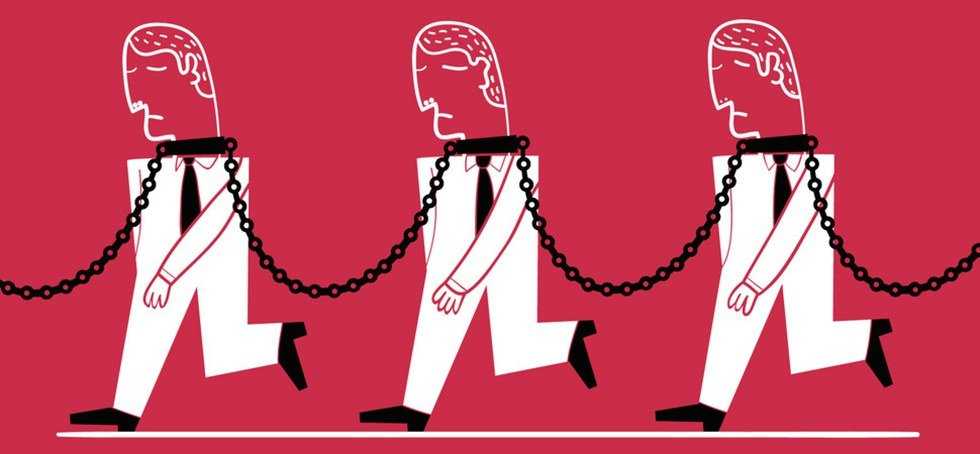
It can make life monotonous and dull and overbearing and exhausting. And we aren’t robots. We can’t keep drinking coffee and pretending like everything is going to be just fine as long as we finish this, that and the other thing.
We also need rest.
As we discussed earlier, we need work to survive. We were made to work. It gives us purpose, and it fulfills some need deep within us to accomplish something. But rest is, arguably, more important.
It not only allows us to recover from the work we’ve done, but it also prepares us to work well.
However, rest is neither best nor bad.
We know too much rest, over time, erodes at our core. It becomes laziness, and then it drives us mad. But taking one day out of the week to stop, breathe, and recover isn’t the worst thing in the world, either. And sleeping well and taking time during the day to slow down and enjoy the things that matter, contrary to popular opinion, actually won’t kill you.
That’s right! Setting down your phone and turning off the television and canceling all your plans for the afternoon and just…breathing (did you feel your shoulders relax a little?). That's not bad at all. In fact, that just might be the secret to it all.
That’s why “more, more, more” isn’t always best.
There’s a great skit on the show "Portlandia" where Fred Armisen is at his desk, frantically typing on his laptop and updating his social media, grabbing his phone to respond to texts, rushing back to his laptop to catch up on his favorite TV show and then grabbing his iPad so he can get a little bit of work done. He’s moving a million miles an hour, he’s talking and thinking so fast that you can barely hear a word he’s saying, and it’s hilarious that he’s so disgustingly absorbed by everything before him, but the satire there cuts a little deep.
While that lifestyle satisfies everything the world says we need to do, it’s pretty obvious that it isn’t what we actually need.
We were made to work, but we were also made to rest.
There's a lot more to be said about balance, but, if we're being honest with ourselves, we need both work and rest in order to be happy, and there’s no way of getting around that.