
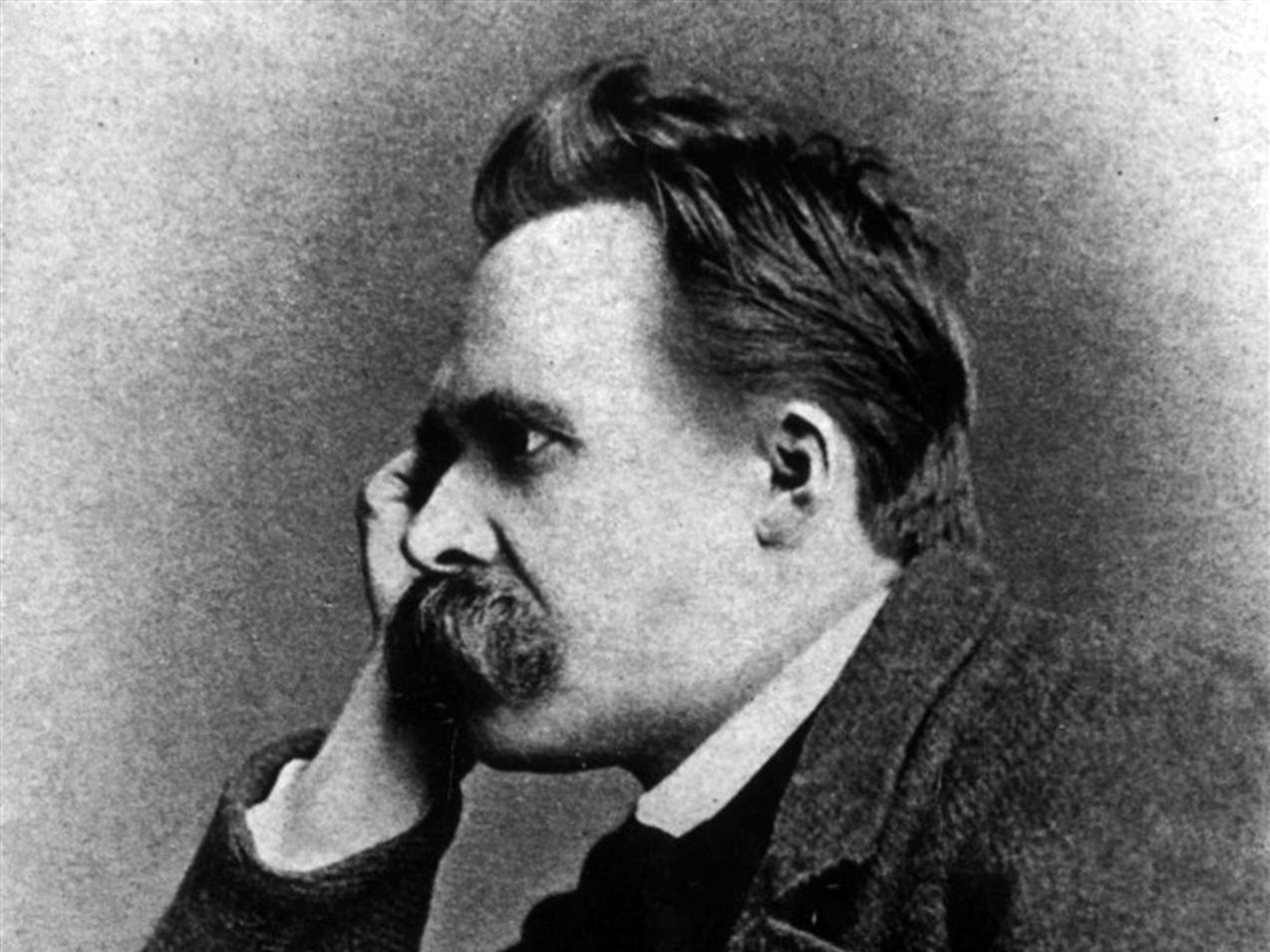
If you have taken a philosophy class or two in your life, then by all means you're familiar with the name Friedrich Nietzsche. Overall, his main concern was with metaphysics and how one can "be". Many look up to him for his sophisticated questioning, but also despise him for his reckless assumptions. Despite his reputation, there are a few things to thank this man for.
I absolutely love Nietzsche for his straightforward personality. Even though (I believe) his philosophy is wrong, he remained dedicated to his work and his beliefs. Grit is extremely important when it comes to philosophy and discovering the truth. Even looking back as he was growing up, it wasn't until later in his mid to late twenties when he started to mature as a philosopher and writer. This shows how his hard work and dedication helped him become a top-notch student and thinker. His work even inspired some of the brightest minds to flourish in the 20th century, including Jean-Paul Sartre, Martin Heidegger, and Sigmund Freud.
However, despite him being a remarkable and well credited philosopher, his ideas still seem absurd to me. His worldview is flawed and doesn't seem plausible to those who are interested in it. For example, the most famous quote of his is, "God is dead". Now that's a pretty heavy assumption to make. From here, he branched the rest of his philosophy and writings off the fact that there is no God and that humans can live independently from a supreme being. His inspiration for this belief would be from Soren Kierkegaard, who is also known as the "father of existentialism". Although Kierkegaard believed in theistic existentialism (that faith and reason can't coexist), he opened a new door for Nietzsche to argue for his cause. Existentialism has to do with freedom and how to make sense of an "irrational" world. Although many don't believe in this anymore, the 20th century was a time period that had quite a few existential philosophers, including Albert Camus, Aldous Huxley, and Simone de Beauvoir.
In the end, Nietzsche was convinced that humans were autonomous, meaning that they are not affected by any external forces or powers. We have our own thoughts, beliefs, and free will. I still believe that he is wrong due to the fact that, ontologically speaking, there is a way to prove the existence of God and how we are in no position to give life "meaning" on our own. Any power like that would make us omnipotent (which as contingent beings, is logically impossible). I would recommend everyone to try and read one his works throughout their lifetime. Even if you don't agree or are against his beliefs, it's always important to take other point of views into consideration and discover how they see the world.

















