
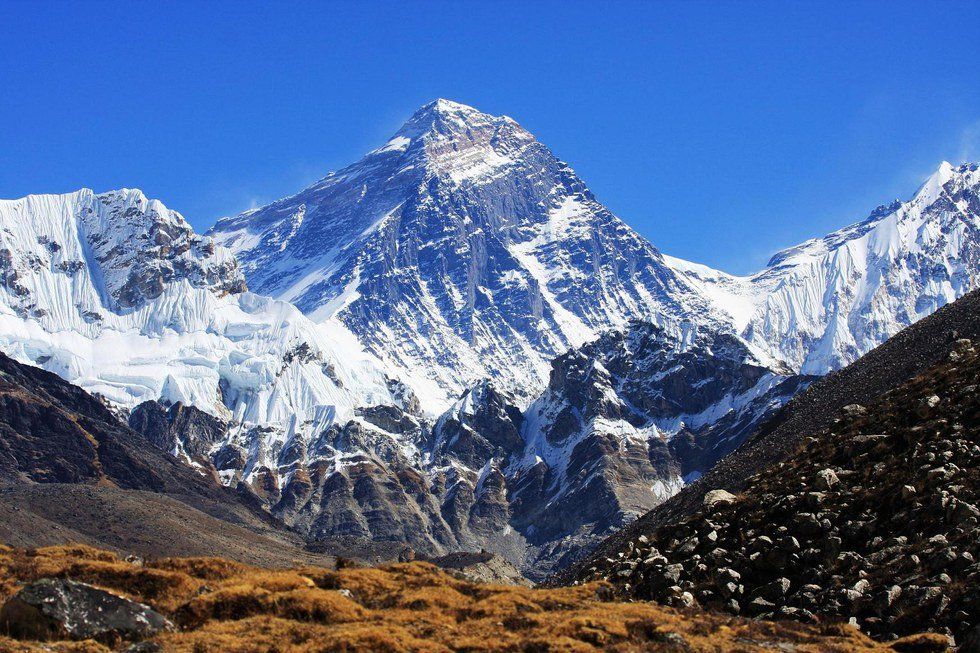
The other day I came across a video on Ted-Ed asking, “Why Is Everest So Tall?” The development of Mt. Everest and other mountains is very well explained and quantified in ongoing geologic studies around the world as well as many basic geology textbooks. Now, I don’t mean to be unappreciative but it almost begs the question, why isn’t Mt. Everest taller?
Mt. Everest towers at a whopping 29,029 feet and is the largest on Earth. However, the tallest mountain in the solar system stands at three times that. From bottom, Olympus Mons stretches roughly 16 miles into the Martian sky. So why is the tallest mountain on Earth only one third of that height?
As it turns out, geology and physics have answered that and question and the answer is really quite simple. Although a number of things actually have effect on the height of a mountain, most of these variables are connected to gravity. Gravity is the greatest limiting factor to height because the greater the gravity the greater the pressure exerted on an object. By the time you’ve made it to the base of a mountain such as Mt. Everest the collective mass and gravity of that mass presses down on the base. So for a mountain where gravity is lower by mass, collectively the mass will not press down into the base until you’ve gathered enough to equate allowing planets with lower gravitational force higher mountains.
It gets more complicated too. The mass itself isn’t just pressing into the base it’s pressing into the crust. Because on Earth, parts of the mantle (namely the asthenosphere) are relatively fluid, there is some amount of buoyancy. In a way this force pushes up on objects and the whole thing becomes a balancing act between gravity and buoyancy.
Thus meaning that not only does it matter the force of gravity on a planet but the crust itself also helps determine how much mass can be stacked on top of it and in turn helps determine how high a mountain can be. As when it weighs too much it will push into the Earth and disperse under the intense heat and pressure of the mantle. When there isn’t enough force from the asthenosphere to push back on a mountain, likely the same result will occur for a different reason. These forces interact dynamically with the change of different variables over long periods of time and effect the height of mountains all over the world and across the solar system. So, while we may not have the tallest mountain in the solar system, they are humbled by being limited by the same factors.






 man running in forestPhoto by