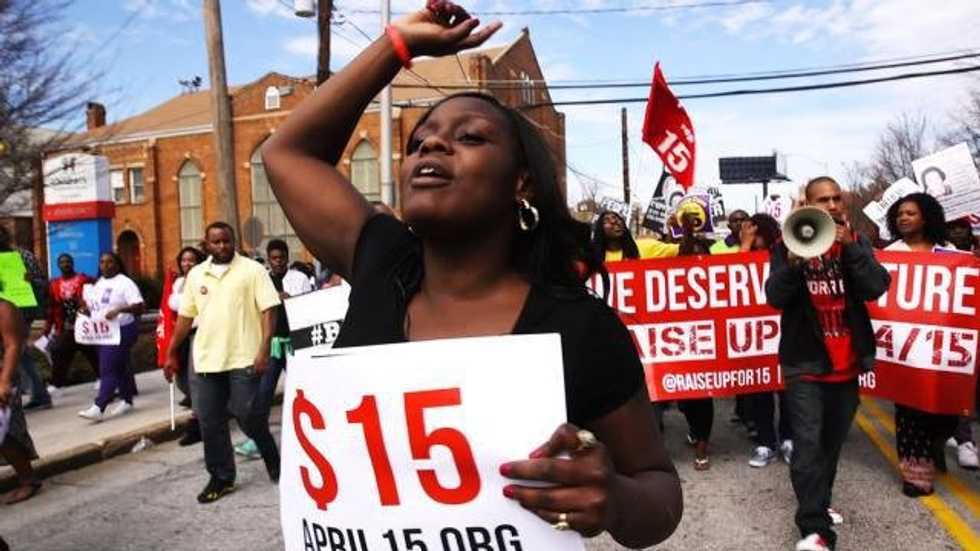
I think it's important that I start this by saying that I am a minimum wage worker. I am also a poor college student and I'm also a democrat i.e. all the perfect mixture of someone who should support a $15 minimum wage, but I don't because I think it would be disastrous. There's no argument that $7.25 is an appropriate minimum wage, it's not. It's far too low, especially in cities with high standards of living. The wage, however, isn't too low because it's not a living wage. Even if it's not a living wage if you work for an hour you should at least be able to afford lunch and $7.25 won't even get you a foot-long, a bag of chips, and a drink at Subway. So yes, I overwhelmingly agree that minimum wage is too low, but I don't think it should be $15 either, and for good reasons.
For one, it isn't as simple as raising the wage. That extra money has to come from somewhere and that somewhere is businesses. For anyone who has studied business, it's known that labor is one of the biggest cost in every and any business. It is the labor that drives the business and how a business makes it profit. It is a sensitive cost that affects both big and small business, everyone from corporation giants like Walmart to small mom and pop stores. To increase the minimum wage by over double means that labor costs automatically increase by over double, and in order to make a profit, that means something has to go. People mistakenly think big corporations like Walmart can easily afford this assuming the extra costs will come straight from the Walton's pockets, it won't, it'll come from yours. Let me help explain why a little further.
Imagine a lemonade stand. You sell lemonade for $1. It costs you $0.50 to make the lemonade and you pay someone $0.25 to sell the lemonade. You keep the other $0.25 as profit. Now imagine you can no longer pay your employee $0.25, now you have to pay them $0.50. Between the $0.50 to make the lemonade and the $0.50 to pay your employee, you now make absolutely no money because you only sell lemonade for $1. You need your business to pay your bills so not making money is not an option, something has to go. For one, you can increase your lemonade to $1.25 to cover your employees salary, so that you still make $0.25 as a profit. Except you can't do this because your competitor down the street has lemonade for $1 and you'll lose business increasing prices. Your next option is to cut your employees hours, or lay off your employee. Increased wages leads to higher prices and layoffs, that's just simple economics.
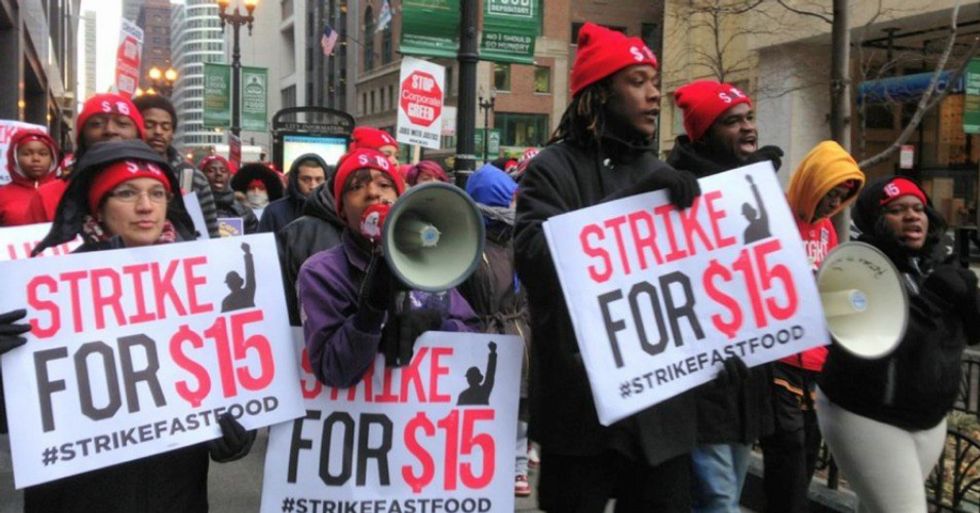
Now, a lemonade stand is just a basic model and while it's true that prices will increase, that doesn't necessarily mean the increases will be disastrous. The negative effects of a wage increase don't happen across the board. In fact large corporations like Walmart have already determined that a $15 minimum wage would only increase prices of products by pennies. The true problem of price increases and layoffs happens for small business. A small business can be defined as one that makes up 500 or less workers. This accounts for 99.7% of all business. When you reduce that number to less than 20 workers, that percentage is still high at 89.6%. Small business accounts for nearly 50% of non-farm GDP. Walmart and McDonald's are not the companies that will get hurt by a wage increase nor have to raise prices and lay off workers to survive. It's small business and encouragement of such a steep wage increase that supports big corporations even more while diminishing small business. All of this, might I add, is very ironic considering many Fighting for 15 think they are "sticking it to the man," when it's more like giving it to the man by ensuring that small businesses everywhere, where everyday people like you and me earn their living, struggle as the corporations around them prosper.
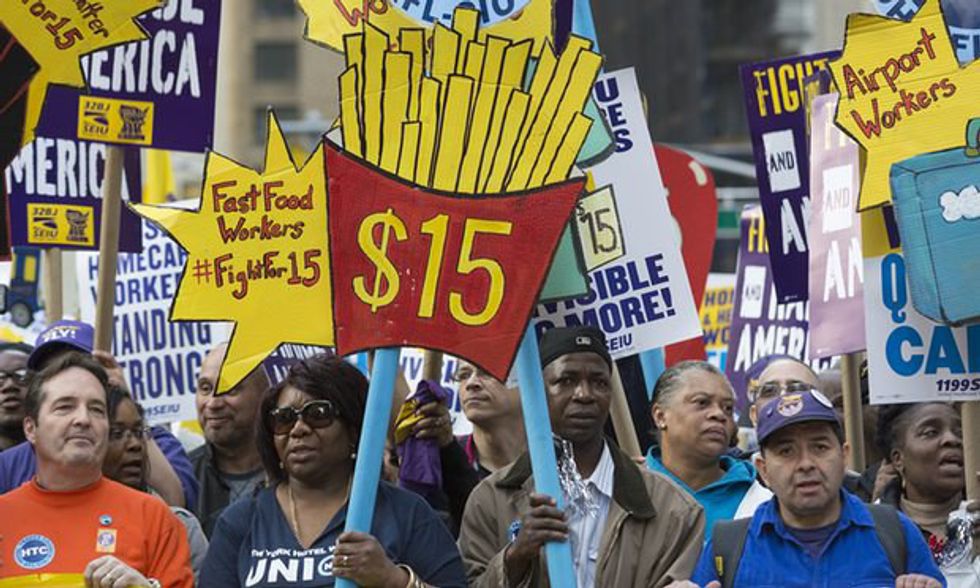
The fact of the matter is that a $15 minimum wage becomes detrimental for small business. Consider your average small town restaurant or pizza shop. 32% of a restaurants money is spent on food and beverage, a cost that can't go. Another 33% is spent on labor and the profit margin is only around 3.5%, at the highest. This is to say if your labor doubles, 66% of your costs would be spent on labor and 32% on food and beverage leaving you 2% to cover remaining expenses and make a profit. It's unlikely for one to live or sustain on a less than 2% profit margin therefore your only choice would be to cut workers, or cut half your hours. You can't truly increase prices to cover labor costs because most likely you have other small business competitors. Imagine your local college town: all small businesses competing.
So, what happens is a raise in minimum wage ends up increasing prices and decreasing workers. The point of increasing minimum wage is with the intended purpose of leaving workers better off but the reality is that many workers will lose their jobs an unintended consequence. So when a jump as large as $15 is proposed, especially when the economy is not strong yet, its easy to see that the end results will be worse than intended. Even talks of a $12 minimum seem a bit high, because at the end of the day, a minimum wage is supposed to be a minimum wage, not a living wage. Most minimum wage jobs require little skill and little education. Most of the jobs don't even require a high school diploma or GED. I had my first job when I was 16. I couldn't drive or vote, was a sophomore in highschool, didn't know anything, and truthfully didn't do much work at my job. I was lucky antone was paying me at all. But, not everyone with a mininum wage job was in the same position I was in. For many it was their only option when the economy got rough. When the economy gets bad, sometimes minimum wage jobs truly are the only option for many individuals and families and educated workers end up underemployed and working jobs that were never meant to provide for their families in order to survive. Increasing the minimum wage is a short-term fix and even a minimum wage as high as $15 is not a living wage.

Instead of working towards the bottom we should be creating jobs for educated workers in growing fields. It is getting an education and gaining skills to work in these higher level jobs that help to make a living wage, not raising the minimum wage. The last minimum wage increases were from $5.85 in 2007 to $6.55 in 2008 to $7.25 in 2009. Clearly it's time for an increase, hopefully one that gets us to at least $10 because while I'm working towards my degree with the hopes of landing a job that provides me a living wage, in the meantime I would like to at least be able to afford lunch.