


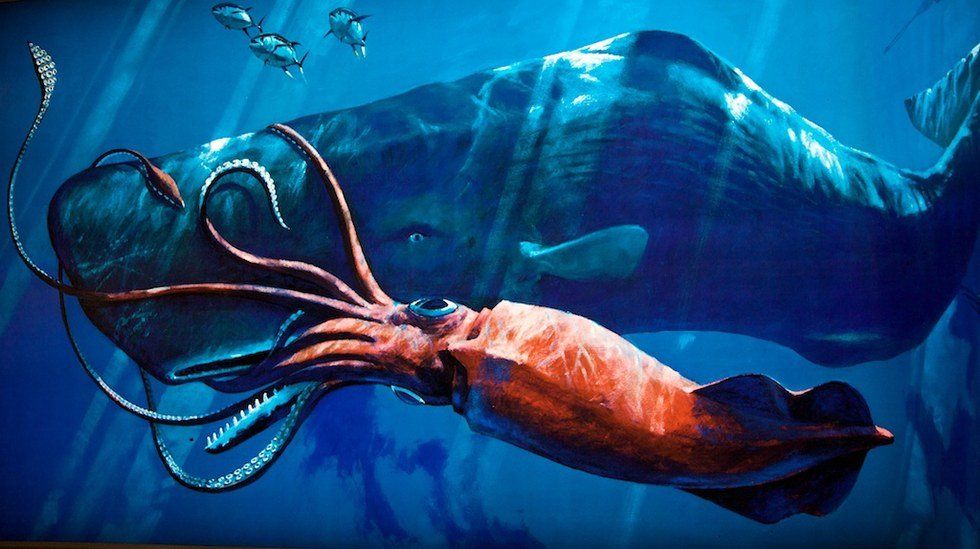
It’s tempting to just say “it’s a 40-foot squid,” and not bother to explain any further—because, wow—but the chance to say more about these sea monsters is too good to pass up. I have not yet discovered how to introduce this topic into a conversation organically. Whenever I feel the need, though, it’s one of those back-pocket interesting fact mines guaranteed to eventually spin the conversation into any number of interesting semi-related subjects: everything from the effects of the seafood economy on the environment to Bigfoot. There’s also relatively little chance at anyone quibbling over details because, lets be real, nobody bothers to memorize that stuff. No one but me, apparently.
Let’s get started with the basics. The Giant Squid (Architeuthis Dux) is one of the world’s largest invertebrates. It's a carnivore, and while its size is generally unclear, the best guess is about 30 feet, though the largest ever reported was 59 feet, so who knows. This is including its two very long tentacles, which have serrated suckers. They fight sperm whales, which is terrifying, and they have eyes the size of beach balls, the largest eyes in the animal kingdom. Until the late 19th century, science dismissed the squid as myth, and the first photo taken of a live one showed up in 2004. Based on the amount of beaks found in the stomach’s of sperm whales, they might eat up to 131 million giant squid annually, meaning there are hundreds of millions of giant squid out in the deep ocean. It’s probably good that humans don’t ever go down there.
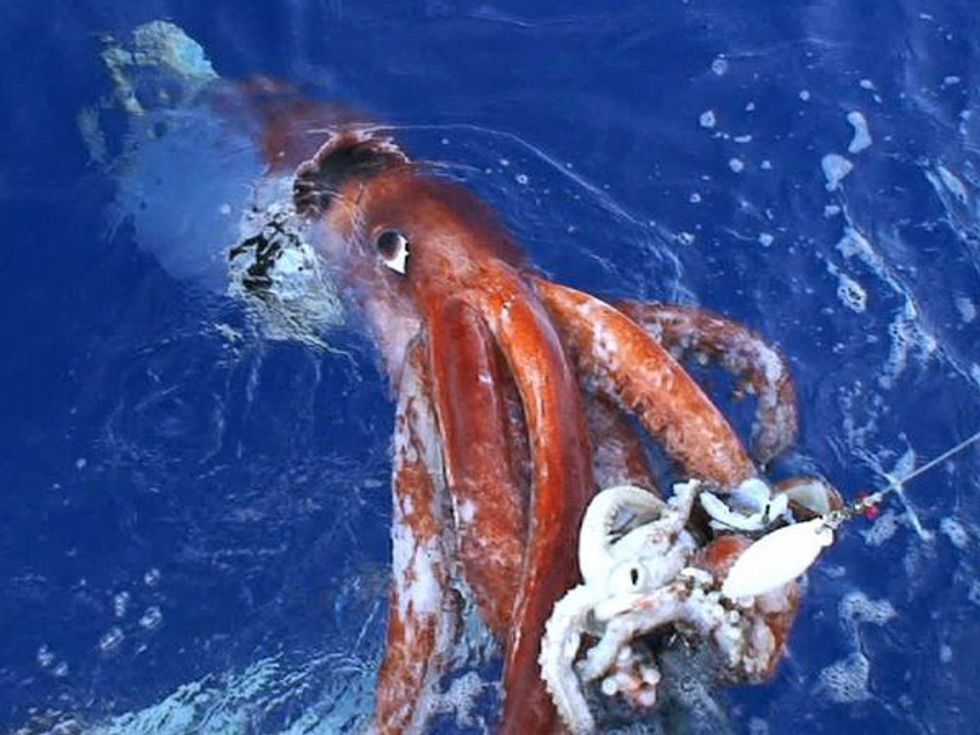
And then there’s the colossal squid (Mesonychoteuthis Hamiltoni), which is even harder to find. It’s a darker red, fatter, has a longer mantle but shorter tentacles. It’s much heavier, and instead of serrated teeth around the suckers it just has swiveling hooks. They may get much bigger than giant squid, but no one knows for sure. This is the world’s largest invertebrate. Don’t worry, though. It only lives in Antarctica.
The animal is fascinating and knowing all the facts will make you sound smart, which is always good, but the real perk of the conversation is all the unusual places this conversation can go. For instance, what does this thing taste like, how expensive would it be, and how many people would it feed? How would you cook it? Would you even eat it? Would it be damaging to the ocean to fish for it commercially? (The answer is always yes). Use it as evidence to back up the possibility of the existence of other huge, mythical creatures from hard to reach places that people don’t believe in, like the Yeti or the Loch Ness Monster. Use it to discuss abyssal gigantism, the tendency of deep-sea creatures to be much bigger than similar creatures nearer the surface. This can lead to a discussion of how much the ocean we have yet to explore and how many creatures we don’t know about.
It is also possibly the source mythological monsters the world over, from the Greek monster Scylla to the Norse Kraken. There are constant references to similar creatures in literature, from Lovecraft’s Call of the Cthulu to Jules Verne’s Twenty-Thousand Leagues Under the Sea. Even Lord of the Rings has a giant squid monster. The important thing is that the entire time you talk about giant squid and anything else that leads to, you will probably never mention the weather, how hungry you are, what’s on TV, or how much you dislike your co-workers. Nothing but engaging, unusual, and intelligent sentences will come out of your mouth, and you’ll probably be much better friends with the person you’re talking to. Good conversation can do that. If you're ever in need of an engaging conversation, giant squid can get you there.

















