


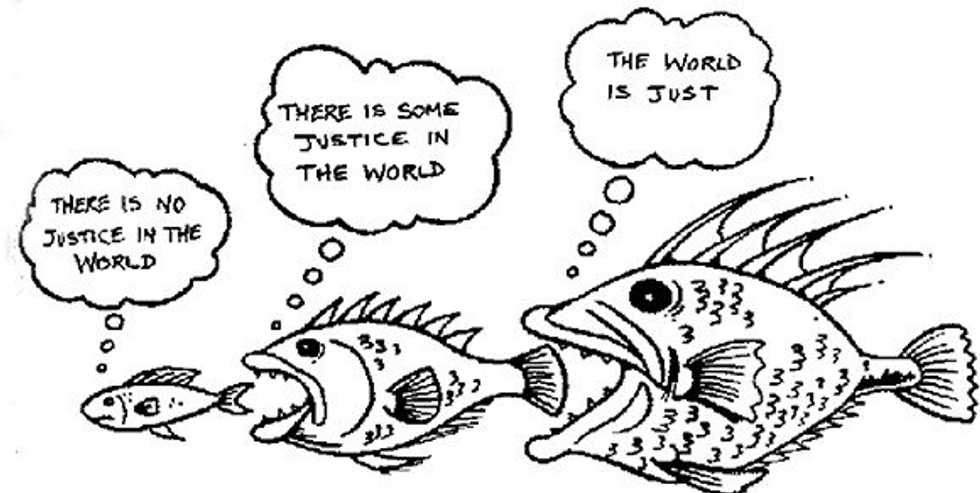
Last semester during my advising appointment my adviser told me that I had to fulfill my last UCORE requirement, which was my capstone class. The adviser suggested taking a certain Human Development class because it was popular amongst the communication students.
As I was scheduling my classes, I realized I wouldn't be able to take the Human Development class she recommended to me because of scheduling conflicts. By scheduling conflicts, I mean that the class was by Ferdinand’s. After the HD class got out I would have ten minutes to get back to Murrow. No thank you.
Anyways, as I was searching for a new class I came across a class called Women’s Studies 489. It worked well with my schedule so I figured I’d give it a go.
As the first day was approaching I had no clue what to expect because I had never taken a Women’s Studies class before. Was it really a class about studying women? I was absolutely mystified.
Finally, the first day of class came around. The first day was much more than reviewing the syllabus. The professor had put different categories on the white board: sexuality, race, class, and gender for our class to discuss. As you could imagine, the conversation escalated quickly.
Needless to say, the topics discussed in my diverse class were intense, eye-opening and intriguing.
I would have never thought to take one of these classes unless it was required. I mean, I study strategic communication and the people in my class were minoring or majoring in women’s studies or cultural ethnic studies. I am so glad that I stumbled upon a class like this. The more I had to read for the class, the more I learned how prevalent these issues are in society. It also made me more aware of the privileges I have.
I now realize the importance of taking one of these insightful classes. It is important that every student takes one of these classes.
But don’t take my word for it. Take the word of my Women’s Studies professor.
“I think it is important to learn about continuing racial inequalities in the United States, since we are generally taught that we are “post-racial” or that race is no longer relevant to one’s life chances and experiences,” said Washington State University professor Mary Bloodsworth-Lugo. “However, race still matters a great deal, and we are all made better people by seriously considering specific realities rather than ignoring them.”
I often hear people say they don’t want to take these kinds of courses because they are unimportant or boring. Bloodsworth-Lugo thinks otherwise, saying these classes actually enrich students’ educational experience.
“The path of least resistance is to do nothing or to pretend that things aren’t really unfair and unequal,” said Bloodsworth-Lugo, who holds a B.A., M.A. and Ph.D. in philosophy and a B.A. in psychology.
Once students understand the impact of the inequalities that do still exist in today’s society, a light comes on in students’ minds. Bloodsworth-Lugo says women’s studies courses challenge students to ask questions like, “What am I willing to do about that?” and “What work am I willing to put in?”
This class has helped me understand that society has a fear of the unknown and how that fear has negatively impacted various marginalized groups throughout history. The negativity projected on these groups still persists because many people are unaware of their own actions. Women’s Studies has helped me become aware and gain perspective on the many current, prevalent issues that are in the world today.
Scheduling season is right around the corner. Before you add an easy filler class, I definitely recommend taking a Women’s Studies class instead. This class has expanded my mind and challenged my belief system in a way that not many classes have done. You won’t regret taking this course, but you may regret not stepping up to the plate to critically address the problems that exist in our society.

















