
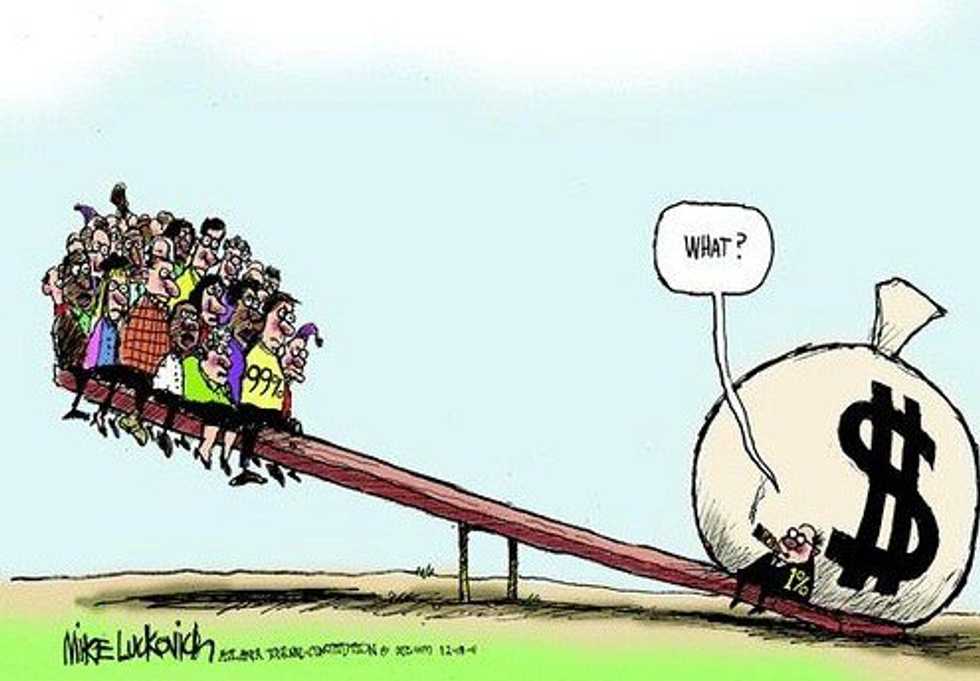
There is a common notion that economic inequality is the root of social injustice and upheavals, and, therefore, that this gap should be bridged at any costs; however, the real moral issue that is disturbing is neither the entity of inequality nor the billionaires’ luxuries, but the fact that some people are living below the poverty line. As a result, the pursuit of the economic equality ideal is not, and should not be, an end in itself, but rather just a means to achieve other important goals.
When a person’s life is adequate and fits his needs, capabilities, and desires, it would be absolutely morally acceptable if some other people have even better lives than his. On the other hand, if a person can barely support his own life and lacks economic independence, it would be troublesome even if all of the other people share the same level of income with him. Therefore, inequality is detrimental only when the lower classes are too far below the poverty threshold to the point that they are rid of basic necessities and cannot grow to their full capacities. In order to bridge this gap of inequality, what society should focus on is to help raise the living standards of these lower classes, and let the upper classes keep on their business ventures as long as these attempts do not interfere with the poverty reduction progress.
However, it should be noted that this argument is only based on a moral basis and not encompassing to all other aspects of economic inequality. Indeed, it is important to reduce inequality, not because of inequality itself, but because doing so can contribute to the process of poverty reduction and boost the economy to some extent. As the huge income gap between the richest and the poorest hinders the growth of the economy as a whole, it does need to be reduced.
According to Jacob Kornbluth’s documentary “Inequality for All” featuring former Labor Secretary Robert Reich, the 400 richest individuals, in total, earn more than half of the U.S. population. This data is disturbing not only because of the size of the discrepancy, but also because just a few people possess such great wealth. When these statistics were juxtaposed to other figures, there was a trend that crises happened when “the fewest had the most.” This is due to the fact that billionaires only consume just as many necessities as ordinary people, but they cannot boost the consumer demand because there are too few of them in comparison to the underpaid middle classes. Furthermore, investors often outsource their capital to overseas countries where laborers and resources are cheaper, and therefore, are not “job creators” for the domestic economy, as many people believe.
Because profit maximization is placed above all for the capitalists, it is not wise to believe in Ronald Reagan’s “trickle down economy,” and therefore, it is up to the government to transfer wealth by imposing higher taxes on wealthier people. The government needs funds from these taxes to create more safety nets and social programs for the society without cutting on other expenditures. The high taxes according to people’s incomes are not equal but just in the way that every one of the same level of income contributes an equal percentage of their revenues to the government. To billionaires, this amount of money only slows down a little rather than hinders the growth of their businesses, but to the society, this huge fund can save numerous lives by giving them opportunities to climb up the economic ladder.