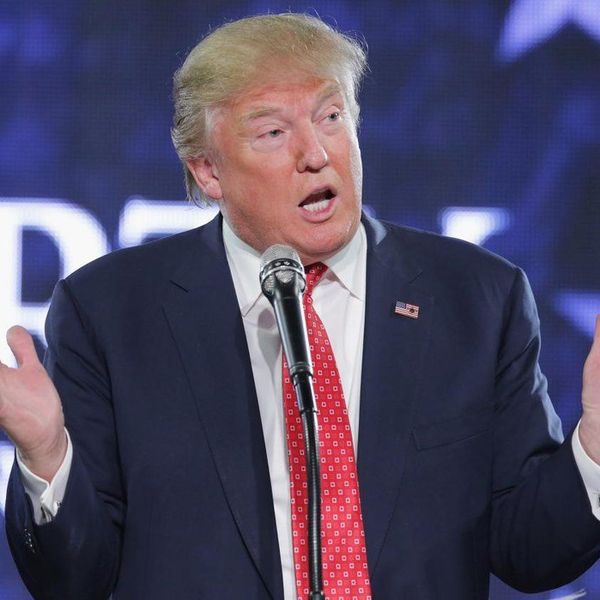

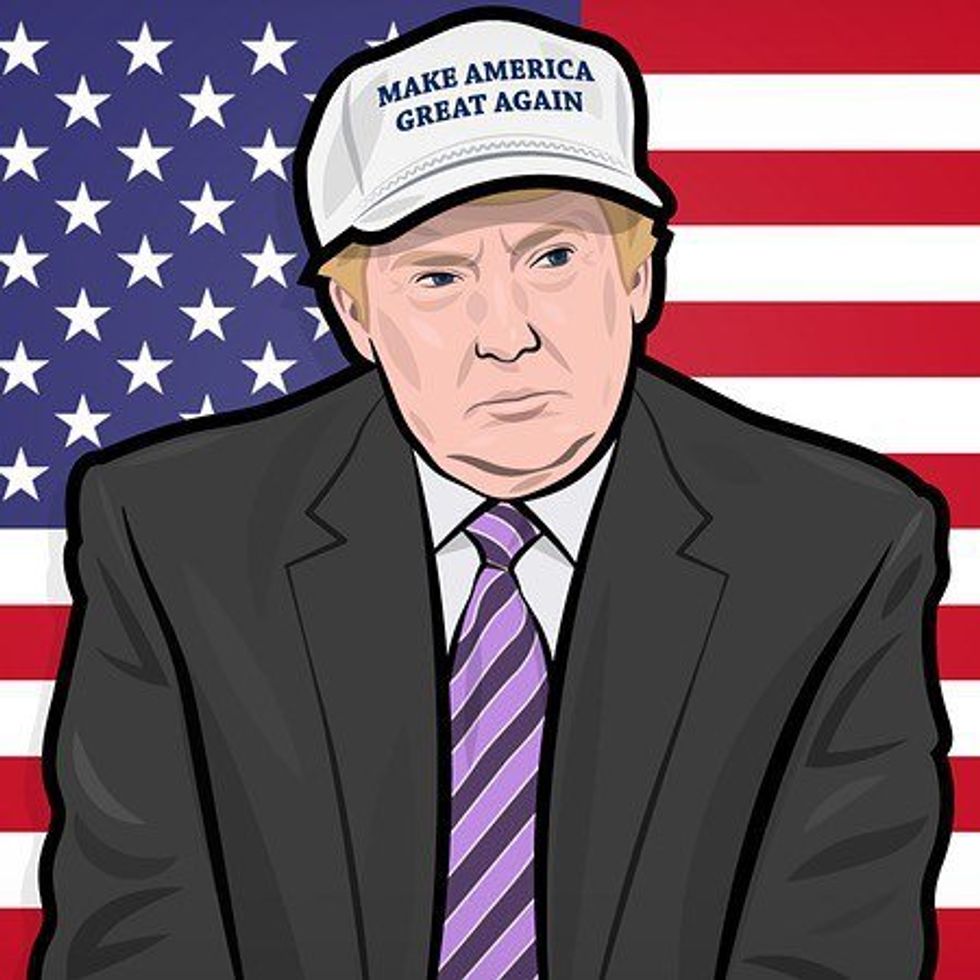
While stuck in stop-and-go traffic a few days ago, I noticed in front of me an older-model Elantra boasting not one but two Donald Trump bumper stickers with his famous slogan "Make America Great Again" written in bold red letters. At face value, his slogan is incredibly appealing, for what true American does not desire a "great" America? However, despite this fact, Trump's slogan is merely a parroting of an age-old American appeal to return to an imaginative past period in which America was on all fronts greater than it is today.
Indeed, the very term "great" requires a distinct definition of what makes something "great," a definition Trump has only loosely provided to his supporters, who are therefore left to fill in their own definition, assuming their candidate holds the same.
When looking at the slogan objectively, one is forced to come to the conclusion that America was at one point in her past “great,” an adjective she has since lost for one reason or another. In light of this, however, we are forced to ask the question: When did this “great” America exist and for what reason is she no longer great? Was it in the 1950s when America experienced an economic surge due to post-war industry? Was it the late 1700s when our Republic was newly founded and tyranny had been squelched? Or was it as recent as the years before 2010 and the passing of the Affordable Care Act, otherwise known as Obamacare?
Indeed many might answer that these were periods in which America was great. But, in reality, was America at any point in her past really as great as many Americans believe she was?
Yes, the 1950s resulted in an economic boom that boosted the middle class. Yet at the same time, African Americans in the south and across the nation experienced discrimination at the hands of both Americans and American law. Yes, the late 1700s were a period of great excitement as the early American Republic provided a new form of government for colonial Americans. Yet at the same time, women held limited rights, the United States supported the institution of slavery and the Atlantic slave trade, and education was not readily available to all Americans. And finally, yes, life before Obamacare was one with lower, sometimes significantly lower, insurance premiums that saved many Americans a great deal of money. Yet at the same time, millions of Americans were underinsured or had no insurance coverage at all (this is not to suggest I agree with Obamacare -- it is simply to make a point).
While I am not one to take the postmodern approach of universal relativity in every situation, it is apparent that Trump’s slogan to “Make America Great Again” is nothing more than a lofty appeal to Americans' imaginations and tainted perceptions of a past, flawless America that never actually existed. His slogan is neither objective nor historically plausible, due to the relative nature of the word "great." To put it simply, it is fundamentally flawed.
Not meaning to add insult to injury, but it is also uncomfortably unoriginal.
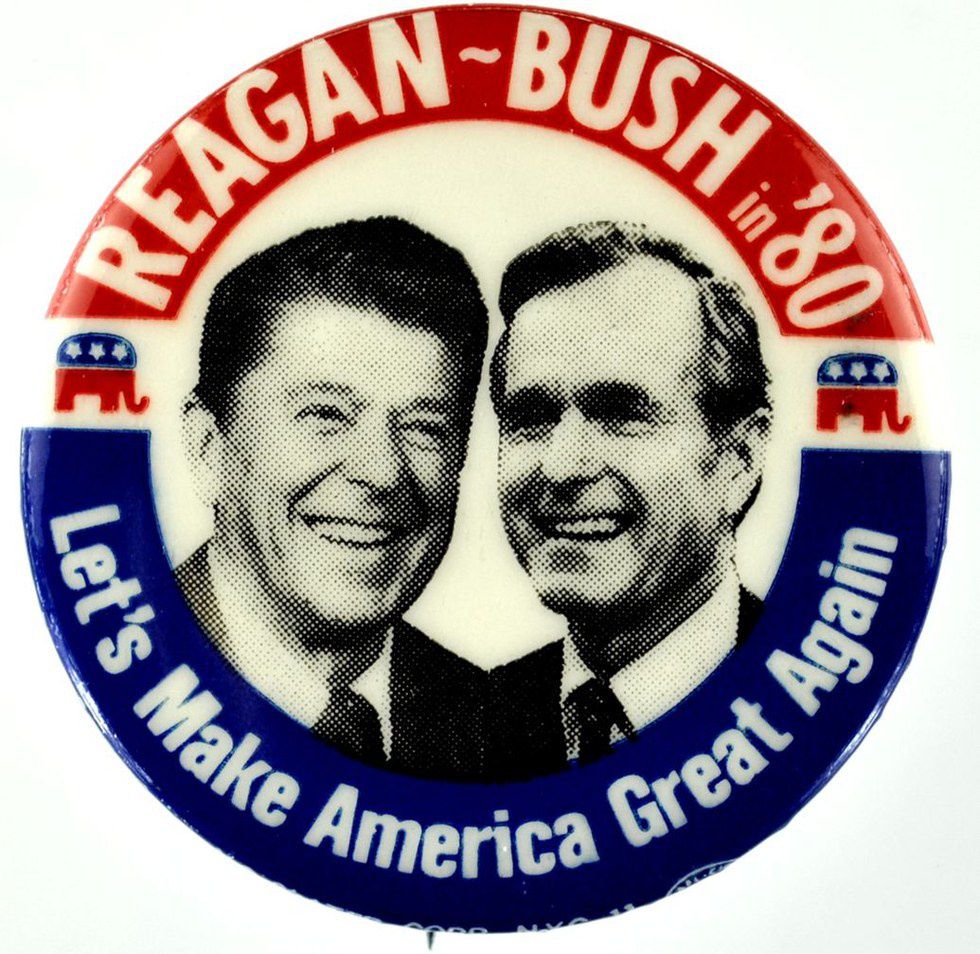
The tendency of Americans to appeal to a past, great America is not a new approach to pushing one’s agenda. In the 1910s, pro-baseball-player-turned-outspoken-evangelist Billy Sunday expressed the concerns of a number of Americans, who, disgusted with the sins of the nation -- especially in regards to alcoholism -- desired to return back to the olden days when they asserted Biblical morality had reigned (side note: Billy Sunday was a pretty good guy). Additionally, over half a century later, Ronald Reagan maintained the same sentiment on the subject of politics rather than morality, using the phrase “let’s make America great again” (sound familiar?) during his 1980 presidential campaign.
In conclusion, one might bring up the case of Barry Goldwater, the Republican candidate who lost to Lyndon B. Johnson in 1964 and campaigned on the appeal to return to a time of limited government involvement. Such a position is certainly attractive to some at first glance, but it is important to note that such an approach at that time would have significantly hurt many Americans on social security as well as African Americans, as Goldwater voted against the 1964 Civil Rights Act and believed civil rights should be determined by individual states, not the federal government.
On another note and in regards to Trump’s slogan borrowing, the real-estate mogul might see a jump in sales of hats and stickers were he to adopt the slogan of Goldwater, which reads, “In your heart, you know he’s right.”
And in turn, his opponents might borrow the slogan of Goldwater’s opponents:
“In your gut, you know he’s nuts."