


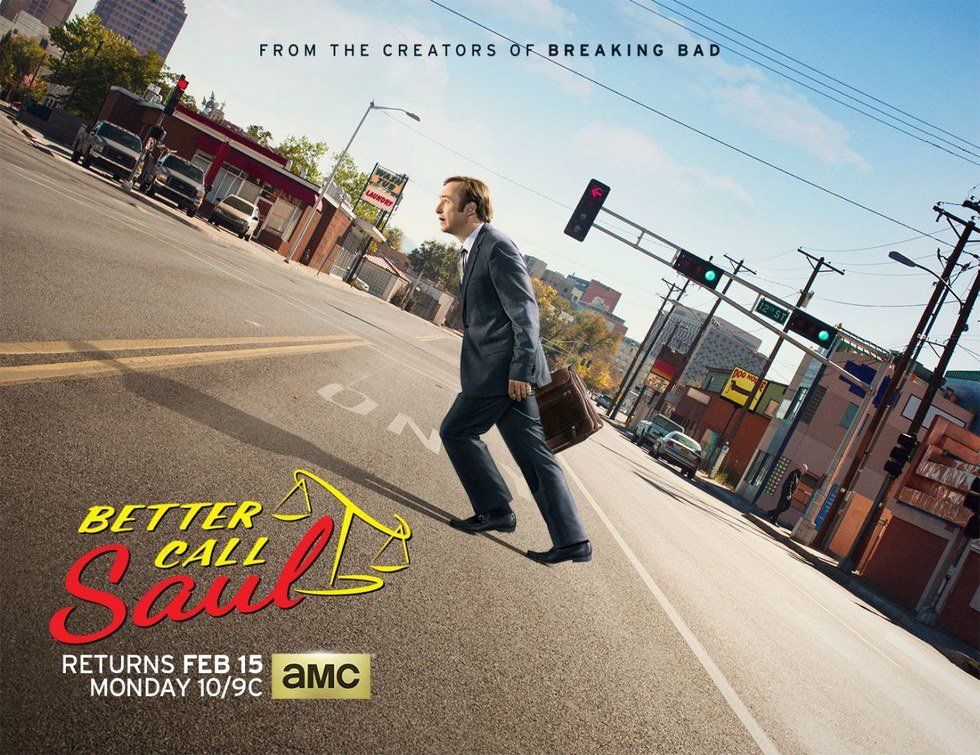
Many, myself included, were doubtful that a spinoff of “Breaking Bad” would live up to its predecessor, let alone be any good. Our doubts were quiet, though, because of our supreme confidence in the ability of Vince Gilligan, Peter Gould, and the rest of the writing, editing, scoring, lighting, costuming, casting, etc., crew of “Breaking Bad” who would rejoin on “Better Call Saul,” to tell a story that delivers on all fronts. But doubts they were. Surely, even with a team like that, arguably the best collaboration television has ever seen, lightning wouldn’t strike twice. Could we have been more wrong? “Better Call Saul” had the dramatic heft of "Breaking Bad’s” later seasons within its first. That’s an incredible feat, especially when the story is dealing with a rather undeveloped supporting character from “Breaking Bad,” the criminal lawyer Saul Goodman.
This is why the season openers of “Better Call Saul” start with a black and white flash forward to Saul, now Gene, working at the Cinnabon in Omaha he mentioned to Walter White at their last encounter. The writers remind us that we know where the story of Jimmy McGill will end, and that is what makes the show so intriguing and at times excruciating. Jimmy is no Saul Goodman. The Saul we came to know on “Breaking Bad” is fully given over to the dark side; he has his moments of trepidation, true, like when he is outraged that Walt would implicate him in the poisoning of a child, but is still willing to suggest sending Hank to Belize when he has found out that Walt is Heisenberg. He is a fully committed criminal.
Jimmy, on the other hand, starts off as a mostly harmless con. He’ll rob you blind if you step into the wrong bar in Cicero, but he’s not looking to inflict bodily harm, directly or indirectly, on anybody. This point is made in the second episode of season one of “Saul,” when Jimmy talks Tuco Salamanca out of killing the twins who called his abuelita a biznatch, in favor of a lighter sentence of horrifically breaking their legs. Hell, he even pays their emergency room bill. Jimmy has a much stronger moral compass than Saul. So, “Better Call Saul” has, based on its ties to “Breaking Bad,” the premise of "how does Jimmy turn into Saul?" built in. And that is the rock upon which the show builds its tremendous drama.
Before we can see Jimmy McGill descend into Saul Goodman, we first have to get to know him. And that is largely what the first season is concerned with, putting Jimmy in situations on both sides of legality and seeing how he will act. To make a long story short, we see in season one how Jimmy bounces between honest work and criminality, and by season two, he is comfortably operating in a fusion of the two. And that is his defining flaw. I’m going to dive into season two now with the expectation that you’re caught up and have followed the storyline enough to understand casual references to it. If you aren’t, and haven’t, not much of this will make sense.
Even when Jimmy is pursuing an honest case, he does so with questionable methods — he isn’t allowed on the Sand Piper Crossing grounds due to solicitation rules, so he pays a bus driver transporting the residents to lunch to stop in the middle of the road so that Jimmy can solicit clients within the bounds of the law. When asked to explain the large volume of new clients, he has to dance his way around this story by concocting a false one that omits any bribes or wrongdoings.
How does he get clients in this particular situation? He plays them. He plays on their goodwill with lines like “It’s not like the Sand Piper people, you know, put on a ski mask and mugged Alma May here at gun point. So I want you to put that mental image right out of your head.” Of course, that is exactly the image he wants in his elderly clients’ heads. But he wants to convince him that their approach is in good will, that they are not necessarily implying that Sand Piper Crossing robbed them blind (which they did), but that there is simply a mistake in accounting and that this is the proper way to go about fixing it. He’s not coming on too strong; instead, he’s slowly revealing the facts of the case to his clients so that they might reach the conclusion that they’ve been wronged at their own pace. And is this practice illegal or even immoral? It’s hard to say. If you listen to the "Better Call Saul Insider Podcast," you’ll hear the writers, editors and actors debating this very question, as well as other character motivations that are never cut and dry.
What does Jimmy get out of this case? For one, he has earned partnership at a prestigious law firm, having started in a mailroom (before then as a hustler in bars and back alleys), getting certified at the University of American Samoa. Talk about upward mobility. But is it fair to say that his motivations are strictly financial? No, there is pride involved too. And that pride is hitched on two people: Chuck and Kim. Jimmy is a slave to their approval, and starts season two working against Chuck’s expectations and toward Kim’s. Altruism is an ancillary motivation as this point.
More cut and dry criminality: Jimmy falsifies evidence to exonerate the ridiculous Pryce, a pharmaceutical dealer who is out of his league in the drug game. He takes this job immediately after having the first conversation with his brother since confronting him last season about his betrayal; he is reacting to the authority that Chuck has always lorded over him. This, as well as the questionable practices in the Sand Piper case, are what will undoubtedly come back to Jimmy later this season. He is going to fall hard. What we are seeing now are the practices that will come back to bite him in the ass.
When Jimmy asks Chuck why he came out of reclusion, he replies, “To bear witness.” Upon first hearing this, the question comes to mind, is he bearing witness to Jimmy’s success, or to his inevitable (in Chuck’s eyes) failure. We know from last week’s episode it is the latter, as Chuck makes abundantly clear. What Chuck expects based on past experience and intuition is what we are witnessing — Jimmy incriminating himself, one unethical move at a time. Some of his practices are worse than others, as we have seen with the bus incident versus the cobbler incident, but all of them are stacking up against Jimmy. The Davis & Main ad hammered this home, as well as the reaction of the partners. They make abundantly clear that Jimmy can’t be a salesman and a lawyer — it’s one or the other. Another abundantly clear piece of advice comes from Kim, who is taking a hit for vouching for Jimmy, and it’s pretty much the same: Jimmy’s actions are not in line with the law, and are poisonous to those around him.
We know where Jimmy’s journey will take him. The beauty of “Better Call Saul” is that we don’t know when or how exactly he will become Walter White’s lapdog. Each ill-advised decision that Jimmy makes is like another block taken from a Jenga tower, and we watch anxiously knowing that sooner (but hopefully later) it will all come tumbling down.
Near or more intriguing than Jimmy, albeit more sparsely featured, is Mike Ermentraut. A chance addition to "Breaking Bad" (Bob Odenkirk was unavailable for the filming of a scene which was subsequently rewrote for a new character, and Jonathan Banks happened to be available), Mike quickly became a fan favorite for what I like to think of as a decadent stoicism: he was the voice of reason in the wake of Walter White’s madness, a former cop turned drug enforcer whose sole motivation was to provide for his granddaughter, and we reveled in every minute of his presence, his begrudging care for Jesse, his tireless efforts to complete whatever the job at hand was, and his tragic death at the hand of Walter’s pride. I say decadent stoicism because he is such a restrained character who navigates a comfortable moral middle ground in the world of crime, and the indulgences into his character are an understated delight.
“Better Call Saul” only indulges his character more, and it makes for some of the new show’s best moments, many of which I’ll discuss next week when I look at the storytelling techniques that work so well on “Saul.” Just like with Jimmy, we now get to see how a Philly cop descended into the underworld of Albuquerque and became a drug enforcer. The origin of Mike also allows for the exploration of him as a character that “Breaking Bad” simply did not have the narrative space for.
Season one’s “Five-0” is highly regarded as one of the show’s best episodes, and it deals with the story of Mike’s son being murdered by fellow cops that he wanted to testify against. Mike’s guilt over his son’s murder informs much of his “Breaking Bad” arc, especially when it comes to his relationship with Jesse. It also provides Jonathan Banks with a long overdue follow up monologue to his famous “Half Measures” speech, this time admitting that his own corrupt practices broke his boy. The scene is heartbreaking, and is only possible on “Saul.”
More recent characterization of Mike includes the revelation that he was a sniper in Vietnam. These bits of information, gradually piling up, explain the tremendous weight that Ermentraut carries with every step on “Breaking Bad,” and continue to illuminate the character.
The same could be said for each character they bring back: Tuco Salamanca; Ken the Douchebag; Krazy-8; the list goes on and on. It would become redundant to detail how each of the characters grows due to their resurgence on “Saul;” suffice it to say, it has the incredible ability to make this show better, while at the same time making “Breaking Bad” more interesting.
The ability to show the origins of beloved characters is just one reason why “Better Call Saul” is the best show on television. Next week, I’ll explore the measured storytelling that puts “Saul” in the upper echelon.

















