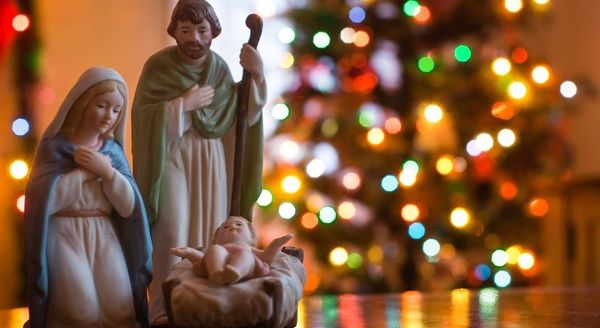


Christmas is right around the corner and according to our "true" American traditions, Fox has unleashed its havoc by accentuating the so-called "war on Christmas" all December long in an attempt to show people that they do have a heart, despite their year-round-eurocentric-Christian-extremism-and-racism. Most Americans see Christmas as an "American Holiday" like Thanksgiving (AKA Thanks- for taking Day) or Christopher Columbus Day (AKA Indigenous Peoples' Day), but others find that the Celebrating Christmas as a National American Holiday is wrong because it promotes cultural assimilation. Many Christians who observe Christmas as a strictly religious holiday don't even encourage appropriation of the celebration of Christmas when it comes to other cultures adapting its celebratory practices. Is the war on Christmas really that much of a public threat?
Strictly as an educational guide to help the public make a decision on their standing in this war, I have compiled a list of the holidays of other cultures and religions that are celebrated in the United States.*
Chanukah: Every year according to the dates on the Jewish calendar, Chanukah begins on the 25th of Kislev and ends on the 2nd of Tevet. This holiday is observed for eight nights because of the tale of the Maccabees. Chanukah is a celebration of the Jewish people overcoming a great adversity that seemed unwinnable. Antiochus IV, a leader of the large empire that was conquered by his father (Antiochus III), did not respect the Jewish people's desire to avoid religious assimilation nor their need to reject the polytheistic beliefs of the larger hellenistic society in which they lived. Judaism was outlawed and those found practicing it, were arrested and put to death. The actions of Antiochus IV provoked a large scale revolt. The Jewish people were outnumbered by Antiochus IV 's army, but Jews won their religious freedom after two years of fighting in 165 BCE. After the war, Judah, one of the main leaders of the revolt ordered a cleansing of the temple that had been looted and destroyed two years prior. An oil menorah in the temple was lit as part of religious practice and was only thought to be able to burn for one night because there was not enough time to make the proper amount of kosher oil. As the story goes, the lamp lasted for eight nights and was declared to be a miracle by the Jewish sages; this gave way to the festival of lights as we know it today.
Yule: This holiday is a Germanic Pagan festival celebrated dominantly today by modern Wiccans. Yule traditionally was a 12-day festival which highlighted the celebration of the winter solstice. Many of the older traditions held during this celebration have been lost because of Christianization. In one account during the Christianization of Norway, the practices and said to have included sacrifices and glutinous drinking. Different parts of the Germanic world had varied customs, but all were in celebration of the earth and what life it has offered to those people. In modern days, neopagans celebrate Yule as a marking of the winter solstice and rebirth of the Great Horned hunter god who is viewed as a newborn of the solstice sun. It is a 12 day celebration starting on December 23rd. Sabbats and gatherings are celebrated and observed in a variety of ways as according to a practitioner's path and personal traditions. Most practices do involve ceremonial meals and gift giving in the spirit of this joyous celebration of the welcoming back of the sun and the start of longer days.
Kwanzaa: This Pan-African holiday was first created in 1965 by Maulana Karenga and celebrated in 1966. Kwanzaa was created as a strictly African- American holiday as part of the black nationalist movement in the 1960s. Its name is rooted from Swahili origins meaning, "first fruits of the harvest". The holiday was created to reconnect African Americans with their cultural and historical heritage and promoted the study of African traditions and "seven principles of African Heritage"which was said by Karenga to be "a communitarian African philosophy". In the early years of Kwanzaa, it was created and promoted to be a oppositional alternative to Christmas, however, as time progressed, Karenga altered his position on Kwanzaa so that it may be observed in addition to a family or person's own religious observances in 1997 so that the meaning did not alienate Christianity. Observers of Pan-African traditions observe Kwanzaa by lighting the kinara; each candle symbolizing a principle. In the 21st century, the circumstances in which the holiday was created and that the original observances of the holiday have changed in America, but this tradition still has importance in promoting the passing down and performance of African traditions and culture. This holiday has spread to other countries beyond America such as Canada and (although officially confirmed), France, Great Britain, Jamaica, and Brazil.
Bodhi Day: Traditions of this holiday vary in accordance the specific sect of Buddhism, but this holiday commemorates the experience of enlightenment had by the Buddha, Siddhartha Gautama (Shakyamuni). According to the tradition, Siddhartha sat under a peepal tree in meditation for many years to find the root of all suffering and how to liberate oneself from it. There are many different ways that the story of the Great Awakening is told; some traditions say that he made a vow to Nirvana and Earth to find the root of all suffering or die trying. Other traditions say that while meditating, he was tempted by Mara, the demon of illusion while others just simply state that he entered deeper and deeper states of meditation, and in doing so, confronted himself and dissected the mental nature of humanity. Bodhi is celebrated on the 8th day of the 12th lunar month of the Chinese calendar or the Gregorian date of December 8th in Japan as a result of Westernization in the mid- 1800s.
Pancha Ganapati: This is a modern five-day Hindu festival celebrated from December 21st- 25th in honor of Lord Ganesha, Patron of Arts and Guardian of Culture. The festival was created in 1985 by Sivaya Subramuniyaswami, a Western convert to Hinduism, to promote observance of Hindu culture and practices rather than giving into the commercialization of Christmas. Each day, children are to dress in different colors (golden yellow, royal blue, ruby red, emerald green, and brilliant orange) according to the day and/or dress a Lord Ganesha statue or picture to stand for the five powers, or shakitis. Although it is a very recently established holiday, the message still promotes love, harmony, and family.
There are many sides of the "War on Christmas" argument, whatever you're opinion on the whole endeavour is, all that is asked of the public is to be respectful of the traditions and observances of others. As a human culture, it is important not to belittle our fellow humans, but promote diversity and acceptance or differing points of view. Together, let us promote inclusion and stop this nonsense of the war on Christmas and let people what they want to celebrate, however they want to celebrate. If the majority of 'minority' people were truly offended and threatened their way of life, an uprising would happen, just refer to the story of Chanukah!
*Festivus is currently established as a parody holiday celebrated on December 23rd. Its customs as according to the Seinfeld episode are hilarious but would not help me reflect the holistic meaning of this article.