


With recent attacks in both Paris and Beirut fresh in the minds of our collective conscious, many Americans find themselves wondering why the Islamic State of Iraq and Syria has chosen to expand its area of operations, and more aggressively target cities of the Western world. This article attempts to explain both the rise and motivations of ISIS.
After the U.S.-led invasion of Iraq in 2003, the U.S. and the Coalition Provisional Government began the process of rebuilding the government of Iraq in a democratic fashion, per the goals of the invasion. Ultimately, a democratic Iraqi government in Baghdad was established in 2005 with an election, one that then-President George W. Bush said represented a "firm rejection of the anti-democratic ideology of the terrorists." Despite the high rate of turnout in these elections, Iraq's problem of sectarian violence was just getting started.
In 2007, al-Qaeda in Iraq, a group that didn't exist prior to the 2003 invasion, and that would later become ISIS, began ramping up attacks on both U.S. and Iraqi military positions around the country with the intent of establishing an Islamic state in Iraq. After the election of President Barack Obama in 2008, U.S. involvement in the region died down as the focus of the administration shifted to the creation of a stable government in Afghanistan. Attacks continued in the region until 2011, when the waves of reform generated by the so-called Arab Spring reached into neighboring Syria.
Starting in 2011 and continuing to the present, a diverse collection of rebel groups has been fighting against the regime of Bashar al-Assad, the president of Syria. This unrest in Syria allowed the leader of ISIS, Abu Bakr al-Baghdadi, to expand his power base into Iraq's neighbor. Eventually, in 2013, al-Baghdadi issued a decree stating that ISIS had absorbed the al-Nusra Front, a jihadi group engaged in resistance to the Assad government. This declaration marked the creation of ISIS as we know it today.
Still, their existence largely confounds both the American public and government, leading to widespread fear and misinformation. Currently, ISIS controls a geographic area larger than the United Kingdom, as evidenced by this map, supplied by the Institute for the Study of War in conjunction with The Economist:
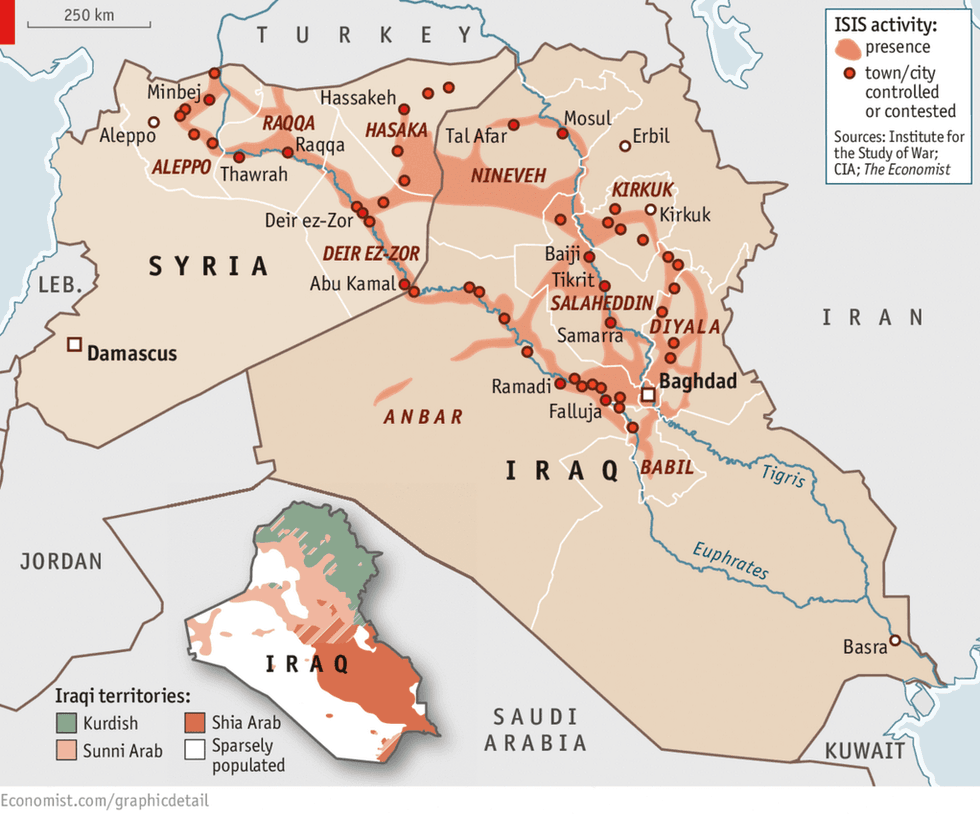
Another confounding aspect of the rise of ISIS has been its relatively opaque political goals. It publicly states its desire to create another iteration of a caliphate, an Islamic state of antiquity, where Islamic law, or Sharia, constitutes the law of the land. Perhaps most dangerous, however, is ISIS' theological rejection of peace as a matter of course. In Graeme Wood's highly recommended article "What ISIS Really Wants" in the March issue of The Atlantic, he articulates a vision of the group as a sort of al-Qaeda 2.0, a new and improved version of global jihad that sees itself as guardian of its version of the end of days:
Much of what the group does looks nonsensical except in light of a sincere, carefully considered commitment to returning civilization to a seventh-century legal environment, and ultimately to bringing about the apocalypse.
ISIS believes in an apocalyptic version of Islam, one in which the "armies of Rome" will meet the "armies of Islam" in Syria in a cataclysmic battle that will usher in the end of the world as it is currently known. Until then, they wish to create a "true" Islamic state, where Muslims can practice Islam in a way they believe will guarantee their salvation at the end of days.
When faced with a group that explicitly rejects norms like pluralism and democracy that have been enshrined in the West for generations, proper punitive action to punish the group is likely inevitable and necessary.