


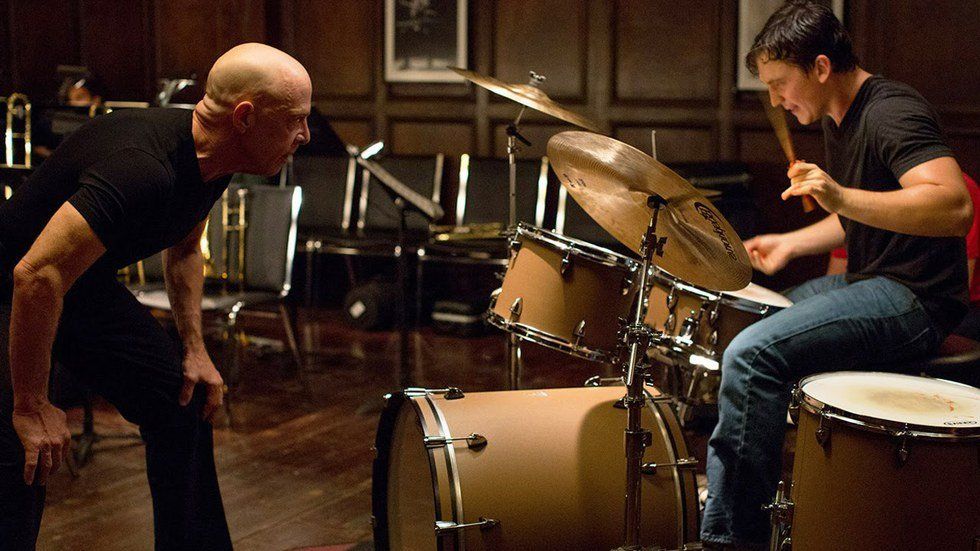
In the wake of 2016 and the start of the new year, it is important to reflect on past years in cinema, and the year 2014 was one of the best years in film in recent memory. Features such as "Birdman" and "The Grand Budapest Hotel" reigned supreme, garnering the highest honors that the Academy of Motion Picture Arts and Sciences can bestow. Following behind those two juggernauts was "Whiplash," a masterpiece of its own. While it may not have received the Best Picture nod, it does not trail far behind on the list of 2014’s greatest cinematic gems. Starring Miles Teller as Andrew Neiman and J.K. Simmons as Terence Fletcher, the story follows a college freshman repeatedly proving himself a disappointment to the abusive conductor. The movie went on to earn three Academy Awards (while being nominated for Best Picture and Best Adapted Screenplay): Best Sound Mixing, Best Actor in a Supporting Role for Simmons, and Best Editing.
The win for Best Editing really can not come as much of a surprise; a film with the content such as "Whiplash" naturally contains some of the most inventive and organized editing one could see on screen. One of many key scenes that demonstrate such technique is Neiman’s first rehearsal in Fletcher’s jazz band. Beginning with subtlety and softness, Fletcher goes from zero to ten in an instant, even throwing a chair at Neiman’s head, then proceeding to slap him until he understands the tempo. Another example of the conductor’s terrifying method is a scene where one member of his band is out-of-tune. Through a brisk but predatory process, Fletcher narrows it down to a trombone player and does not hold back in making an example of him. A scene that serves to really demonstrate Neiman’s tenacity —and Fletcher’s patience— would be the transition into the Third Act, where Neiman loses his role in the band (and his temper) after a brutal car crash forces him to arrive late to rehearsal, and inhibits his ability to perform. One final feat of the film is the finale, where Neiman performs in a band on stage, conducted by none other than Fletcher. Neiman plays an intense drum solo for quite a period of time, and it is this performance that ultimately wins a smile from Fletcher.
In regards to the editing techniques utilized in the film, it is worth noting the respect paid to musicians and music theory throughout the movie. Standard quick pacing is frequent throughout the feature, something one would expect from a movie about playing instruments in a jazz band. But beyond the formalities of its pacing, the editing actually employs something even deeper and more true to its own music: the cuts of the film take place in time, that is, during scenes where Neiman is actually drumming, cuts occur on beats. Cuts occur on motion, in time, or when Neiman hits a drum, or when Fletcher cuts his band off. It’s a truly brilliant way to cut a movie like this; it flows fantastically as if it were a jazz piece itself, but only because of the way the cuts take place. Everything continues through motion, so even when the music stops, the rhythm is still there. The genius editing of the film lends itself to the very pacing of the narrative, to the ultimate benefit of the film as a whole. "Whiplash" earned every bit of its acclaim.

















