
"As a child, fat was the first-word people used to describe me, which didn't offend me until I found it was supposed to."
These words come from Blythe Baird's spoken word piece, "When the Fat Girl Gets Skinny." In the age of the body positive movement and fat acceptance, I have tried to ignore how much these words, or rather Baird's entire piece, resonate with me. Unfortunately, I cannot—I cannot forget the power of language or the power of private and public shaming that I have endured because of my weight's incessant yo-yoing. But, there is another line in Baird's poem that speaks to me more and really gets to the core of what I want to address in this piece. After about a minute and 25 seconds, Baird waxes on the dichotomy of eating disorders and the perceptions of individuals who live with eating disorders:
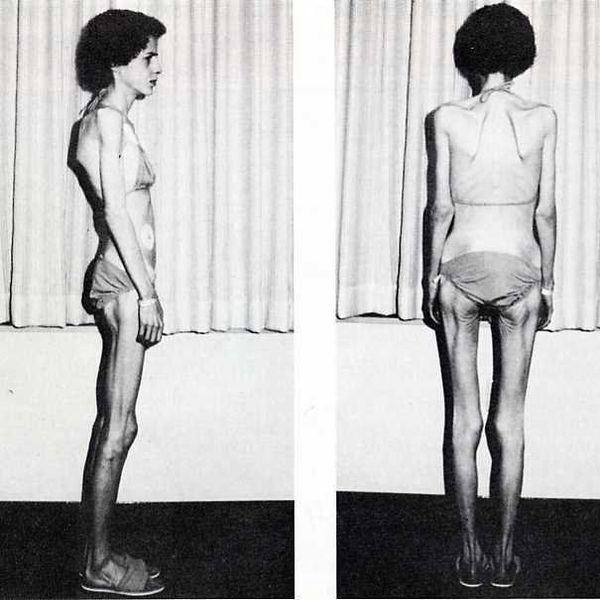
"If you develop an eating disorder when you are already thin to begin with, you go to the hospital. If you develop an eating disorder when you are not thin to begin with, you are a success story."
First, stigma surrounds issues of mental health, and eating disorders are no exception to that stigma.
Second, I do not intend to undermine the severity of someone who "is thin to begin with" developing and maintaining an eating disorder, or losing his or her life to an eating disorder. Undermining the obstacles that face anyone living with an eating disorder is by no means my intent. However, what I do want to focus on is how the idiosyncratic nature of the dialogues and discourses surrounding non-thin individuals developing eating disorders seems almost congratulatory—as long as you lose weight, it seems as if the (maladaptive) method means less.
I feel that the best way to illustrate this difference is through an example.
At a young age, maybe around eight or nine, I began putting on weight exponentially. I went from a relatively athletic child to a slightly overweight and then obese preteen. I tried everything: diets, more communal sports, less time in front of the television or anything I could think of that I thought would help me slim down. My focus wasn't on being healthy; no, my focus was on being thin and lithe. Granted, that mentality, in and of itself, is and was inherently problematic for me and my body, especially at such an important developmental stage. But, I digress.
By eighth grade, I was obsessing over calories and cardio. I did more math in my head in an hour than most kids my age did in an entire week—forever counting. Calorie counting manifested into extreme exercising, which eventually compounded with skipping meals. Within two months time, I had lost between 40 and 60 pounds, and my skipping meals had exacerbated into not eating for days at a time. I practiced extreme restricting, fasting and exercising to the point of exhaustion. But, I weighed 98 pounds and stood five foot seven, which felt like a small victory. At the time, I knew my eating and exercising habits were abnormal, but I would never admit to having an eating disorder. Even saying the word anorexic felt like giving up.
This practice continued well into high school. I didn't start the recovery process until the summer between my sophomore and junior year in high school. But, I remember the words of those around me more than the strange practices that I lived by or the physical pain that I suffered through. People I didn't even know applauded my weight loss; they congratulated me and wanted to know my secret.
It seemed as if my disease was the most interesting thing about me.
I always wonder how differently things may have been if I had started restricting as a thin preteen. If I had been a waifish wallflower of sorts, would those around me have responded differently? Would their congratulations have been concern instead?
Regardless, Blythe Baird eloquently sums up the dichotomy in her piece, "When the Fat Girl Gets Skinny," better than I ever could; and if the dichotomy still seems a little gray, a little fuzzy, then check out Megan Falley's, "Fat Girl," or Samantha Petersen's "Dead Men Can't CatCall."