Friday evening, I went to an event for the Russian Club at Hunter College. It was a screening of Olga Lvoff's documentary film “When People Die They Sing Songs.” I soon came to find out, that the title of the film refers to the last line of a famous Russian poem.
The poem, “When Horses Die,” by the famous Russian poet, Velimir Khlebnikov, goes as follows:
“When horses die, they breathe
When grasses die, they wither,
When suns die, they go out,
When people die, they sing songs.”
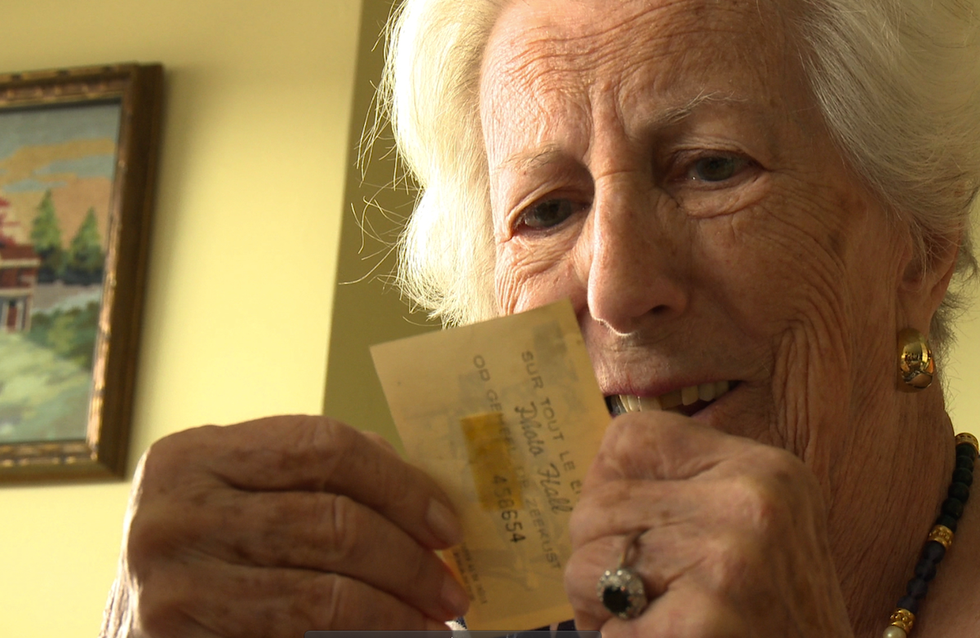
Lvoff’s emotional documentary beautifully represents this somber poem. The film tells the intimate story of a mother and daughter who uncover their wartime past, which was repressed in their memory for many decades. The mother is a 93-year-old Holocaust survivor who starts getting music therapy after a stroke. Singing songs from her childhood, she reconnects with her daughter in a new way and they revisit the past they always wanted to forget.
At the end of the film, there was a Q&A for the filmmaker and her surprise guest, the daughter Sonya, who by taking part in the documentary, uncovered a part of her identity which she had repressed and concealed for decades. In one of the many questions that were asked by the audience, one man mentioned in his question how, in his opinion, there is a two-dimensionality to the Holocaust for most of our generation. To paraphrase, he claimed that we learn about it in school and we’ve seen family photographs of Holocaust survivors in museums, but we don’t necessarily connect to this tragedy, which affected millions of people worldwide.
I, on the other hand, disagree. To an extent, I can relate to Sonya’s experience. She concealed such a significant part of her family history from others and she never wanted to talk about it. But when she reconnected with her mother, uncovering their wartime past, she discovered a part of her identity which she never felt an attachment to before.
On first impression, many assume that I’m European although I sound very American. Few people guess correctly on their first try that I’m Russian. And for those who see my last name right away, they automatically ask me if I’m Jewish. Though I don’t identify as being Jewish religion-wise, I do have Israeli blood in me and my family background is predominantly Jewish. Growing up I hated learning about the Holocaust; the same horrors repeated over and over. I couldn’t get the horrendous visuals out of my head. I couldn’t stand seeing videos and images about this genocide of the Jewish population, which had affected my family history though I was unaware of to what extent. I felt conflicted about my emotions toward it.
When I was in elementary school, or perhaps middle school, I learned that the late husband of my great-aunt Alla, the oldest of my grandpa’s sisters, from my mother’s side, had passed away during the Holocaust. I had this new information presented to me and there was nothing I could do with it. What I mean by this, is that my family had no knowledge of what exactly happened to him. Whether he passed away of natural causes, of illness, or if he died in a concentration camp- I thought I would never know. I was certain that all records had been lost and when my great-aunt passed away, I was sure that any information about him and our family history had died with her.
At the time, I accepted the limited knowledge I was given and for me, it was enough. I hadn’t given it much thought until I watched the documentary Friday evening. I had a strong reaction to the intimate story, and perhaps in the back of my mind, I was thinking about how a crucial part of my Jewish identity is lost forever.
It wasn’t until Saturday night, when I spoke with my mom about the film, that she greatly changed my perspective. She called my grandpa’s last living sister, my great-aunt Raya, who although her memory is not as great as it used to be, was still able to provide my mom and me with new information that had been concealed for many decades.
There were 10 siblings, with Alla being the oldest, and my grandpa the youngest. 4 of the children died of illness during childhood. Their parents, my great-grandparents, were taken to a concentration camp in Chynadiyovo, Ukraine, where we assume that they died.
The remaining children were taken care of by a family member and it is rather unclear whether they stayed in Ukraine or moved elsewhere. Alla, met her husband, in Uzbekistan, where they were separated when he was taken to a concentration camp. She was able to come to the United States, and the rest of the children, including my grandpa and great-aunt Raya, went their separate ways, although the three of them reconnected after their arrival in the United States, while the rest remained in Europe.
Alla’s husband survived the concentration camp and found his way to get to the United States where he and Alla were finally reunited. He passed away in the U.S, whether of old age or illness, I don’t know. But I am extremely grateful to find out all of this information that I thought was lost. My grandpa kept a lot to himself and was never open about his childhood or his upbringing. And when my grandpa passed away last year, I thought I would never find out. But now I know more than I could have ever imagined.
And I hope that someday I can find out for sure whether there is any record of them, and the concentration camps that they were in. As of now, I feel enlightened and more connected to my family history and Jewish heritage than I could have ever hoped. Uncovering such a significant part of my identity makes me relate to Sonya, from the documentary film, so much more than I could have expected.