When is it ever appropriate to use the n-word?
The simple answer is that it depends on the individual and the context in which they find themselves in. Regardless of whether you disagree with my critieria, one thing is for certain: censoring the word is nonsensical and childish.
Although the word is rooted in white supremacy and the desecration of African-Americans and blacks, banning books like "The Adventures of Huckleberry Finn"--which includes heavy usage of the n-word--or saying "n-word" whenever the entire word is spelled out in literature is infantilizing behavior. Becoming an adult requires understanding that the world is not a pretty place and that the story of America is filled with blood, oppression and the dehumanization of minority groups.
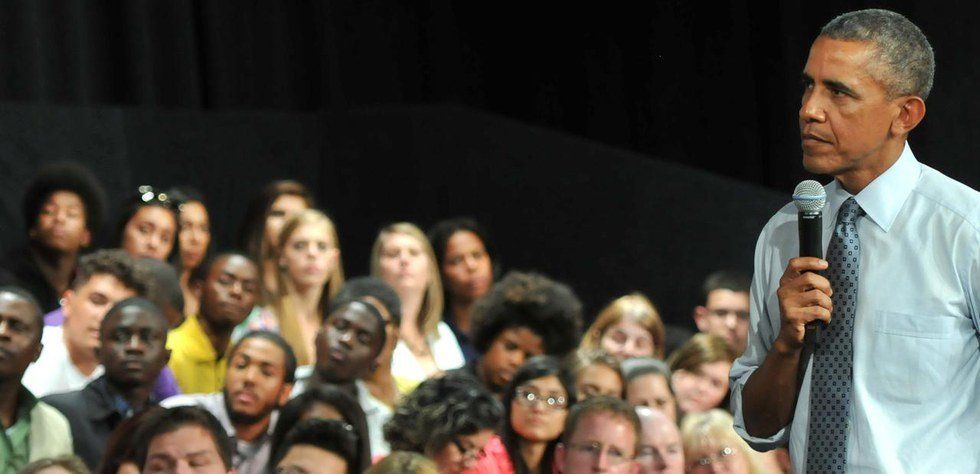
When President Obama used the n-word on Marc Maron's podcast, in context, to make a point about how racism has not been completely eliminated simply because it is socially unacceptable to use the word, the anti-Obama right-wing went into their predictable outrage. Their outrage completely ignored the fact that if President Obama had simply said "the n-word" his point would not have had the same impact on his audience.
The current climate of political correctness on college campuses has proven that conservatives do not hold a monopoly on misplaced anger.
Recently, a professor at the University of Kansas, while discussing her own difficulties when it came to talking about racism, was forced to take a semester off.
“As a white woman I just never have seen the racism… it’s not like I see ‘Nigger’ spray-painted on walls,” the professor said.
"We students in the class began discussing possible ways to bring these issues up in our classes when COMS 930 instructor Dr. Andrea Quenette abruptly interjected with deeply disturbing remarks. Those remarks began with her admitted lack of knowledge of how to talk about racism with her students because she is white," The students who reported her violation claimed.
This "damned if you do, damned if you don't" style of identity politics is a terrible way to go about educating oneself and it is also a mentality that allows minority groups to assume malice simply because a person is not a member of a minority community. People of color are still fighting to gain equal rights under the law for all, but that doesn't give minority groups a pretext for silencing free speech based on a person's immutable qualities.
I can hear the objections already.
But we're merely thinking about the feelings of the students, we don't want to offend them.
This line of thinking ignores the purpose of the civil rights movement, which was a movement not to establish and protect the feelings of minority groups, but rather to grant minority groups equal rights and protections under the law. Feelings are not more important than values, and they sure as hell are not more important than rights. That is where I fear our institutions of higher learning are headed. There seems to be a growing pattern on college campuses in America wherein the idea of avoiding offense is viewed as more important than actually addressing the important issues minority groups need solved.
One particularly sad moment occurred when Oberlin College students decided to protest the food served at their dining hall because it wasn't cooked the way they liked it. To make matters worse, they claimed that the dining hall's food was a form of cultural appropriation.
“When you’re cooking a country’s dish for other people, including ones who have never tried the original dish before, you’re also representing the meaning of the dish as well as its culture,” said Tomoyo Joshi. “So if people not from that heritage take food, modify it and serve it as ‘authentic,’ it is appropriative.”
Even the creators of "South Park" couldn't have come up with something so comical.
Harvard University also fell victim to political correctness when they decided to change the name of residential administrators from "house masters" to "faculty dean." According to Rakesh Khurana the dean of Harvard "the title causes discomfort" especially in the "context of a university in the United States--a country with a history of slavery and racial dsicrimination." So student activists get to feel better about themselves for a little while, but their victory means almost nothing in the grand scheme of things.
These examples are only a few of the many instances of college students demanding superficial reforms. Arguing about whether or not food is culturally appropriated or whether or not a teacher who wants to engage in a dialogue on race has ill-intentions does nothing to fix the problems of mass-incarceration, police violence, poverty, racism and other issues that disproportionality affect minority communities.
Compared to other groups, Millennials are the most willing to drop old habits and pick up new ones in a heartbeat, so here's hoping that the current trends dissipate and that sanity is brought back to politically-correct college campuses.
Until that day comes, socially-conscious and politically active millennials must be cautious and wonder whether the actions that we take are productive or detrimental to our causes.