
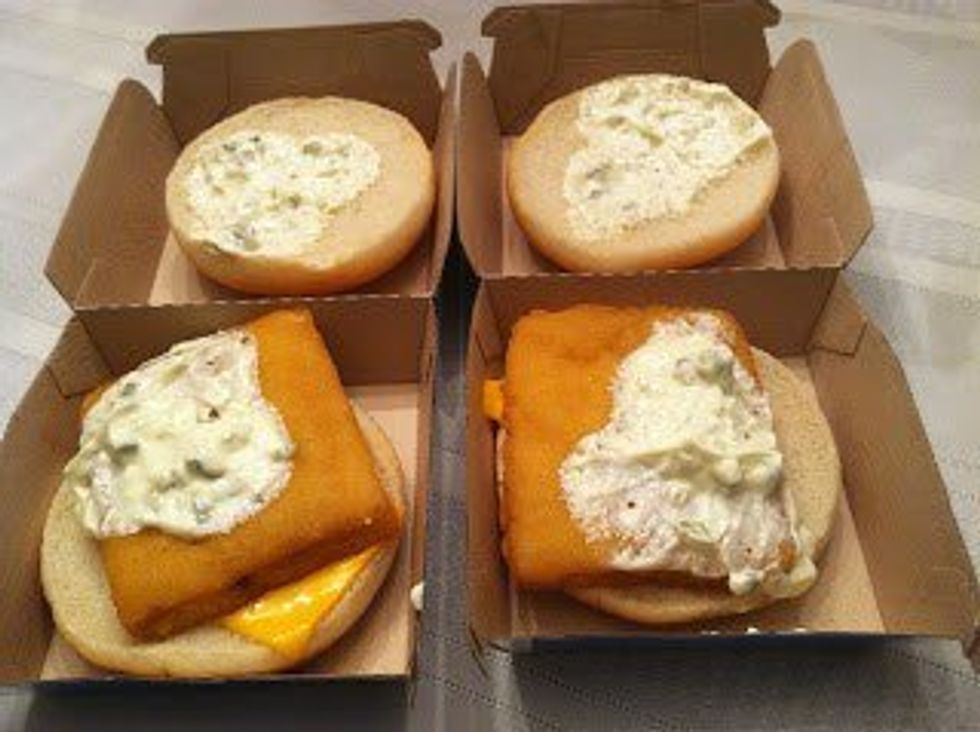
Nearly everyone has heard of McDonald's reputable “Filet-O-Fish" sandwich, which becomes seemingly more popular during the month of March and April when the Catholic holiday, Lent, is in season. Giving up meat each Friday can be challenging when you are on the go, so grabbing a fast food fish sandwich can be a decent alternative. And sure, maybe we've all thought about trying the Filet-O-Fish … but if you're anything like the majority of the population (myself included), the idea of a fast food fish sandwich makes you a bit queasy. Actually, try a lot a bit queasy. TWO Filet-O-Fish sandwiches costs a mere $3.33 cents (ONLY 1 dollar on Fridays) — doesn't sound like the fish is so real, does it? So how can we really trust where that fish is coming from when it's being served to us so fast, alongside grease-infused french-fries and clusters of meat recognized as chicken nuggets?
And McDonald's isn't the only one offering a fish sandwich on their menu. In addition to the Filet-O-Fish, Arby's serves a fish sandwich, as does Wendy's, Burger King, and Chick-Fil-A. All fast food chains serve their fish sandwiches in a similar style — breaded and fried, served with either tartar or mayonnaise sauce on a bun. But after doing some thorough investigating, the substance within a fish sandwich is still mildly questionable.
On McDonald's company website, they list the nutritional facts of every item on their menu. You can find specific details like how many grams of fat are in the tartar sauce found on the Filet-O-Fish sandwich. McDonald's also lists (in great detail) what the ingredients are in each component of the sandwich — the bun, the tartar sauce, and the cheese — excluding the fish itself. Is it possible McDonald's just forgot to list the ingredients of the most important component of the sandwich? Probably not. It seemed a little fishy that they could leave something so significant out.
However, after more investigating, I was able to locate the ingredients of the filet itself. Turns out, although it is not purely fish, it's actually not so bad. The ingredients are Pollock (which is a type of Codfish), wheat flour, water and modified food starch. The sandwich also contains 2% or less of yellow corn flour, bleached wheat flour, salt, whey, dextrose, dried yeast, sugar, cellulose gum, colored with paprika and turmeric extract, which are spice extractives. McDonald's claims the fish is wild-caught Alaskan Pollack from U.S. fisheries certified by the Maine Stewardship Council. But, searching through the ingredients and uncovering the nutritional facts has nothing on the actual taste of the sandwich. So, I decided to try it myself.
Turns out — although I cannot say this is my favorite McDonald's item — the sandwich isn't half bad. If you enjoy fried fish, this will surely be right up your alley. It has a nice (very fried) crunch to it and isn't too fishy at all. The texture is flaky and crumbles in your mouth, which was sort of appealing. The item is not a bad idea to eat during Fridays during Lent, since it is a (slightly) healthier, nonmeat version of McDonald's other various sandwiches.