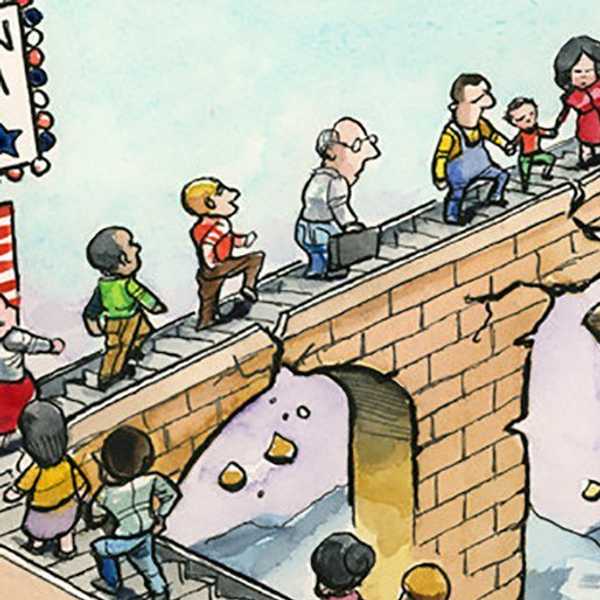
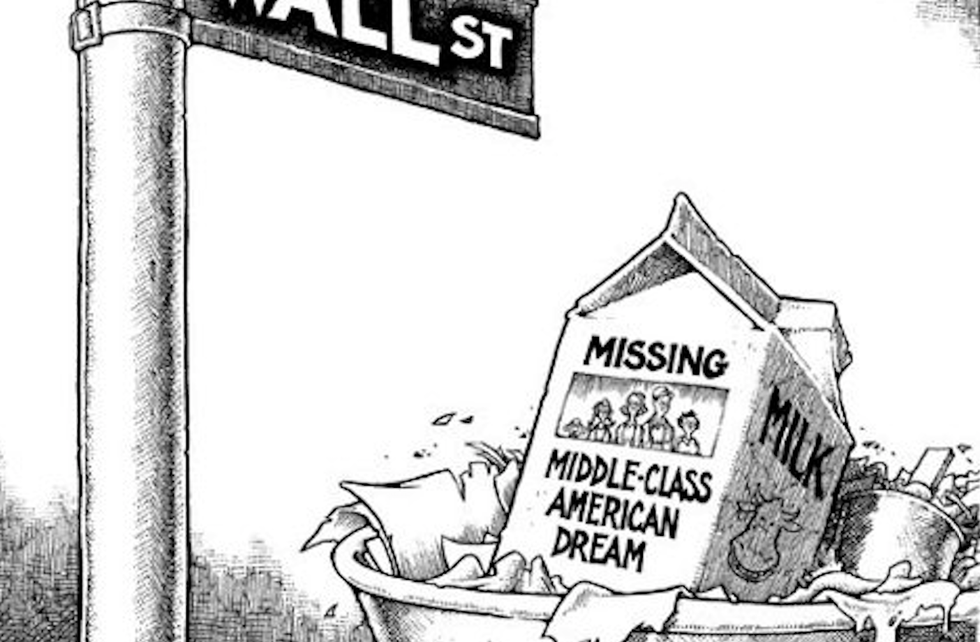
Two words historically dominate the primaries: middle class. The middle class accounts for 85 percent of Americans, but that number is diminishing as wealth concentrates in fewer and fewer hands and income disparities shove Americans on the margin beneath the poverty line. It is notoriously the most appealing campaign headline: Let's bring back the middle class!
But according to CNN host and Washington Post opinion writer Fareed Zakaria, the white middle class is long gone. In an op-ed published last week, Zakaria wrote that America's white middle class is "dying in increasing numbers" when compared to other socio-economic ethnic groups in America. It appears that, according to Zakaria, the most popular, sought-after vote, the one driving Donald Trump's success in the polls, is diminishing.
The death of the middle class is both figurative and literal, according to Zakaria. Due to climbing rates of stress, depression, alcohol and tobacco abuse, and idealized expectations, white middle America's mortality rate is either unchanged or rising. Minorities, and other ethnic groups, show decreasing mortality rates. According to Zakaria, expectations play a major role.
White middle America believes the system does, and should, work in their favor. They drive the machine of industry, they sustain a robust economy, and they constitute the vast majority of tax payers, market consumers and voters. Minorities, especially African Americans and Hispanics, understand more thoroughly that the system is not, and should not be expected to, work in their favor. Zakaria tells us that this is a fundamental point; those groups conditioned to persevere, even where policy does not favor them, have lower, more easily met expectations and therefore less depression and stress.
It is not only unmet expectations that are hurting the middle class, one psychological toil at a time. It is also the changing climate of the global economy. America, which long insulated its laboring class from the more negative repercussions of globalization and technological change, is likely about to pass a multilateral trade agreement with Pacific Rim countries that could potentially deprive white middle America of employment. The Trans-Pacific Partnership aims at strengthening American trade ties with East Asian countries by lifting tariffs and facilitating free movement of goods, labor, capital, and services across borders. This implies that, potentially, corporate America may be granted more flexibility in displacing work abroad, where wage labor is cheap. It also implies that America's automotive sector will suffer a blow, as cheap parts could be easily imported from Japan at a fraction of the cost.
The TPP has important positive implications, too, however. American agricultural goods could flow freely across East Asian borders, where previously they met a hefty tariff. Also, East Asian countries must now adhere to labor and environmental standards, which include better conditions in the work place, the right to unionize, and frequent check-ups to enforce the lowering of greenhouse gas emissions.
The partnership certainly has its pros and cons, but it represents an ideological shift away from insulation and towards the dangers, and opportunities, of further opening up the global marketplace. What used to be the epicenter of America's economy, the middle class, may slowly be replaced by global trade, and economic endeavors beyond the scope of domestic policy.
What Zakaria predicts is not as radical as it may sound. How can a presidential hopeful "save" a rapidly diminishing group? It is certainly the most favored slogan; it is easy enough to say, but perhaps too difficult to implement in a country where the trend is shifting in the opposite direction.
But ideational politics are slow to change. Policymakers adhere to constituents, and constituents want protection. The average American voter cares, above all else, about employment. If America's democratic system continues to do what it says it does, and represent the people's voice, how can it reconcile the tension between an unnerved white laborer and a steady shift away from its beloved middle class?