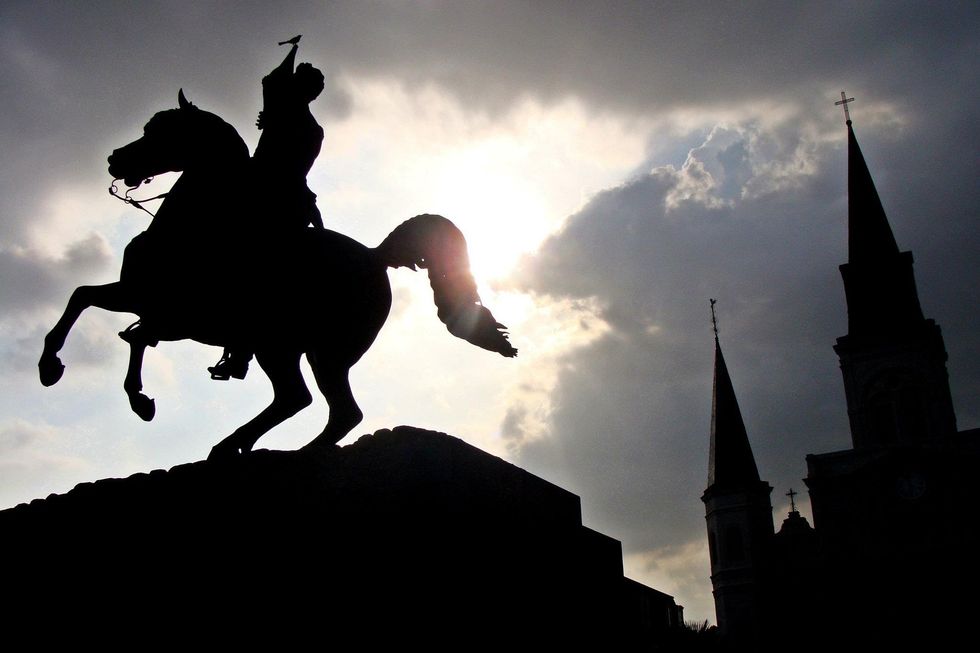
Andrew Jackson grew up in the time prior to the Revolutionary War. For Andrew Jackson, life started in a rural community in the Carolinas called the Waxhaws. He grew up with two older brothers and his mother. Three weeks before his birth, Andrew Jackson's father passed away. When America declared independence from Britain, Andrew Jackson read the news from the steps of his rural, community church.
As the War drew closer, Andrew Jackson's entire family became involved. His oldest brother, Hugh died from heat exhaustion on a battlefield. His younger brother, Robert died of complications from a saber wound which caused brain inflammation, and exposure to smallpox. His mother, Elizabeth died from Cholera while aboard a ship saving soldiers from the Waxhaws. The death of his family members left Andrew orphaned at the age of 14. These deaths, Jackson blamed entirely on the British. Losing these people only added to the hatred Jackson already had for the Redcoats.
As a young boy, Andrew Jackson and his older brother, Robert were messengers for the Continental Army. One morning the brothers were being chased by British soldiers. They had safely made it to their house when a loyalist neighbor turned them in. They were questioned, and as they were standing before a British officer, he ordered young Andrew, "Kneel down and clean my boots boy". Young Andrew Jackson replied, "I will not clean your boots, I am a prisoner of war sir, and I claim to be treated as such". This statement angered the officer, he then drew his saber and drew back, striking Jackson in the face and cutting his hand to the bone. This single incident was believed to have begun that slow, growing, hatred for the British, Which he revealed at the Battle of New Orleans.
As a 14-year-old orphan, Andrew Jackson pissed through all the money he had left through gambling and drinking. Later his Irish grandfather passed away leaving no immediate heirs, Andrew Jackson inherited the entire estate of 400 Pounds Sterling. With no care in the world, Andrew Jackson rode to Charleston he gambled, drank, bet on cockfighting, and horse racing. After a short time in Charleston, Andrew was destitute yet again. Andrew Jackson could not even go home because he owed the innkeeper money. On a final move, Andrew gambled his only belonging left, his horse. He rolled the dice on a $200 gamble and won, he soon paid the innkeeper and left for the Waxhaws.
Upon his return to the Waxhaws, Andrew Jackson became a teacher at the age of 17. After teaching for one year he began internships with some local lawyers and after passing his Bar exam a year later, Andrew's new career began, Lawyer. Later Mr. Jackson was appointed to Solicitor for the Superior Court. He was then elected to The United States House of Representatives and The United States Senate. In 1801 Andrew Jackson was appointed to Colonel of the Tennessee Militia and then Commander a year later. Later becoming the 7th President of The United States of America.
In 1814 Andrew Jackson secured a major victory in the Creek Wars. At The Battle of Horseshoe Bend, Andrew Jackson completely overwhelmed the Red Stick Indians and Chief Menawa. Many persecute Jackson for his treatment of the Indians, but he was only responding to a Red Stick Chief's orders to "Attack every white settlement". Andrew Jackson saw the destruction done to unarmed settlers at Fort Mims, he agreed that he must neutralize the threat.
Aside from his politics, Andrew Jackson had a terrible temper, which truthfully..... affected his politics too. In his lifetime Andrew Jackson dueled more than 100 times. One of those duels being over his wife's honor. A man named Charles Dickinson who was an acquaintance of Jackson, was drunk in a tavern when he decided to say that Rachel was a whore. Jackson's response can be summed up by saying he "Flipped a switch". Andrew Jackson's wife was one subject that he did not tolerate being slandered.
Throughout his presidency, Andrew Jackson helped end the National Bank. He also formed what is now the present-day Democratic Party, this was prior to the (1960-1970) party swap, where Southern Democrats became Republicans. Another interesting fact about Jackson is that he was the first president with an Assassination attempt. Richard Lawrence, a painter with severe financial problems who began blaming his issues on Jackson and then plotted to kill him. Lawrence waited outside the funeral of South Carolina Congressman Warren R. Davis. When Jackson walked by leaving, Lawrence pulled a pistol and fired at Jackson. The first shot misfired, the bullet did not exit the gun. Lawrence panicked and reached for another gun and pointed at the point-blank range Andrew Jackson. The second shot misfired as well, the bullet not exiting the gun. Before Lawrence could react, Andrew Jackson approached Lawrence and drew back his cane. Andrew Jackson began beating Lawrence severely with his cane. Davy Crockett a Tenessee congressman pulled Jackson off of Lawrence, worried for Jackson's health.
As you can see in this article, Andrew Jackson was a man of temper. What most readers do not know is that Andrew Jackson was also a man of love. The night of the Presidential election, Andrew Jackson's wife Rachel passed away. After her death, Andrew could not stop thinking of her. At the Hermitage, his Tennessee home he had a portrait of Rachel hung above his bed so she would be the first thing he saw every morning, and the last thing he saw every night. He is even credited with saying, "Heaven will be no heaven to me if I do not meet my wife there". Andrew Jackson had an unexplainable love for Rachel.
In writing this article, I have learned several things about Andrew Jackson. Jacksonville, Alabama is named for Andrew Jackson. Jackson raised an Indian boy named Lincoyer/Lincoya which he rescued at the Battle of Tallasahatchee, near Alexandria, Alabama. In his post-presidential interview, he was asked if he had any regrets towards his presidency and he replied, " My only regret is that I did not shoot Henry Clay and that I did not hang John C. Calhoun (his former vice-president)". Apparently, Calhoun and Jackson did not get along well and when Calhoun was no longer vice-president, he supported states seceding from the Union. Andrew Jackson told him, "Mr. Calhoun, if you secede from my Union, I will secede your head from the rest of your body"!