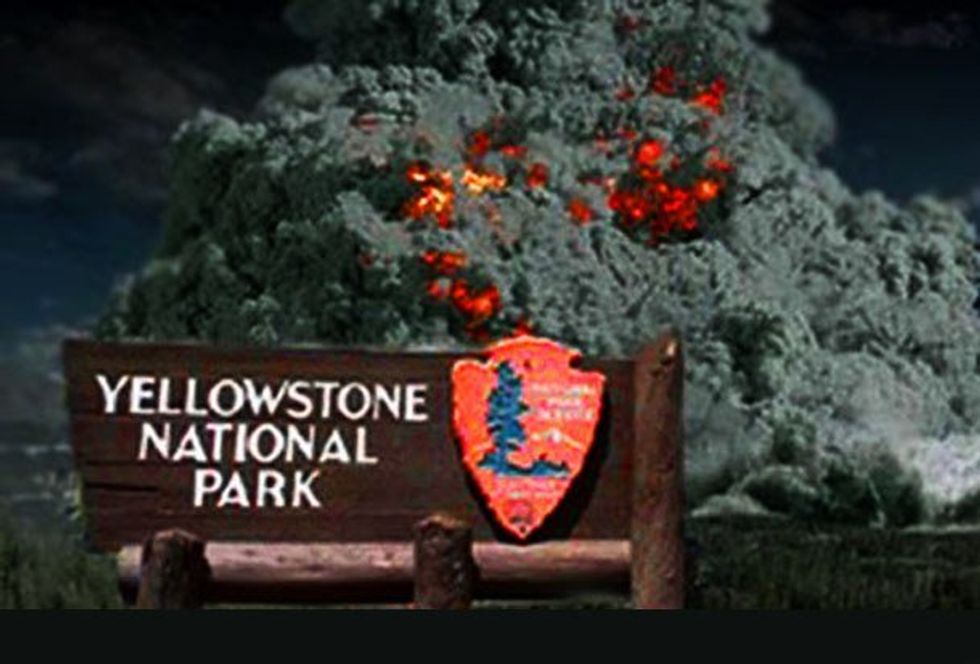
Many people are not aware that Yellowstone is actually a volcano, sometimes referred to as a “supervolcano” due to the large chamber of rhyolitic magma it carries underneath. It has been approximately 640,000 years since Yellowstone has had an eruption, and the question that arises is not if it will erupt again but when. The impacts of a Yellowstone eruption on the United States and globally today are catastrophically dangerous.
The supervolcano located in the heart of Yellowstone National Park releases around 45,000 metric tons of carbon dioxide each day, but the magma chamber directly underneath the ground is considered too small to produce that much. In April 2015, geophysicists uncovered a secondary chamber deeper underground. The chamber is so large that its partly-molten rock could fill the Grand Canyon 11 times. If Yellowstone were to erupt, experts claim that the explosion will be 1,000 times greater than the 1980 Mt. St. Helen eruption.
Today, the chance of a volcanic eruption at the site is a one in 700,000 annual chance, experts say. This starts to give an insight of what would happen to the earth if this supervolcano erupted.
According to experts from the US Geological Survey, the chance of an eruption is very slim but also very plausible at the same time. The results of said eruption would leave most of the United States covered in ash with most areas close to the source buried in over a meter of ash. Seismograph finds would hopefully give scientists enough time to warn people close to the site to evacuate. Unfortunately, a large number of people would perish due to other causes. The amount of ash in the air for several days after the explosion would hang in the air making it difficult to breathe. Vegetation would be smothered and water supply would be polluted by the blanket of ash. This would quickly lead to a nationwide food crisis.
In addition, air transportation and electronic communications throughout the whole North American continent would be shut down. The entire globe would experience major climate effects.The rest of the world would be faced with years of climate change caused by the tremendous amount of ash. The ash cloud which would literally wrap around the globe, could cast a shadow and alter the chemical composition of the atmosphere for up to a decade.
The eruption in essence would be powerful enough to create its own winds and dominate weather patterns in the United States. The winds that are created would then form large dunes of ash and cover roads and buildings. If said eruption was to occur, the United States would have to rely heavily on foreign governments to come to our aid to help with the cleanup. Without help, the midwestern section of the U.S. would host inhospitable conditions for up to a decade. New vegetation does not start to grow again until about 10 years after a super eruption, and that is dependent on how much rainfall the area receives.
Even though an eruption from the supervolcano underneath Yellowstone National Park is quite unlikely, it is still an event that cannot be ruled out. Scientists and geophysicists keep a close eye on the area every day in hopes to prepare for a future catastrophe. The effects of said eruption would not only be devastating to the United States, but the entire world as well. In light of a horrible event, people around the world have to pull together and come to each other’s aid.