



Recently, European astronomers using the TRAPPIST telescope discovered three exoplanets- planets in solar systems other than our own- which all orbit their dim red star at just the right distance to be habitable by humans. Scientists are already discussing their potential as human colonies, but this has also brought an old conversation back to the forefront: the possibility of alien life on other planets.

These three exoplanets are being considered by some to be the best targets for the search for extraterrestrial life, due to their temperatures and sizes being comparable to those of Earth. Because of their sizes and locations in their solar system, they have near perfect conditions to maintain liquid water, long considered to be one of the necessities for life. However, the nature of the star these planets orbit has raised some questions over what alien life on these planets would be like. Their star is much smaller than ours, and might not provide enough energy to support what we would consider the "normal" chemical processes that make life possible- like photosynthesis. Instead, they might be "infrared" in nature, adapted to gather energy from their dim sun.
This is something that few sci-fi movies even consider: that alien life might be somehow fundamentally different from life on Earth. Aliens in movies or on television tend to be more or less human- they have two arms with hands, they have two legs, they have a head at the top of their body, they have two eyes and a mouth. They eat food like ours, they see things like we do, they often enjoy the same music and games we might. The most exotic you might see is a giant crab, or lizard, or some combination of the two, or some other mundane animal given a space suit and a raygun.

But why would life that evolved on other planets, completely separate from our own development, be anything similar to life as we know it?
It most likely wouldn't.

Even on a planet with liquid water, where life evolved (somehow) with the exact same carbon based biochemistry as humans, that life might be completely and utterly unrecognizable. Why would they have eyes? They might all "see" using echolocation, or heat signatures. Why would they have legs? They might travel through the air, attached to balloons filled with nitrogen. Why would they have mouths? They might absorb all nutrients through the soles of their feet (if they even have feet).
And that's just assuming they have identical biochemistry to ours, and evolved on a planet almost identical to the Earth. Life could theoretically arise anywhere, in any strange situation. Life might arise on a planet covered in oceans of liquid nitrogen, and navigate entirely based on magnetic forces and eat only frozen oxygen. Life might arise on a planet devoid of an atmosphere, and survive by burrowing through solid stone at enormous temperatures, eating gemstones and basking in lava-light.
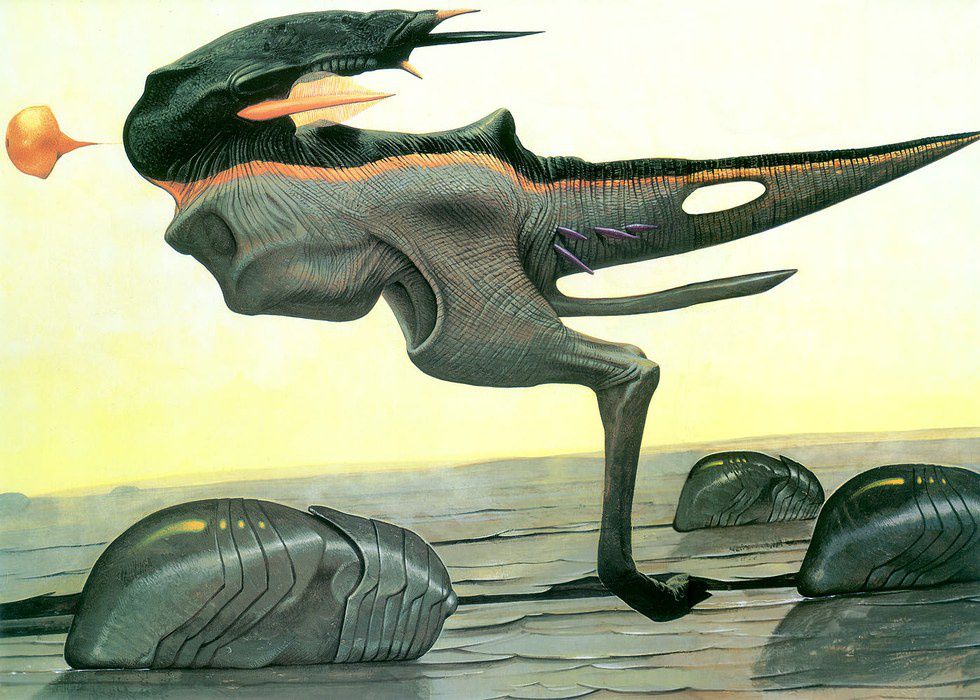
Sure, the three planets recently discovered by TRAPPIST might have liquid water, but they're just as likely to support life forms as any other planet in the universe. Life might come from anywhere, and it might look like any thing. Don't be too surprised if scientists discover something on a far distant planet, and don't even realize it's alive at first.

















