

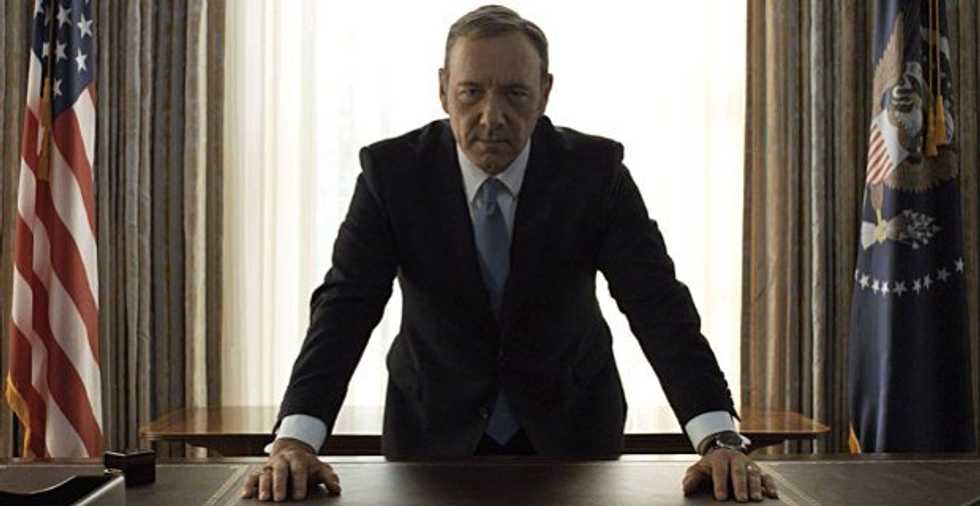
Frank Underwood has been making some public appearances as of late, in preparation for Season 4 of "House of Cards." While Kevin Spacey is always a pleasure to see more of — his performance as Underwood is hypnotizing — these teasers for the new season of "Cards" also serve as a reminder that the show has a lot to recover from.
Season 3 of "Cards" was, to say the least, underwhelming. Story arcs were convoluted and muddled by holes in logic, characters were erratically developed, and the show just lost that magnetic effect that it had in its first two seasons. Where exactly it went wrong is hard to say, more likely a combination of things, but it’s safe to say that Season 2 set the third one up for failure. With Frank stepping into the Oval Office, his rise to power was complete, his revenge fully exacted – the stakes lessened.
The show began with Frank’s snubbing for the position of Secretary of State; a Macbeth-like character’s wronging that would drive him towards revenge. Frank is ambitious, that much was true long before his being slighted, but that moment signaled a changing of the rules. Like Macbeth being told he would become king, Underwood’s denial of the position was a moment where the structure of fairness and social laws collapsed. When this occurred, Frank was let loose of the system he was promised would reward him, and he began his climb up the political ladder.
What made the first two seasons of the show so compelling was witnessing Frank as this Machiavellian, Shakespearean, ruthless character. The direction and cinematography were great as well, but it was the character and his soliloquies that engaged viewers. All of which is to say, "House of Cards" only works as a character study of a man who seems larger than life – as well as those other interesting persons such as his Lady Macbeth-like wife. Season 3’s focus on using FEMA funds to support a program for jobs and Frank’s bid for re-election lost focus on what people really enjoyed about the show.
With the show’s central focus being Frank, the audience’s investment is set entirely on him achieving – or not achieving his – goals. If the central character doesn’t have a direction, the viewer has very little to set emotional stakes in. When Frank ousted the president at the end of Season 2, his arc – as far as the show had set it up to be – was over. "Cards" is set in the United States, thus we know that the president can only be in office for eight years at maximum. Unless the showrunners plan on bending reality and having Frank declare himself king of the U.S., the show lost its tension as soon as he reached office.
Frank’s two motives were: vengeance against those who used him, and the power/status that came with office. Having completed both upon acquiring the presidency, "Cards" loses its power. We know Frank has succeeded – whether or not he holds office for two more full terms is somewhat irrelevant. If his days as President are numbered by term limits or by incumbent challenges, either way the audience knows well that he can’t stay there forever – what was enticing was the journey to get there, the will he or won’t he. What satisfaction do we really get in seeing Frank keep power, when he will have to give it up anyway at some point in the future? Our investment in Frank is lessened by the fact that he has absolutely nowhere to go upwards.
Season 3 demonstrates this problem with direction as we see a character, formerly a sort of underdog using wit and tactics to undermine those with power, in a position of total power trying to dominate those with less. As viewers, it is less compelling to witness the exertion of power than the assumption of it. We want to identify with, relate to, or imagine ourselves as this character who is able to overcome the forces trying to submit him. As president, Frank is the one in power,
however, and his maintaining that position weakens our ability to sympathize with his dilemmas.
Considering the blatant Shakespearean influence, "Cards" should’ve known that there could only be the plot of ascent or decline. Traditionally, like in "Richard III" or "Macbeth," Frank would have risen to power and then fallen due to his arrogance. Conversely, in a plot of decline, Frank would’ve started out as president and then fallen from grace into poverty or obscurity, but ultimately redeemed his character – think "King Lear." "Cards" stopped the former plot structure, leaving Frank at the top, and didn’t hint too much at the latter structure being an option.
If "House of Cards" wants to succeed in its fourth season, it needs to readdress its sense of story structure. The truest way to keep with its Shakespearean influence would be to execute a sort of plot of decline with Frank. He has to fail, fall from his high stature, and then understand something about the world or himself that redeems him – not fully, seeing as how he’s murdered someone by this point — in some way. If Frank maintains the presidency in this season, and all history of the show points that direction, there is very little for the audience to care about. Watching a great character succeed against obstacles is the basis for storytelling; watching a great character knock over every hurdle and still win seems like cheating.