


The other day, I had an engaging conversation with a Christian preacher who showed up at my doorstep. I am not religious and no, she did not convert me. Which is what made it even more surprising. Anyone who has seen fights between secularists and religious people online and offline can vouch for the vitriol exchanged. When my doorbell rang that afternoon, I expected it to be the delivery from Amazon for either me or one of my roommates.
However, on opening the door, I was surprised to find an elderly woman smiling at me. “Do you have questions about the Bible?”, she asked in a hopeful voice. “Great!” I thought. “Just the thing I needed as I am studying for two midterms this week.”. I was born in an Indian Hindu family but am myself not religious. I was about to tell her that I had a class and did not have time. However, partly because I didn’t want to sound rude to an elderly woman I ultimately decided to invite her in. Surprisingly, I didn’t regret it what followed was an interesting conversation about faith. I questioned her on various things in the Bible and she answered without it delving into a fight with name-calling and ad hominin attacks. “Doesn’t the Bible promote misogyny with passages advocating stoning to death as the appropriate punishment for adultery?” I asked her. “But Jesus forgave an adulterer when she was brought in front of her,” she countered, referring to a well-known story in the Bible.
What about slavery? There are pages after pages in the Bible referring to this brutal practice that was widespread in those times without ever condemning it? Surely, it should have condemned an institution as inhuman and exploitative as slavery? “That’s not true!”, she protested. She insisted that many abolitionists used the Bible to justify their crusade against slavery. So did many of their opponents I said. She hesitated for a moment. I couldn’t help but smile. She had a much harder task of defending a book written two thousand years ago than me who had to just poking a few holes in it.
Then we came to the elephant in the room: homosexuality. Didn’t the Bible categorically condemn it as a sin and hence condemn gay people as sinners? “It doesn’t condemn gay people” was all she could manage. I realized we couldn’t make much progress on this issue. In any case, my next class for the day was to start soon so we wrapped up our conversation. She thanked me for my time and handed me a few pamphlets and asked me to check out the website of her organization before taking her leave. Neither of us made the other abandon their position. Yet it didn’t delve into the mudslinging that often happens when religious and non-religious people talk about faith.
This made me reflect on the importance of conversations in resolving differences. Short of being at each other’s throats, dialogue may be the only way to resolve our differences. It is not limited to just dialogue between people. For example, the only alternative to dialogue, which the US wisely chose to resolve the vexed issue of Iran’s nuclear program was air strikes to eliminate Iran’s nuclear program. When it comes to the issue of religion, politics or other closely held personal beliefs, the key is to respect your counterparts and keep an open mind and, at least, hear their point of view.
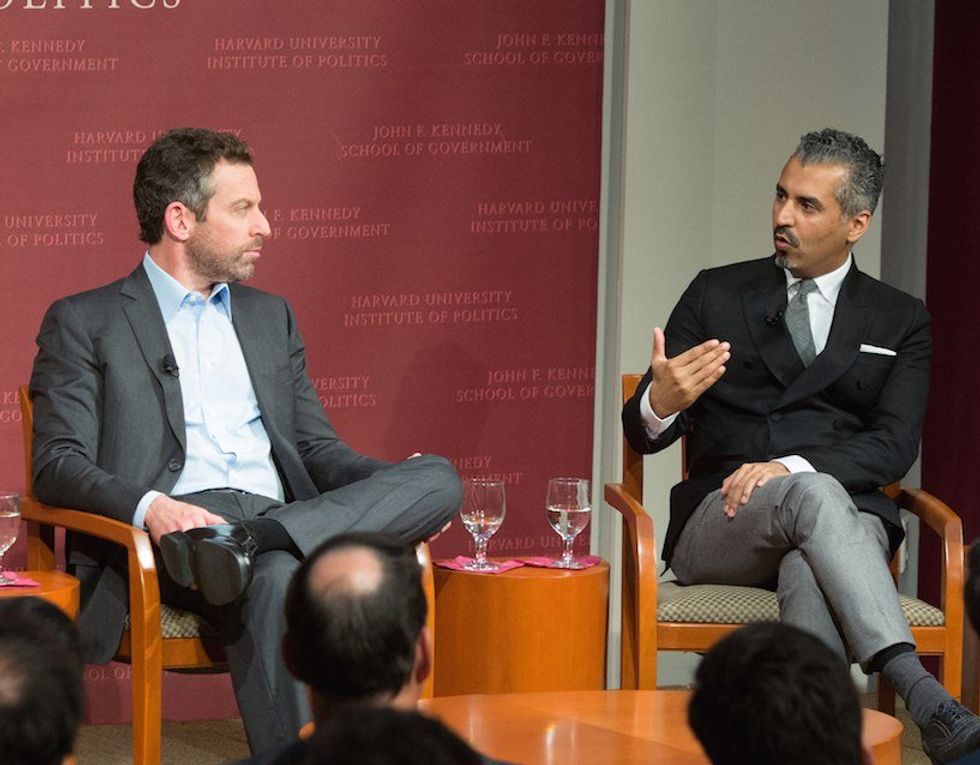
For centuries, it was religious people who were guilty of not subjecting their beliefs to any critical reason and shutting down any conversations challenging them. However, in recent times, atheists and secularists have been at fault too. The Dawkins approach of simply dismissing religious people with contempt may actually be counterproductive and turn away religious people who may otherwise have been open to having their faith questioned. In this regard, Dawkin’s fellow ‘New Atheist’ Sam Harris has been more open to dialogue with people with different ideas. Harris, who has been a fierce critic of religion in the past has just co-authored a book entitled ‘Islam and the Future of Tolerance’ with British Muslim reformer Maajid Nawaz.
The book is a dialogue between them about Islam, its doctrines and how to advance secularism and human rights in the Muslim world. In it, Harris and Nawaz go back and forth about the doctrines of Islam while remaining mutually respectful and most importantly without delving into name-calling. One need not agree with the perspectives of both the authors to be enlightened by reading it. Harris acknowledged that his perspective has changed as a result of the conversation and he now focusses more on Islamism or Political Islam than the religion of Islam itself which he remains a critic of.
Silence is not an option either as some of these topics, like the one Harris and Nawaz discussed is one of the most important discussions of our time. So the next time you decide not to associate at all with someone because you find their views antithetical to your own, thinks again. You may end up having a civilized and productive discussions like me and the preacher had or even better like the one Harris and Nawaz had.

















