
Elon University has a high density of communications and business majors; communications takes 1,200 students (about one-fifth of the whole university) where as my major, Environmental Studies, has 34 in my graduating class. While a majority of my classes have been in the school of arts and sciences and abroad, courtesy of my liberal arts education I have had the privilege of taking classes with students from probably almost all of the different majors offered. After four years, I have noticed an interesting trend.
Collaborating with someone from say, the business school, on an assignment is a lot different that working with a fellow “sciencey” person in one large regard: citations. I have written entire papers with students where I have pulled scholarly research, peer-reviewed texts, etc., written in text citations for all of the information I draw on and they do not have a single one. The sources they then drop at the end of the document would be laughed at by any of the professors teaching in the sciences. I was fascinated as this continued in other cross-disciplinary classes I took.
Whether it is independent research, a lab report or a lit review there have been three things reinforced in every science class I have ever taken:
- In independent research, lit reviews, anything you write, you cannot make unsubstantiated claims. Period. If you’re going to say something you better have the evidence to back it up and it better be of quality and the more evidence the better.
- Nothing is black and white. Your ideas should develop and grow with new information and take all that you read with a grain of salt.
- Science isn’t exact, there are a plethora of variables that complicate each situation and we may believe things today and in a few years, other research might shed a new light on findings.
There is a certain humility inherent in scientific work; you must fit your research into this wealth of knowledge accumulated for generations and you must also back up anything you say with data and/ or someone else’s research. Nothing stands alone and all research lends itself to some sort of application and implication for future research and development of our understanding of human or natural phenomena.
Now I will acknowledge that not every science major follows these principles every moment of their waking life; we don’t research every comment we hear but I believe that this exposure and philosophy creates a unique mentality that gets translated into everyday life.
I will also acknowledge that I am probably painting an overly simplistic view of other majors at Elon. Although, I have had conversations with business majors and communications majors where they’ve said that citing information is rarely emphasized, and I think that this can be justified more often than not but I think the implications of not needing citations are interesting.So let’s entertain for a few hundred words what a world where the three points above were adhered to by all.
Imagine a friend comes to tell you a “fact” they heard from Ted Cruz in a recent interview. There has not been significant global warming in the past 18 years.This would meet the first criterion; they have a source for their claim. However, how do we imagine this person is expressing this fact? Heatedly? Probably out of anger from something you’d said or you overheard someone say?
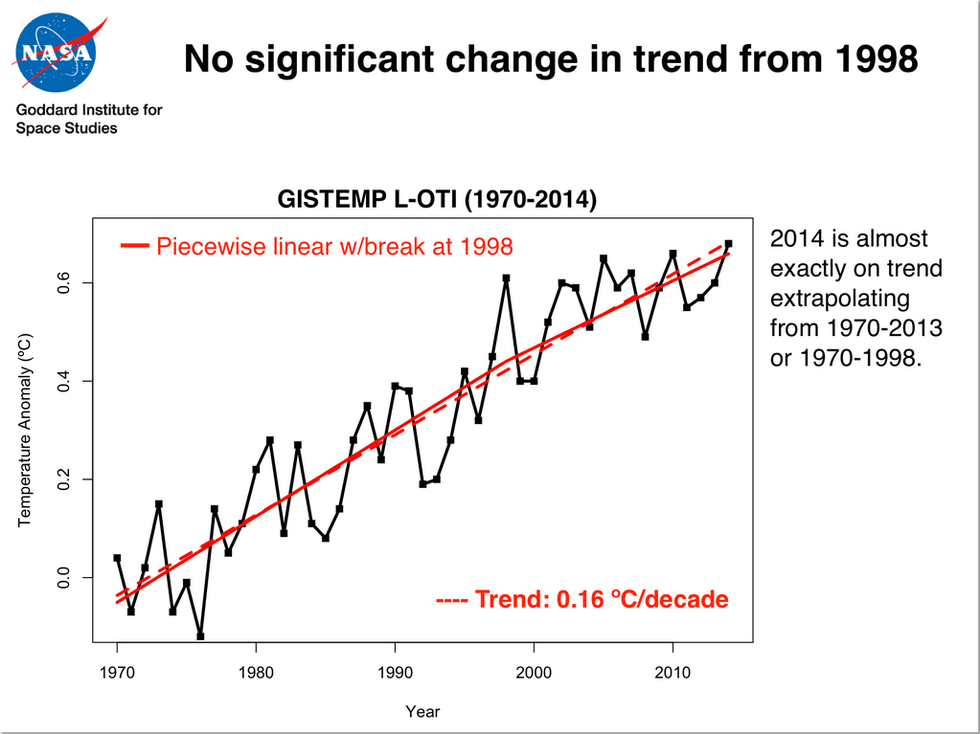
Well, what if you came back with this chart (the title is a direct challenge to the senator’s claim)? And also shared the fact that 1998 was an El Niño year, exceptionally warm in much of the world, giving an unrepresentative starting year. What would their response then be? Dismissive?
If we were all brought up with the humility of the scientist, receptive to new, scholarly information, I would venture that this new information would soften their skepticism.There is a wealth of information refuting their claim and they would find their own nature absurd if they adhered to the first two points above.
Or maybe they really believe that leading world meteorologist Ted Cruz is right, is there another principle the scientifically minded would adhere to that could sway them?
There is - the precautionary principle. This idea states that when given uncertainty or conflicting science you want to side with the option that does the least damage. So when the options are between ignoring climate change and assuming everything will be peachy in 50 years versus climate change is going to deteriorate air quality, exacerbate species extinctions, destroy coral reefs, flood entire countries, etc. you would want to assume that the latter idea will actually happen and work to prevent those outcomes.
This is why even though there was no outright ban on BPA, a toxic chemical in plastics, most people still avoid it. Research has been conflicting- this is largely due to biases in research done by special interests groups, with scientists linking the chemical to cancers and corporately funded studies finding no concern, regardless of the nature of the studies, in the effort to be safe, people have avoided the stuff. The EU has even banned it.
Anyway, what I am trying to say is when you have a scientific mindset you take some of the edge off dogma and biases.You know that things are complicated and one point or “fact” you heard might not tell the whole picture.There is receptivity to new information; the passion of those frustrated environmentalists talking about climate change comes from a wealth of studies, research, and backing what they say.
Let’s think about some different contexts for this mindset, say your boss has you working horrible hours, holidays, etc.You come to them and politely express your distress and then share how studies have found employees who work reasonable hours and maintain a work-personal life balance are more productive in the long term. Now if he/she had the humility of a scientist and was respective to new, factual information and didn’t see it as his/her way or the highway, your schedule would be adjusted, or at the very least he/she would explain why he/she can’t make the changes right now, but keep the information in mind when there are more people on the payroll. Information is received, analyzed and acted upon, there is no room for “this is how it’s always been done.”
But it goes beyond the way we would interact with others. One WebMD search tells you that ginseng supplements will help support your immune system and may lower blood sugar. Good. Supplements are great. Go buy some. But the scientifically minded person would probe further, one source cannot answer all of your needs, and if you were to buy your ginseng supplement at Walmart, Walgreens, GNC or Target, you ginseng supplement wouldn’t actually contain ginseng.
Let’s take Adderal, a somewhat controversial drug that is lauded by many doctors as a cure to attention disorders, helps countless, and is abused by more. But is it always the answer? Without detracting from the enormous help that the drug has done for people who truly need it there are many cases of people who had “attention problems” because they did not fit a western education model; they were artists, dancers, athletes, who could not be crammed into the box of our math/science education system.
What of matters of consciousness? The religious and moral fervor that surrounds issues like the death penalty and abortion are interesting in this hypothetical world. Is it simply pro-life versus choice? Or is one forced to consider what constitutes life? What are the statistics on many aborted fetuses futures? The burden on those families livelihoods? Etc. What is the cost of a death penalty trial compared to that of a lifetime incarceration? You get the picture.
You see science and morality are inherently intertwined and despite branding them as conflicting, science and morality are synonymous. You see the “right” and “wrong” that morality attempts to define cannot exist without consideration of implications, facts, and ideas. Society needs information for morality to blossom and develop constructively.Therefore, a scientifically minded society does not shirk morality; rather it has a more informed development of personal principles.
Morality told too many of us that slavery was acceptable, that segregation could be law, yet the informed, questioning, ethical, moral mind challenged this. We are too often taught ideals are politicized, static and already set in stone.
Are they? I would confidently say no. And for that matter would anyone want to live in a world where we got it “right” and there was no more change?
Whether it’s a political issue that ends with both people developing a new point of view, or leading your dogmatic uncle to trade in his old truck to save gas money and help the environment or just developing a more informed consumer and voting base that thinks critically, scientifically, and is open to new evidence and ideas if this mindset were universally applied, or even sometimes applied it would revolutionize the world and the way we interacted. Imagine politics, where seriously talking about climate change wasn’t a “liberal agenda” and it was taken as the scientifically backed problem we need to privately and politically address.
One does not have to be a scientist to think openly and critically though, that would be absurd, but the way science and scientific research is taught forces a consideration of opposing research and ideas, the development of your own in the context of the entire body of scientific literature and has incredible implications for impacting the way we interact as people.
So while you can do all of this without setting foot in a lab (and some of the people who embody this model best never have or will) I hope some of you will when confronted with a decision about your health, politics, anything, you’ll stop and think, “what would a scientist do?”