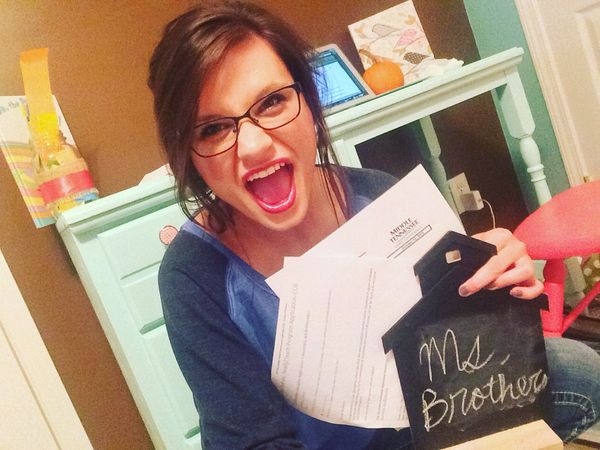

I was lucky enough to land a near-dream job before I was even officially a college graduate. Tomorrow, I celebrate one full month of my professional, post-grad life. The weirdest part so far is that I spend every afternoon staring across my desk at a student tour guide, who is doing the same job that I did at my alma mater only five months ago and chatting with her the same way I used to do with Fitchburg State’s Admissions counselors. Those counselors were, and still are, my mentors, but also now my colleagues – or my competition, depending on how you look at it.
The first thing that happens when you make the transition from student tour guide to actual Admissions' counselor is that you immediately become irrelevant. When I was a tour guide, I used to joke all the time that counselors handle the tough stuff like scholarships and transfer credits, and I was able to have all the fun with the tour group – well guess what, it’s mostly true. I do get to have a little fun with our guests and I love giving information sessions, but it’s certainly not of the same lighthearted nature as being Tour Guide Barbie.
The reality is this: even though I was a college student exactly a month ago, things have changed even since then and prospective students and their families don’t want to hear it from me anymore. The questions I am asked are more along the lines of “are these merit scholarships renewable?” and less of “how do you like the food?” which is a shame, because I really love talking about food.
It’s crazy how quickly the tables have turned. Snapping myself into this reality has been hard; for so long I was the “expert” in the college experience because I was living it. An energetic, almost carefree approach to college was acceptable and even desired, and that was what I shared with visiting families and high school students. While I’ve still maintained the energy level, my perspective has been completely reversed and I’m expected to represent a university on a different level; I'm an expert of a different kind. Now, I’m the person waiting at the office to handle any crazy questions or conundrums, rather than being able to pass them off to a counselor and run for the hills. That part alone has been a tremendous learning experience. And you wouldn’t believe some of the questions we get, even if they’re not difficult in nature; recently, a coworker got this one: “How many cows are there on Plymouth State’s campus?” Um, none, but Alvirne down in Hudson has got some.
This spiel certainly is not meant to be negative, because there are so many upsides to doing this professionally. For one, I now have an office with a desk in it that's mine, and only mine. Those of you who have been tour guides probably share the common frustration of sharing desk space with five (or fifty) other guides, and it’s all part of the experience. I’ll reiterate the same point I opened this article with - now the tour guides sit in my chairs in my office, talking to me about their lives and their tour groups while I sit and wonder where the past four years of my life have gone. Wasn’t I just doing that at Fitchburg State like, two weeks ago? I feel so old.
There is also a really neat sense of validity when you get to put on that professional name-tag and stand in front of a group to do a presentation. Another core aggravation that all tour guides have probably faced at one time or another is a distrustful prospective student or family member who seems to just invalidate everything that you say for no reason other than that you are a “student” tour guide. Obviously, that’s bogus and as I said earlier, the students really are the experts; we counselors are there to handle everything that goes on in the background. That’s another hard pill to swallow for someone like me, who has gotten a little too used to being in the spotlight as a tour guide, Orientation Leader, whatever.
But the torch was once passed to me, which is why I’m here now, and it’s time to pass it again so that some other student tour guide can someday have this opportunity, too. I started doing tours because I saw that it gave me the potential to impact someone's future, and that part of the job has only gotten better as a professional.