Being from an upper-middle class, upper-middle socio-economic background, I am aware of the privilege I carry when I come from a small percentage of the total population of India. So, when I say that for me, being Indian means a paraphernalia of strange, disparate things that are brought under one roof for no apparent reason other than a short answer of "just because" I know I don't speak for everyone.
The long answer for the khichdi (read as melting pot) that is India is its long, long, long (Indian students between elementary and high school can attest to this) history of colonization, invasion, drawing and re-drawing of boundaries where none before existed, and so on... India is a palimpsest, and the map you see now, with new lines starkly drawn beside the barely-rubbed outlines of its past holds the strangest mix of cultures you'd ever see.
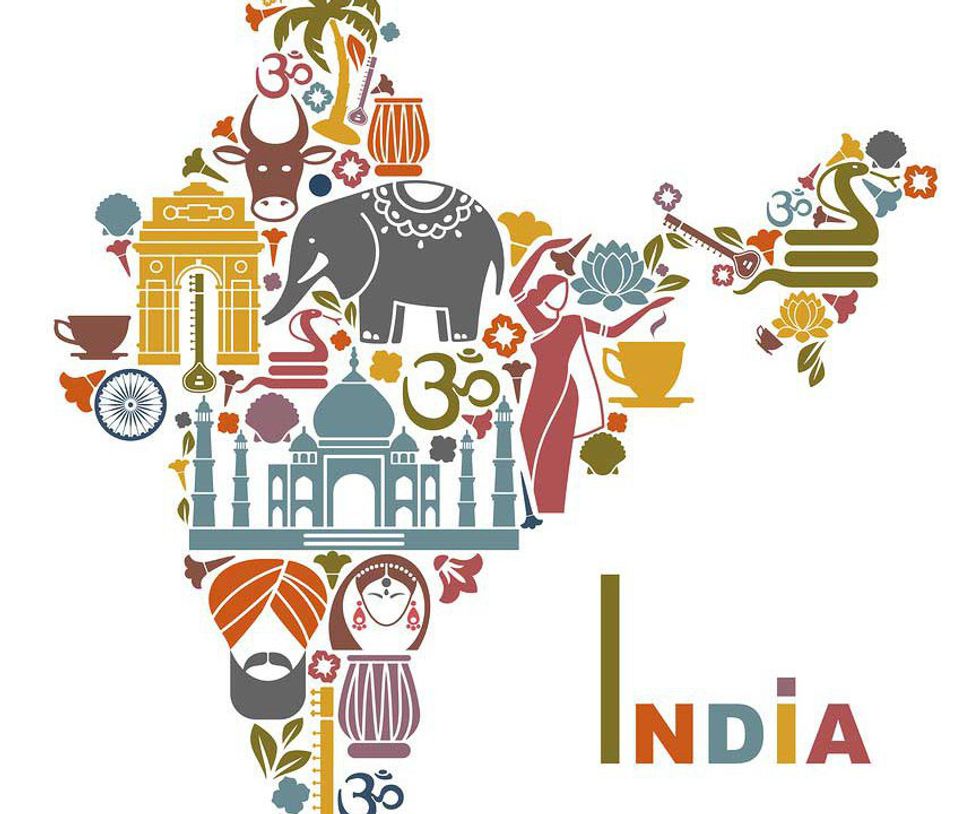
I only recently realized how strange some things about India, and especially my experiences as a child, were after speaking to an American friend at college. She expressed her confusion and curiosity about how I knew bits of the Bible and hymns and psalms by heart while I came from a non-Christian family, and had never really followed or believed in the religion. The readiness with which Indian families--like mine-- sent their children to private schools that were affiliated with a certain religion--like mine, a private Scottish missionary non-denominational Christian school-- even though their own personal family culture and religion was nowhere close to that which their children were imbibing astounded me.
I grew up in this school for 12 years, singing the Lord's Prayer and several psalms and hymns every school day of those 12 years, and never once questioned why I, an agnostic from a Jain family, prayed to a Christian god every day. School holidays ranged from Eid (Muslim festival) to Diwali (Hindu festival) to Mahavir Jayanti (Jain festival) to Christmas (Christian festival) and all were, if not celebrated, then given importance, in some way or the other.
In my part of India-- Bombay-- this melange of cultures is so deeply ingrained that I needed to physically move continents to really absorb how diverse my life has been up to this point. What heartened me was that children, at the very least, do not think much, if at all, of this. There are multitudinous religions and cultures–including certain practices, foods, holidays, lifestyles–should become so apparent in everyday life that diversity becomes the norm is, in a way, a step closer to beginning to see everybody as equal.
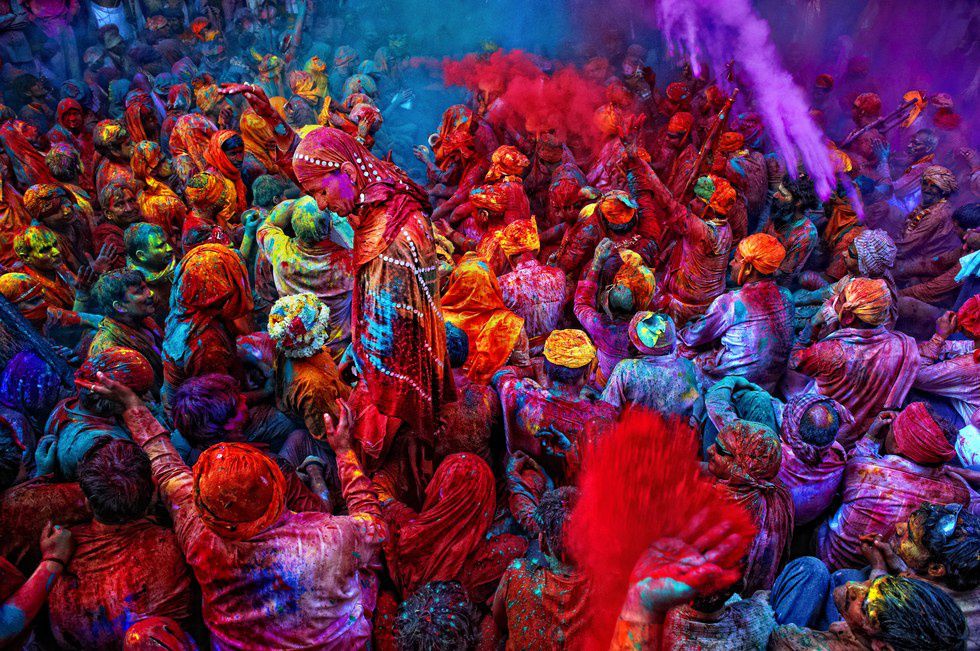
Though complete equality is nowhere close to realization, the fact that India's diversity is so fully-fledged and self-contained makes me immeasurably happy and proud. When foreigners talk about India's colourful stereotype, I don't disagree and say there's more to India than it's "colours"-- it simply reminds me that even though Holi is originally a Hindu festival, being Hindu isn't a requisite for being an Indian and enjoying something that ties everybody together. Being anything isn't a requisite for being an Indian; I adore every part of it's identity that has, no matter the turbulence, always precariously balanced itself.
I love that India has a Mughal, British, French, Portuguese, Parsi, Sikh, Christian, Scottish, Hindu, Jain, Buddhist (need I go on?) history. It simply reinforces the fact that Indo-Chinese food tastes amazing, that most kids who went to Indian Christian schools know Psalm 23 better than their own names, and that Diwali or Eid means amazing food at home no matter what your religion.