

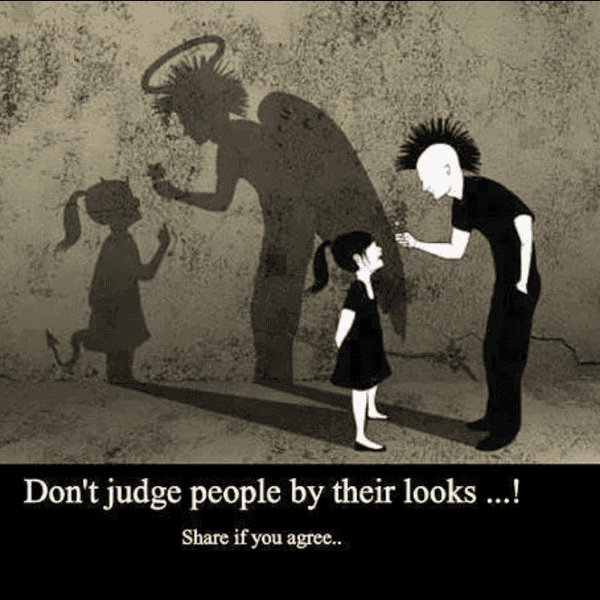
Everywhere I look, I see people pointing fingers and throwing terms around that are designed purely to describe groups of people as "other." Let me say up front that I'm not excluding myself from this; I do it, too. It's a human thing, not restricted to any particular demographic. Many of us like to claim that we're different; we don't label, but it's time to face the facts: we, as human beings, have a thing for putting people in convenient little boxes. We meet people, assign them to a category, and dictate all further interactions based on that category.
Obviously, some labels are more dangerous than others. A Muslim individual being labeled a terrorist by the majority of white America experiences incredible difficulties in day-to-day existence purely because of a label they personally did nothing to deserve.
Other labels are less obviously problematic, such as the label "poor person," which, based only on the words I have typed there between the quotation marks, might be an entirely accurate evaluation of a person's financial situation. That person may truly be poor by American standards. However, this label often comes with such assumptions as "freeloader," "lazy" or "unintelligent." These assumptions can be incredibly damaging to a person trying to overcome that label, even affecting their ability to find work.
Of course, the labeling problem goes beyond these big issues that most of America is aware of. Perhaps, before we can tackle these bigger—and very important—issues, we should look at the smaller ones we experience in our everyday lives. We are all labelers, and labels come with assumptions that can forever affect our interactions with the person being labeled. In order to take control, it is vital that we understand why we do this.
Perhaps one of the best explanations I've so far discovered relates to a theory called Uncertainty Reduction Theory. This theory explains that one of our primary goals during our first interactions with new individuals is resolving our uncertainty about them. The state of being uncertain generates what is known as "cognitive dissonance," a kind of psychological discomfort.
To put it simply, we don't like not knowing things. When we bump into the unknown, we do our utmost to make it familiar. Think about it -- when you meet a new person, before they even speak, you are evaluating them based on their clothes and how they carry themselves. Your first exchanges occur along the same lines as a twenty-questions game, broad questions that grow more and more specific until you find the information that gives you your answer. Boom. Gotcha. That person is a "feminist," or a "nerd," or a "Christian." Everything we think we need to know about someone wrapped up in a convenient little label that sometimes even decides whether we seek that person out again!
I find myself doing this at school constantly. If you're a college student, I'm sure you're used to being asked what your major is by now. We ask it of each other so we can find what box to put each other in. Every school has its own convenient set of built-in labels, assumptions to go along with the terms "music major," "science major," "comm major," "art major," etc. These groups quickly splinter off from each other because they've been labeled, and why would they interact with another group that considers them separate, that assigns all these assumptions to them without taking the time to know them? And so we stick to our own kind, the people who understand us, the people who see past our stereotypes, and we keep the "other" at arm's reach. I see this happening, and I see myself contributing to it, and I am frustrated. Perhaps we need to approach our interactions with a new goal in mind and a new script on the tips of our tongues.
So, from here on out, I am going to try to challenge my own assumptions. Whenever I start to feel comfortable with the identity I've assigned someone in my head, I will seek out information to challenge it. I will make a real and concentrated effort to know people for who they are outside their stereotypes. I know I won't always succeed at this, but I will do my best.
My thought is this: perhaps if we can do this in our little day-to-day interactions, we can eventually affect even the bigger issues, the issues people in this world are dying for. If we can change how we relate to people and start treating them as people, rather than as a faceless group with a label, maybe we can change how the world works. And, maybe, someday, the television will tell us different stories than the ones we see now, of warring groups who have assigned each other such violently opposing identities that they no longer either see each other as human. These groups demand of us that we take a side, but I want to be on the side of the individual, of the person who has a life and dreams and who desires meaning—I want to know people for who they are.

















