
“Archimedes was an ancient Greek thinker, and he taught us that if we lean on the right levers, we can move the world” - Andrew Youn
“For those of us who believe that our identities are not mutually exclusive, we have to all work together to ensure that globalization takes everyone with us and doesn't leave people behind.” - Alexander Betts
We have failed as a human race. I have come to this conclusion after watching a total of thirty minutes and thirty-six seconds worth of TED Talks videos and it goes without mention the recent Brexit referendum. We have failed as a human race, this is a concept that many of us have yet to acknowledge and start exercising solutions in order to help ourselves. With that being said I would like to tackle the following failures: poverty, focusing on Sub-Saharan Africa and globalization, using the recent Brexit referendum as an example
As I stated before I’ve recently watched a total of thirty minutes and thirty-six seconds worth of the TED Talk videos, one of them titled, “3 reasons why we can win the fight against poverty” by Andrew Youn, one of the founders of the organization One Acre Fund. In the video, as you might guess, Youn addresses the problem of poverty focusing on Sub-Saharan Africa and he brings up a very interesting idea as to how to tackle poverty in this area. His first point is that most of the world’s poorest are farmers, the people who are responsible for growing and producing our foods are the ones who are in most need. The reason for this is because they either don’t have good conditions for farming in order for them to treat their crops correctly, or they might not have the appropriate knowledge as to how to maintain their crops and make sure they are safe from pest. Therefore less to no productive farmers lead to poverty, so how do we make these farmers more productive? Well, that brings us to the second point, “humanity actually solved the problem of agricultural poverty a century ago” (Youn), we have created hybrid seeds, fertilizers that if used responsibly can lead to huge yield gain, and lastly farming practice, which translates to farmers knowing how to correctly plant their seeds and how much compost to use in order overall gain increase agricultural productivity. These are known as “the three most basic factors in farming” (Youn).
These three factors have helped many regions around the world, then why is Sub-Saharan Africa still in poverty? One reason is, many of these farmers live in remote areas where they are not able to have access to these basic factors, which brings us to the third point. All we need to do is deliver these resources to these farmers. All that is needed is the will and time to do it. By delivering these resources and teaching the farmers how to effectively be able to gain more yield they will thrive and the economy and the communities will thrive as well. However, according to the United Nation’s Human Development Report “More than 2.2 billion people are vulnerable to multidimensional poverty, including almost 1.5 billion who are multidimensionally poor” (2014). We should not choose to fail, when we have the tools to succeed.
Equally important, we have Globalization up next. If you go into your browser and type in the following “What is globalization” you will get this definition, “Globalization is the process in which people, ideas and goods spread throughout the world, spurring more interaction and integration between the world's cultures, governments and economies.” (TechTarget). At plain sight many of us would agree that we have done a very good job at not allowing the language barrier stand in our way of interacting with people from different places around the world, however, in recent light of the Brexit referendum I say that we still have some work to do. This time I would for you to watch the following video “Why Brexit happened -- and what to do next” By Alexander Betts. For those who might still be unaware, on June 24th the United Kingdom decided to leave the European Union which caused many disruptions in the stock market, and subsequently the resignation of the prime minister. All this did not happened overnight, as Betts explains “Brexit teaches us many things about our society and about societies around the world. It highlights in ways that we seem embarrassingly unaware of how divided our societies are” (Betts). If we were to take a look at the map of the United Kingdom below, we are able to see which countries voted to stay and which voted to leave.
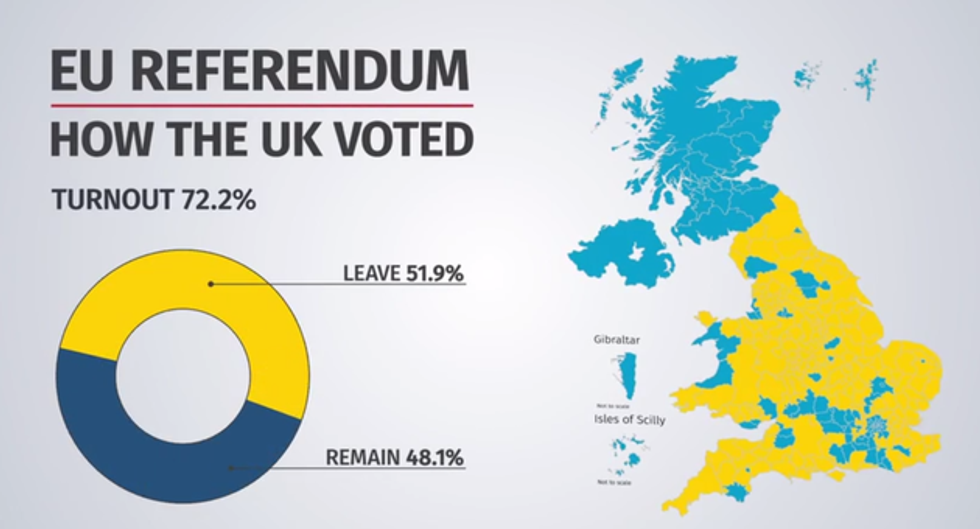
Of a turnout of 72.2%, (33.6 million people) 51.9% voted to Leave and 48.1% to Remain. “Geographically, it was London and Scotland that most strongly committed to being part of the European Union, while in other parts of the country there was very strong ambivalence.” - Betts
Something really important to recognize about this is that well nothing is black and white anymore, if you consider the factors (education, age, social class) that lead to those who voted make the decision they made they all tie back to globalization. Some people welcome the idea of globalization because they benefit from it, and those reject globalization because they might feel some sort xenophobic, or simply because they won’t have access to the benefits of globalization given their social status. So how do we change this? Well perhaps if we were to educate more of our fellow citizens of the world on globalization, and its benefits and make sure we, as a whole, share those benefits we can avoid situations as the one that is currently happening in Europe. “We need to encourage, even on a local and national level, more movement, more participation, more interaction with people who we don't know and whose views we might not necessarily agree with” (Betts) let that sink in.
So after, going over some of our failures as a human race I believe it is more than important to point out that we are more than capable of changing these things, making sure that instead of having to say, we have failed as a human race, we can actually are succeeding as a human race. Just like Andrew Youn said, it’s all a matter of time and will.