

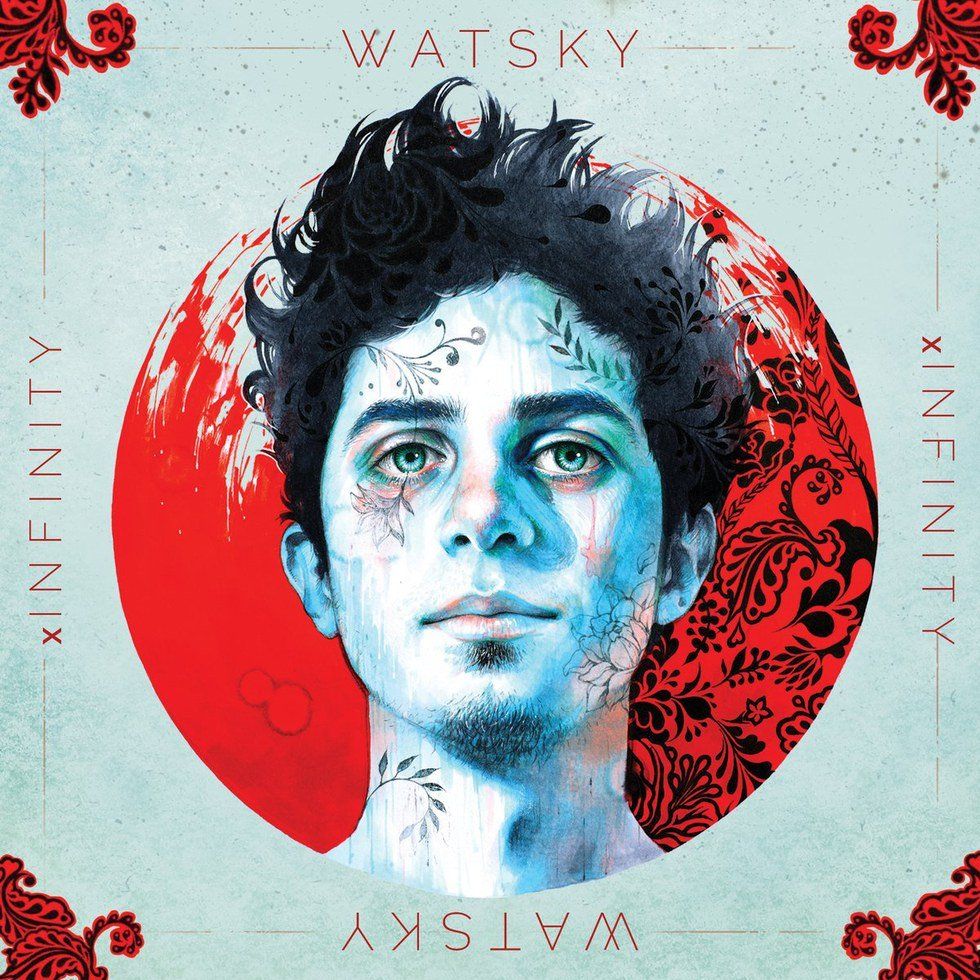
There is nothing more satisfying than saying your favorite artist’s newest album is better than the last. An artist’s progression signifies that the artist is growing up with you (the fan) and that they are trying new ideas out, changing rhythms and going for more mature lyrics that reflect a deeper sense of identity and thought process. In his eighth album – fourth studio album if you exclude early mixtapes (which are still fire) – George Watsky does exactly that. "X Infinity" (times infinity) bests his 2014 album All You Can Do, a record revolving around the experiences of early fame, which itself was a continuation of his second studio album "Cardboard Castles" in 2013, revolving around the struggles of starting out on a music career.
Watsky starts off his 18-track masterpiece with “Tiny Glowing Screens, Pt. 3.” This is a call back to "Cardboard Castles" which has parts 1 and 2, symbolizing his growth and simultaneously a reverence for how far he’s come as an artist. However, the songs that leave the greatest lyrical impact are "Chemical Angel," "Stick to Your Guns" and the four movements of the "Lovely Thing Suite." That’s right, Watsky rapped a suite, with movements, all surrounding the idea of mortality, suicide and music through the lens of the 20th century Chopin interpreter-pianist Arthur Rubinstein.
"Chemical Angel" reflects Watsky’s struggle with antidepressants: The song goes in depth into the split he feels between taking the medicine and living “through a filtered lens” that separates him from everyone else. The antidepressants make it harder for him to relate to those close to him because he is struggling to feel emotions and experience life the same way they do.
"Stick to Your Guns" shows a cynical – albeit realistic – depiction of the cyclical nature of a school shooting in the United States. Moving first from the point of view of the shooter, to a news anchor covering the story who’s more interested in media buzz, political spin and corporate sponsors. Finally, it ends with the point of view of an incumbent Senator saying that “nothing ever could have been done to prevent it” and that the shooter was just hateful and insane: “But [that he has] gotta mention that it’s sick and insane/ [His] opponent’s twisting your pain for political gain.”
Within the movements of "Lovely Thing Suite" is "Knots," which surrounds Arthur Rubinstein’s dissatisfaction with himself that would lead to his attempted suicide at the age of 27. The song features Watsky rapping over a more melancholy and ominous version of the same piano phrase used throughout the suite, before finishing in a crescendo of Rubinstein tying a noose and stepping off the chair “into the air.”
The album also features a nine-and-a-half minute – what I would call an epic – story detailing an apocalypse where Watsky and seven other rappers try to survive their new landscape and reborn society: underground colonies, goose-stepping “robot overlords” that are also clown zombies as well as lyrics dissing Iggy Azalea. The song is a lighthearted farce of the apocalypse through the eyes of millennials and first-world problems, ending with Watsky’s admission that he really isn’t that important in the grand scheme of things and that the world will be just fine after he’s gone. Through this admission, he has gotten over his personal entitlement. The song includes Watsky at its bookends and features Dumbfoundead, Grieves, Wax, Adam Vida, Chinaka Hodge and Daveed Diggs (aka Marquis de Lafayette and Thomas Jefferson from "Hamilton").
In short, Watsky’s newest album is thought-provoking and surreal, giving us – the listeners – an unimpeded viewpoint of our politics, society and culture with fast rhymes, clever lyrics and brilliantly crafted beats. I can’t wait to see him on October 24 when he comes to Boston, especially since I missed his last performance two years ago because of a flight.