The choice of simplicity in Asian art is to capture the essence of cosmic harmony by establishing a balance between spiritual, natural and physical elements to compose a work that embodies the intertwined relationship between nature and man—a relationship of peace.
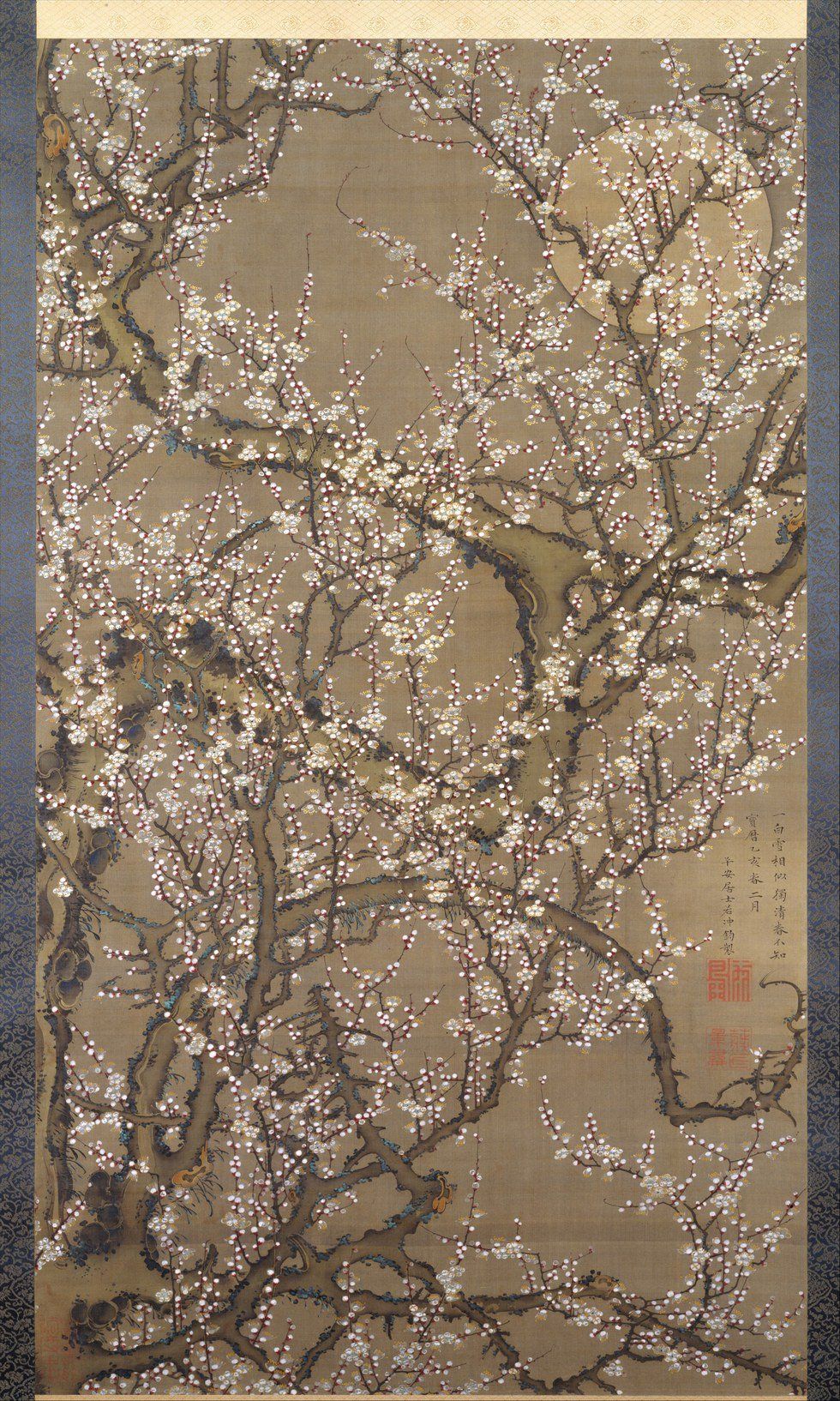
The painting, "White Plum Blossoms and Moon" by Japanese artist Ito Jakuchu (1716-1800), embodies the very essence of the Asian art form—simplicity—through an eccentric Japanese lens of perception. It is an ink painting applied on a hanging scroll made of silk decorated with both ink and color pigments. The work was painted in the Edo period of 1615-1868 and dated to “spring, second month, fifth year of the Horeki era [1755]” as translated from Jakuchu-san’s original signature located on the bottom right of the silk scroll. Jakuchu-san portrays a mystifyingly beautiful image of blooming plum blossoms in the moonlit night, on a scroll about 56 inches long and 31 inches wide, the size of which only adds to the attraction of the work towards the viewer, as if a gravitational pull was being exerted from the energy flowing through the veins of the painting’s rhythmic design.
In the motionless shroud of night, a single old plum tree is experiencing a sudden burst of life as its flowers bloom under the full moon. White plum blossoms, with white petals and yellow stems, fill the dark sky, adorned with the arched branches of a decrepit old tree. The moon sits in the top right corner of the scroll without painted color; yet, it manages to maintain a mysterious luminescence as it bears witness to the renewal of life and cycle of natural energy. There is a serene-like mood created by a brownish-grey darkness that acts as a backdrop for the gnarled plum tree outlined in black lines, colored by interwoven shades of brown and gray, and finished with touches of green moss and orangish brown plums.

The foreground of the painting is dominated by the expansive branches of the plum tree turning in the night sky without rest. The green moss and the edges of the tree’s body are carefully littered with a surprising amount of detail. However, all such details and the full moon of the night are suddenly upstaged by the wildly blooming white plum blossoms that are placed intimately on every branch of the old tree. In the dark undertones of the moonlit night is a scene of natural purity that captures the arrival of life as a sudden yet enlightening experience.
"White Plum Blossoms and Moon" incorporates the deep symbolism behind the plum blossom and the moon to tell a story of life that comes and goes with change. The plum blossom is a symbol of renewal, perseverance, integrity, purity, luck, protection, and health while the moon embodies the ideas of calmness, detachment, spiritual development, and the driving forces of life. As elements of composition they create an exuberance in the calm evening as the renewed life of the plum flowers signals the coming of spring under the blessing of the full moon.
The Japanese have a long-recorded visceral understanding of the importance of the moon concerning the rhythms of nature. The moon is the regulator of the tides and reflects the flow of natural energy. Thus, Japanese culture ties closely the phases of the moon with farming, rituals, and fortune. The significance of the moon is that it reflects the rhythm of natural energy; it is a force that maintains life on the earth. With this in mind, the implementation of plum blossoms, representative of continuing life and fortune or new life and fortune to come, along with the moon creates a visual equilibrium through the connecting idea of natural energy as a cosmic force that permeates the perceivable world.
Jakuchu-san’s achievement of such an artistic feat is due to his eccentric style of painting characterized by a tendency to combine seemingly incompatible elements, such as carefully detailed natural objects, magnificent colors, and decorative forms. His unconventional style of representation seeks to establish a perceptual work by integrating elements that are both realistic and somewhat abstract. Jakuchu-san skillfully outlines the old plum tree in "White Plum Blossoms and Moon" with ink to give it a weirdly organic shape that combines rigid and angled lines with long curved lines to create the impression of an aged tree with stubborn vivacity. Furthermore, he utilizes an overlapping layout of colored pigments to add a subtle charge of energy to a tree that has observable realistic detail in some areas and simplified effects in another area to construct a frame that combines reality, aesthetics, and natural beliefs. His work draws on both careful observation and the inherent understanding of humans to compose a uniquely aesthetic work.
When I first saw "White Plum Blossoms and Moon" hanging in the Japanese section of the Metropolitan Museum, I stopped in awe at its beauty. It seemed simple at first, but upon closer inspection it was revealed that the simplicity of the piece actually helps to create this complex composition that combines visual and design elements and cultural ideas to build a work that has an air of grace, serenity, peacefulness, calmness, and life.
Despite Jakuchu-san’s distinct composition, he invokes the inner nature of man to make the individual perceive the world through a perspective that encompasses the brilliance of life. He allows us to witness a scene of true harmony using art as an intermediary.
Ito Jakuchu transcended the set of standards in the sphere of Japanese art and society through his technical precision and obsessive attention to detail. "White Plum Blossoms and Moon" transcends the boundaries among the physical world, spiritual belief, and natural energy to convey a newfound essence of life and beauty that embodies peace and harmony in an ever-changing world. An allegory for the human reality, the old decrepit tree with gnarled branches experiences the change of a season, the change from one phase of life to the next.