
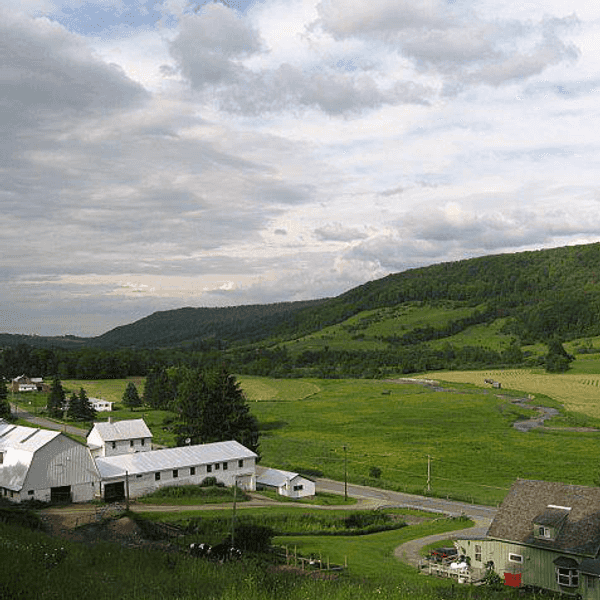
Tully, N.Y.—Travelling on Otisco Road, north towards Onondaga Nation’s recognized territory, a dead end sign halts travelers. The road ends at the area where a bridge once stood. The Otisco Road Bridge was closed almost a decade ago after the ground around it gave out. Landslides, collapsing ground, and giant cracks in the bedrock have plagued this area since the mid-1800s.
Solvay Process first started mining this area in 1889 and continued to do so for almost a century. Solvay needed a great deal of salt for the production of soda ash. It was a staple for the manufacturing of glass, detergents, chemicals and other industrial products. They needed the highest amount of salt solution possible in order to maximize the business’ efficiency, and Tully’s geology presented a landscape rich in mineral salt.
Syracuse was coined “The Salt City” because an inland sea dominated the area 400 million years ago and left large salt deposits. This is what first drove business to the region. Before refrigeration salt was used for the preservation of food and was an extremely valuable resource.
Solvay Process used a brine mining technique, in which solution was pumped underground, and washed into basins. The amount of solution Solvay pumped out of the ground could fill the carrier dome 35 times. For every pound of soda ash produced, Solvay generated a pound and a half of waste.
Brine mining became increasingly more inefficient as salt reserves were depleted. Solvay Process looked for new opportunities for resources. They merged with four chemical companies in 1920 and together formed Allied Chemical Corporation. Over the 20th century Allied infamously dumped mass amounts of sludge waste product around Onondaga Lake, the location where the Lakeview Amphitheatre stands today. In the 90s, Allied Chemical merged to become Honeywell International. Honeywell owns the lakeside waste beds, the Tully mining property and the surrounding area.
The mining left underground voids where wells had removed salt layers, some over 150 feet thick. This results in land subsidence characterized by sinking and cracking on the ground of the former brine fields. Just north of the brine fields on Honeywell property, a unique phenomenon has been causing big problems for Onondaga Creek and the Onondaga Lake Watershed.
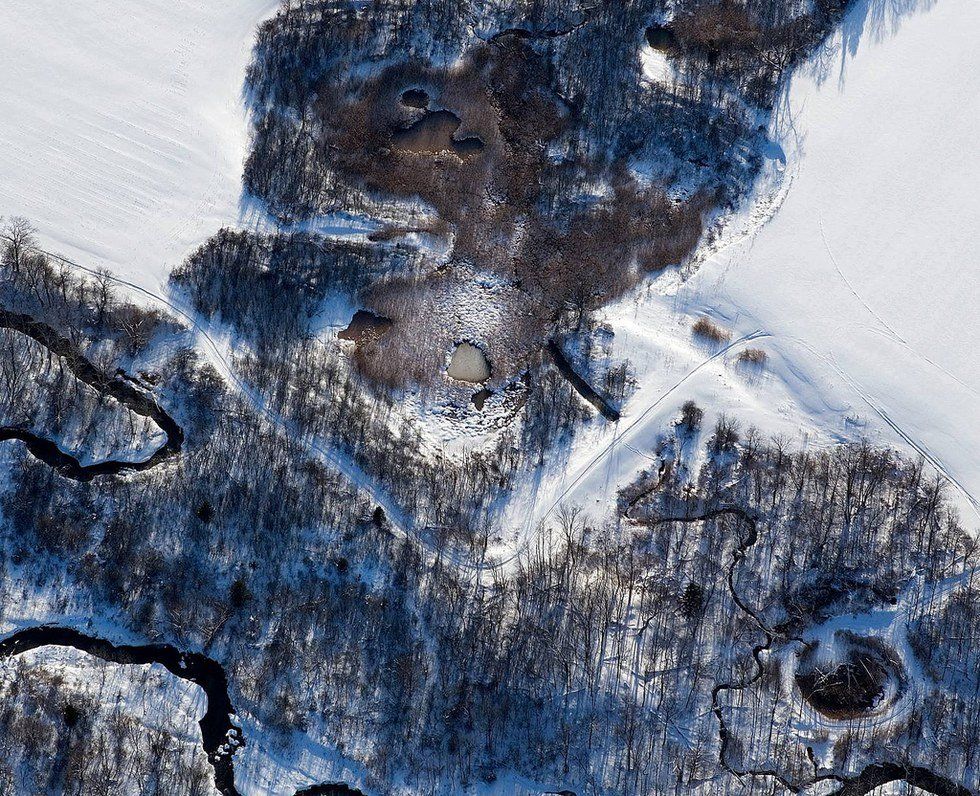
Giant fissures of fractured bedrock in the valley floor allow surface water to run down into salty underground basins. The pressure created in the caverns form narrow cone-like channels that catapult salty water mixed with fine sediments up to the surface. These volcanoes of mud and salt water are known as Mudboils.
According to Aimee Clinkhammer, Environmental Analyst and Onondaga Lake Watershed Coordinator, the boils are naturally occurring. The glaciers that carved out the Tully Valley 200 million years ago created artesian pressure, which is released through a natural process. She sourced United States Geological Survey (USGS) hydrologist Bill Kappel, who has done most of the research on mudboils in the area. He has carbon dated what he believes to be mudboils back before mining operations started. Most experts agree that mining of this area has extremely exacerbated the number and tenacity of mudboils by intensifying the pressure vacuum that pushes the salty sediment up and out of the ground.
From the 1980s to present day, there have consistently been between three and seven active boils at a time. Previously there was only one or two. They would pop up, disappear quickly, and had little impact on the region. Mudboils increased after mining ceased because the underground pressure was not controlled. On any given day mudboils will bubble about 30 tons of brackish water and sediment to the surface. These boils can form and discharge sediment anywhere from a few days to years. One boil in particular has been observed discharging for a whole decade.
After the salty sediment laden water comes up to the surface, it runs off directly into Onondaga Creek. Upstream from the mudboils, the creek runs clear and clean, and is a home to trout and other freshwater fish species. According to Joe Heath, General Counsel for Onondaga Nation, downstream the water is as brown as the coffee in his cup. The sediment filled water flows downstream to the City of Syracuse, where it enters Onondaga Lake.
Onondaga Creek is the only body of water that runs through Onondaga Nation’s recognized territory. The salt and mud contamination of the creek is severely affecting communities. Fish cannot live in the creek anymore. Decades ago, the Nation’s community was centered on the creek. A third of their diet was fish. According to Heath, some of the older generation of Elders from the nation remember “spearfishing for trout at night with a kerosene lantern” when they were teenagers.
This oral storytelling carries a lot of weight for the people of Onondaga Nation. “The creek used to be the lifeblood of the nation,” Heath said. According to him, the non-indigenous people of Tully remember the same thing. Communities in the area are in agreement. The creek has been severely impacted over the last 50 years.
The biggest roadblock in fixing this problem is the amount of funding remediation projects would require. In the 90s, USGS built depressurizing wells, a dam, and a diversion channel that rerouted an unnamed tributary of the creek away from the mudboil depression area. This project successfully decreased mudboil flow from 30 tons a day to around one. It seemed like an excellent solution until it quite literally came crashing down, and the infrastructure caved in from subsidence.
“To simplify we have a huge mess,” said Heath. He believes the onus is on Honeywell to provide funds for a remediation project. “They deny responsibility which is a very big problem, because they’re the ones who should pay for it,” he stated. Regarding if Honeywell can be associated with the blame, Aimee Clinkhammer stated, “It’s a complex issue. Not to say never—but I don’t know who would take that on.” According to Heath, Honeywell has denied any responsibility thus far.
“Trying to sue Honeywell is something that would be very difficult for this small office to do,” Heath said. The Nation has pushed against Honeywell on issues surrounding Onondaga Lake’s superfund cleanup for almost two decades, and according to Heath, they’ve been ignored. Trying to find legal and political support to hold Honeywell responsible is something that the Nation is focusing on for the future.
A Mudboil Advisory Board, made up of city and county municipalities, Environmental Protection Agency (EPA) and Department of Environmental Conservation (DEC) appointees, and other community representatives was created. To gain further knowledge about the implications of mudboils, DEC contracted the formation of a Technical Advisory Panel last year. The panel was facilitated by SUNY College of Environmental Science and Forestry (ESF) faculty members Dr. Valerie Luzadis and Dr. Andrea Feldpausch-Parker, as well as graduate student Katherine Powers.
Facilitating and forming this expert panel was not an easy process, according to Dr. Feldpausch-Parker. The aim was to have technical experts giving unbiased recommendations to the advisory board. “It took way longer than we thought it was going to,” she said, “Somewhere between six and eight months to recruit.” After recruitment and a period for review, four panelists were chosen. Two were from academic backgrounds, and two from government institutions. The technical report on their mudboil advisement was released this week to the public.
Once the members were selected, they were given all the current research on mudboils. A two-day panel was held at ESF for discussion on current state of knowledge. “It was not an easy task for them,” Feldpausch-Parker said, “They combed through a lot of data.” Panelists were given a tour of the mudboil depression area, and other areas with impacts like subsidence and bedrock cracking.
The panel then turned their focus on figuring out what mitigation strategies can be done.
Short-term and long-term solutions were proposed in the draft of their technical report. Engineered water detention basins, constructed wetlands, and floodplain development were all considered as potential strategies to alleviate sediment loading. Reintroducing native beaver species in effort to create sediment-capturing micro-dams was also proposed.
Short-term solutions are less expensive and can be started now, but are still not cheap by any means. Feldpausch-Parker said, “They’re kind of like band aids for a gaping wound”. Long-term solutions will require further research according to the panel. They recommended an in-depth, subsurface model. “With everything we do, there’s going to be an impact. So the model is really critical to see what that impact will be”, Clinkhammer said.
“We have bits and pieces of data but not anything that gives us a real idea of what’s happening underground”, Feldpausch-Parker said. The goal is to depressurize the system. This solution means going higher up in the valley and working on underground engineering projects. These strategies can only be implemented once the experts understand the model in its complexities. But like any other remediation projects, solutions will rely heavily on the availability of funding.
Clinkhammer described that under Superfund, there’s something called Natural Resource Damage Assessment (NRD), which is a clause that states that responsible parties are required to remediate resources to their original condition or as close to original condition as possible. Because the creek flows directly into Honeywell’s Onondaga Lake Superfund site, contributing funds to solve the creek’s sedimentation impact could be a necessary step to take.
The creek’s sediment and sewage pollution negatively affects the City of Syracuse according to Clinkhammer. She imagines a clearer future for the creek. “How great would it be if you could actually fish from the creek—especially in more impoverished communities on the South side of the city?” she asked, “It would be great to get kids interacting with the water more and not have to worry about contamination.”
Heath said, “The ultimate solution would be to have a clean creek and a healthy native trout.” Remediation will take hard work, community dedication, and ample funding to get to that goal. As for now the Tully valley is sinking more and more each day, affecting infrastructure and turning once usable land into sink holes or giant cracks.
“The fissures are really scary”, Dr. Feldpausch-Parker said, “you could easily fall in and die”. Tens of feet wide and stories deep, these cracks are perilous. Unless you’re on a guided tour of the area, trespassing on Honeywell property to take a peek at the mudboils is dangerous and highly discouraged. Groups can contact Honeywell International to find more information about touring the area. As Joe Heath said, “You cannot understand it unless you see it for yourself.”