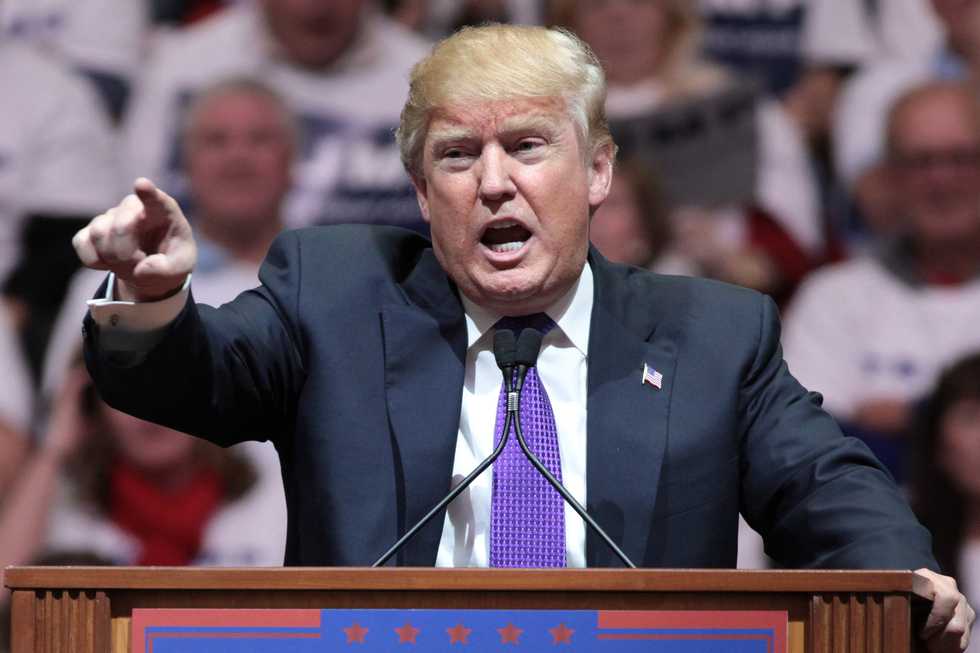
On July 26th, 2017, the internet blew up. Tweets, Facebook posts, Instagram videos, and Snapchat stories flooded the world with opinions on Donald Trump’s latest tweets. The statement he made was clear: “Transgender individuals [are a] disruption” and the “U.S. Military... cannot be burdened with the tremendous medical costs.”
Upon reading this, some citizens were burdened with a sadness they hadn’t felt since President Trump was elected in November. For many individuals, though, this decision didn’t come as a surprise. Throughout his campaign, Donald Trump made statements and references that indicated he was against LGBTQA+ rights. In 2015, he stated that he was for “traditional marriage,” and Trump’s running mate, Mike Pence, was open about signing the Religious Freedom Restoration Act, a bill allowing business owners freedom to hire (or not hire) based on criteria such as sexual orientation or gender. While Trump never directly specified that he was against gay rights, it was clear that economic issues, immigration, and military power were more important to him. Which wasn’t a negative thing, at least to 65,844,944 voters. Yet on Wednesday, the balance between military power and the protection of LGBTQA+ rights was out of balance, and members of both the military community and the queer community had strong and visceral reactions.
For Kelly Lepley, a transgender veteran based in Alaska, this Trump tweet was not only saddening, but deeply personal. Kelly joined the Army Reserve when she was 17, a dream since childhood, but suffered an injury at the age of 21 and was medically discharged. Now, she is in training to become the captain of a multimillion dollar jet – the largest cargo ship in the fleet. She has been featured in magazines such as The Advocate, National Gay Pilot Association, and Runway Girl. In her Ted Talk in 2015, she stated, “I am transgender. For me to have the courage to utter that statement took four decades.” In a private phone interview on July 26th, she told her story, and how it related to Trump’s statements. She shared that she “grew up in a Christian home, where [she] was taught that being gay or transgender was wrong.” She said, “At the expense of my personal life, I excelled in my professional life.”
Having told her personal story of her coming out, she then related her experience reading Donald Trump’s tweets to a blockbuster movie, "The Imitation Game." She referred to Alan Turing, a World War II hero who cracked the German enigma code. She said, “Here is this brilliant man who was able to do incredible things and save millions of lives and design this enigma... and yet society looked past that and focused on his sexuality. By sterilizing him, they not only took away his identity, they took away the whole person and in the end, we in society lost a brilliant mind.” She then circled back as to how this parallels President Trump’s impending policy. “At the moment,” she said, “it is just a tweet from the President. There has been no formal change of policy. However, his tweet undermines the sacrifice our men and women who serve under his leadership who are transgender... This deprives them of their wholeness which [stifles] their ability to give everything they have to serve and in the end this hurts all of us.”
Many individuals, both in the armed services and not, compared this proposed policy to the “Don’t Ask, Don’t Tell” Act (DADT) that was repealed in 2010. As some background, the DADT was an act that stated, in short, that openly gay men and women were barred from the military, therefore, if one wanted to serve, he or she must remain in the closet. Many felt that Trump’s projected policy change would cause more transgender individuals to remain in the closet out of fear. Lucy Austin, a college student at The Boston Conservatory and an active member of the LGBTQA+ community said, “‘Don’t Ask, Don’t Tell’ wasn’t horrific because it was exclusive, exactly- gay men and women could technically serve. It was horrific because it... told gay men and women that they were wanted in the armed forces only if they were willing to be false about who they were.” She felt that barring transgender individuals from service made the same statement. The word “fear” and “falsehoods” were recurring ones in many of the interviews given by members of the community.
Even for those not in the LGBTQA+ community, there was still fear regarding homosexuality (and now transgender individuals) in the military. United States Air Force Veteran David Gary was in active service when the DADT act was repealed. “A lot of the guys I worked with," referring to straight men in the service, "they felt freaked out because they felt that somehow it was going to directly affect them. But the military doesn't work that way.” He then elaborated, “It's a job, it's a job that needs to get done. Being transgender has nothing to do with taking the oath to defend people's lives.”
When asked about how the DADT policy compared to Trump’s impending one, Marine Corp veteran and current employee at the Pentagon, Kimberly Moore, referenced her own coming out journey. She stated that her feelings of being transgender began when she was five or six, but she buried them because she viewed it as a character flaw. When she eventually made the decision to transition, she had already put in eighteen years of active service. As for the funds that her transition cost the U.S. military? Zero. She said, “I started going out [of] town and paying out of my own pocket to get my own healthcare, because had I gone through the military, I would have got kicked out. 18 years of active service, medals, etc., all out the window. They wouldn't have let me serve to the fullest. It's just wrong. It goes against all our ideals.” Kimberly now works for an organization, Transgender American Veterans Association, and fights for proper medical documentation of transgender individuals in the military so that they can benefit from their military retirement and other benefits just like the rest of America.
As for these “ideals” of the U.S. military that she had previously referenced, Kimberly was quick to elaborate. She stated, “The marine corp, they have this saying - honor, courage, and commitment. They expect that to be the fundamental core of our service members. Honor. To have honor, do you hide yourself and not stand up for your beliefs and rights? Courage. Now you're telling me I can't have courage, if I do, you'll punish me for it. All for what? Commitment? That's what servicemen and women are there for. They're committed to the ideals of their country.” Lauren Kasdan, a recent graduate from DuPont Manual High School in Kentucky referenced these ideals, saying “[The policy] is a disgrace to everything that America should stand for.” David Gary, referenced above, also stated, “Every person in the United States as a base is allowed all freedoms. Women, men, black, white, Hispanic, Asian, gay, lesbian, transgender. In the military, it should be the same. Yes, you take orders, but at the end of the day, you're a person. You're a person who took an oath to do a job.” It seemed to be the violation of these American ideals, those such as freedom and equality that citizens fought for in 1776, that has the world in an uproar.
These ideals, these intrinsic American values, are what is violated by this proposed policy. Even if the law never comes to pass, the President has made a very strong statement as to his feelings toward the minority that is transgender individuals in America. Kelly Lepley said it best with the statement, “Many of my transgender peers who serve in the military are highly intelligent, serve in multiple capacities, [and] took an oath to defend our Constitution. They're not just a simple tweet. They are real people who are willing to give up their lives for our freedoms and today, and with a swoop of a tweet, they were trampled on.” These people refuse to be viewed as chess pieces to be moved flippantly by men in marble buildings. They are people, who are not only fighting for their rights, but for the rights of their children, their neighbors, and every United States citizen regardless of color, orientation, or gender. Their stories are unique, empowering, and uniquely “American.” It’s time they be treated as such.