
It always seems to be a 50/50 shot when asking someone if they like movies with subtitles or not. I’ve come across a lot of people who say “no” while others are just indifferent about subtitles.
However, I can understand why a lot of people say “no” to subtitled movies. Sometimes, it can be hard to keep up with what’s on-screen when words are mixed in and distracting the viewer from the picture. Other times, it can be the issue of not watching the movie with the viewer’s tongue. It’s been that issue with a lot of foreign films here in America. I can’t tell you how many times, during the Oscars, when a foreign film came up, many people at my party were confused. There were a lot of “what?” and “huh?” I think the last time I heard about a foreign film gaining a great amount of fame was in 2011 for "The Artist."
The biggest complaint I have ever heard about a subtitled film has got to be “It takes me out of the movie.”
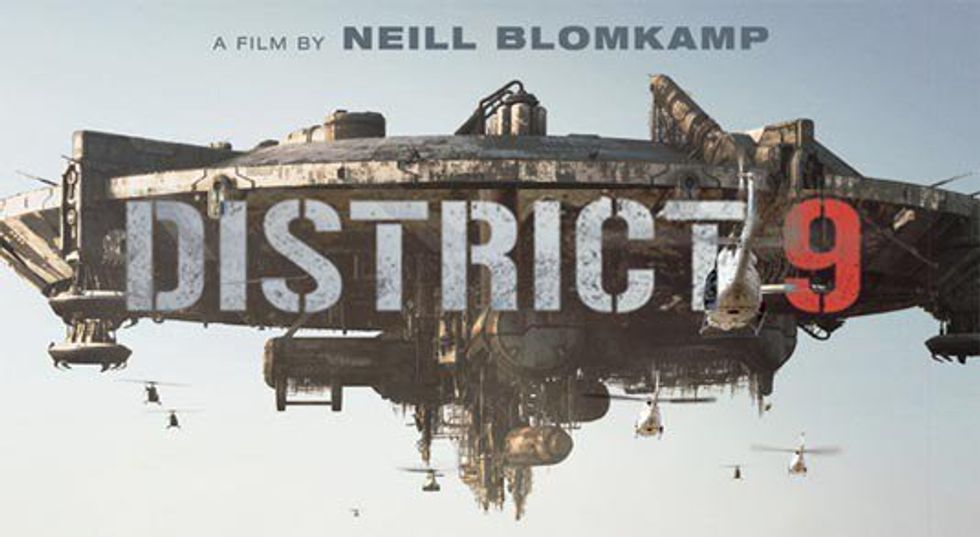
What makes this issue a little interesting to me is that even in our own American films, we still use subtitles. I noticed this when I watched Neill Blomkamp’s films "District 9" and "CHAPPiE," which both use subtitles in a strange way.
"District 9" is about a colony of aliens called the Prawns that are stranded on Earth. The humans create an organization to (somewhat) assist these aliens in living a peaceful, but highly prejudiced and restricted environment. When one of these agents gets his DNA scrambled with an alien substance, he slowly starts to become one of the Prawns and discovers that his company is more corrupted than he thought before.
"District 9" is a really good sci-fi movie and Blomkamp’s use of subtitles was appropriate in most areas of the film. The Prawns have their own language, which gives Blomkamp a good reason to even put subtitles in the first place. On top of that, we have the mix of Nigerian merchants in the alien’s desolate neighborhood. And Nigerian accents can be difficult to understand, sometimes. Both sets of races provide a good reason to use subtitles.
The one thing I don’t understand about Blomkamp, though, is why the use of subtitles in CHAPPiE was so off.
In "CHAPPiE," we have a robot, three street thugs, an Indian programmer, and a crime lord. My question to you, Blomkamp, is why can I understand the Indian programmer better than the other five characters?
Throughout "CHAPPiE," I can understand Chappie well enough to make out what he is saying, but his audio is still bad. The three thugs seem to just be making funny voices for most of the movie and don’t have a clue what accent they’re trying to pull off. Honestly, I think their tongue was part Boston, part Cockney, part Scottish, and part Spanish. But, then again, I couldn’t tell. Most of the time, it just sounded a bit like bad voice acting.
As for the actor playing the crime lord, he was the worst. Subtitles were used on occasion and when subtitles weren’t being used, I couldn’t understand the guy. It was like he couldn’t decide on speaking English or using a foreign language. He’d just switch in and out whenever he felt like it, as if Blomkamp said, “Doesn’t matter to me. Just sound foreign. I’ll do what I want to edit.”
And this is where "CHAPPiE" gets me, it’s that infrequent and occasional use of subtitles. Every time the crime lord came on screen, I groaned. It was another round of switching between watching and reading the movie when it was least expected. This even caused me to pull myself out from the world of "CHAPPiE." If your actors aren’t using English correctly or are using an accent correctly, you, as a filmmaker, are doing something wrong.
At least in "District 9," there was good enough reason to have subtitles for certain characters. Aliens are aliens; there is no telling if they really know the English language and that is left up to the filmmaker to decide. People who speak another nationality need subtitles, depending on your audience.
"CHAPPiE" just needed a lot more cleaning in the audio department. The crime lord didn’t need to spastically switch between languages every few lines and Chappie himself could have done without overly-excited and fast-paced dialogue. It's the things going on outside of the screen that cause some viewers to get pulled away from the fantasy. And isn't that part of watching a film—to immerse yourself in an entirely different world to lose yourself in?
If there is anything I’d like a film student to take from this article, it’s this: be mindful of your audience, know what you want from your actors, and always clean up the audio. You can’t make a movie in Latin and then release it in Japan.