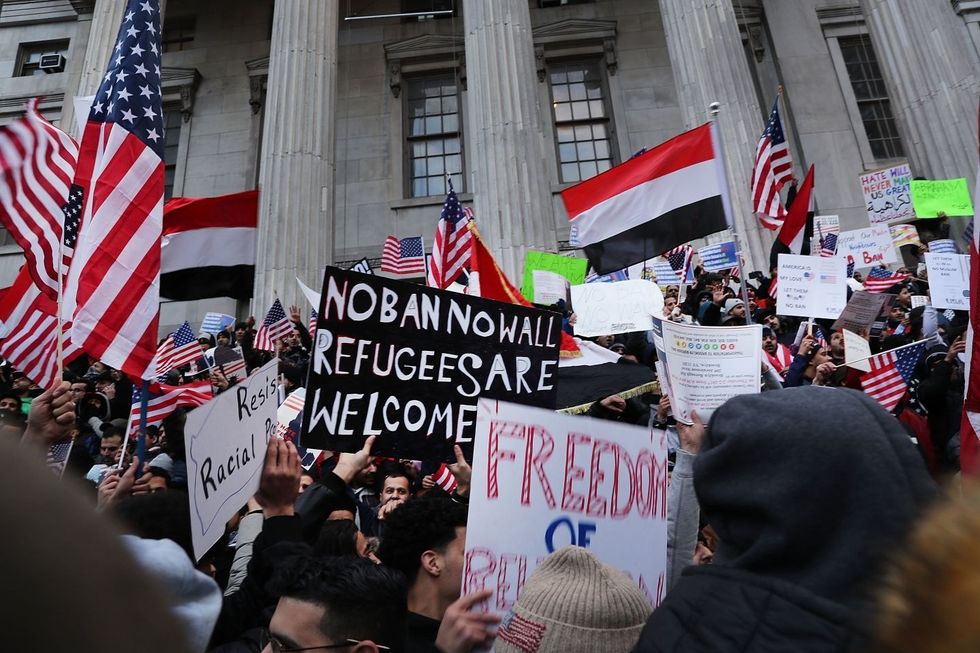
Ever since Donald Trump first proposed a ban on all Muslims entering the US early in his campaign, policy experts have noted that this unconstitutional proposal couldn’t see the light of day. They were right; something that drastic couldn’t be implemented without significant legal pushback. Of course, it was still possible to implement a smaller policy with more narrow goals, but still reverse-engineered from the original stance.
By Rudy Giuliani’s admission, that is more or less what the Trump administration did. The first travel ban barred immigrants and refugees coming from seven Muslim-majority nations: Iraq, Iran, Sudan, Syria, Libya, Somalia, and Yemen. After an absolute disaster in several airports where valid green-card holders, including translators who served alongside US military personnel, were turned away, Congressional leaders were stopped by CBP agents when trying to talk to constituents, and even Syrian Christian families, who were supposed to get priority status, were turned back to their home countries. Inevitably, the order was challenged in court, and after the 9th Circuit heard arguments from the Trump administration and they lost. While Trump threatened to take them to court over Twitter even though they were already in court, the administration essentially dropped the case.
They tried again, this time taking advice to waive green-card holders as well as removing Iraq from the list to prevent jeopardizing anti-ISIS operations. Both the Ninth Circuit as well as judges in Maryland and Hawaii struck down large parts of the order. While it lost in an appeals court, the Trump administration very quickly took the case to the Supreme Court which, just a few days ago, agreed to hear the case. Justices Gorsuch, among others, struck down key parts of the state judge’s ruling, paving the way for the Trump administration to reinstate the travel ban largely on Thursday.
While the Supreme Court only moved to hear the arguments on the case, the Trump administration declared a unanimous victory and reinstated the order. The ACLU and others have criticized this move, and litigation is possible. While the merits of the order have already been debated, and there are several legal opinions that state these points more clearly; arguments will be made at the highest court in the land, and only time will tell if this order will finally stay or be struck down for good.