


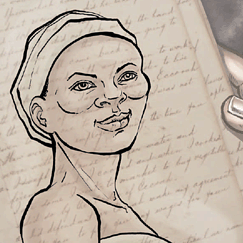
Karl Marx, a German thinker of the 1800s, argues through his central thesis in "The Manifesto of the Communist Party" that “The history of all hitherto existing society is the history of class struggles. Freeman and slave, patrician and plebian, lord and serf, guild master and journeyman, in a word, oppressor and oppressed, stood in constant opposition to one another.” According to Marx, democracy is a myth and capitalism created division in class warfare. For this oral argument, I will use Trevor Getz and Liz Clarke’s "Abina and the Important Men" to support Marx’s claims made in the Manifesto of the Communist Party and in his pyramid of capitalism system.
First, Marx critiques religion by arguing that it is the opiate of the masses. He says in the Manifesto that “In one word, for exploitation, veiled by religious and political illusions, it – being the bourgeoisie -- has substituted naked, shameless, direct, brutal exploitation.” Here Marx critiques capitalism and the bourgeoisie by arguing that religion veils what is really happening in a society of democracy and capitalism. Religion numbs us to our environment so we can’t see the bad happening in capitalism. "Abina and the Important Men" supports this claim as demonstrated by a quote on page 74. The narrator of the graphic novel speaks of Melton after the defendant was acquitted and says “History must not judge William Melton too harshly. He believed strongly in doing what was right. But what did right mean? Melton’s ideas of right and wrong has been formed over many years and through many experiences.” Melton was “guided by the teachings of his church, by his pastors, and by his own readings of the bible.” Here we see a direct example of the ways in which religion has molded Melton’s mind and ways of thinking which blinds him to the capitalist society he takes part in, leading to potentially unjust behaviors justified only by his religious belief system.
Second, Marx critiques the bourgeoisie in saying “Our bourgeois, not content with having wives and daughters of their proletarians at their disposal, not to speak of common prostitutes, take the greatest pleasure in seducing each other’s wives.” Gender is not removed from capital, according to Marx. It is not enough that the commoners are completely dehumanized, they are also sometimes used for violent sexual relations. While "Abina and the Important Men" does not explicitly mention situations including the usage of women in sexual violence in the democratic society that Abina offers her case in, we do know that female voices must be marginalized in that society. There are no women of power, only men, thus the graphic novel’s title, “Abina and the Important Men.” The only women who do speak are those who are asked to for Abina’s case, with the exception of Abina, who is seen as a second class citizen because she is a slave.
Finally, Marx’s pyramid of capitalism system is another critique Marx has for capitalism. It too is a representation of marginalized voices in society, although it is ironic for the way it is set up. Building from the base, we have those who say, “We work for you and we feed you.” Above are those who say, “We eat for you.” Next are those who, “Shoot for you.” Then are those who say, “We fool you.” Next are those who say, “We rule you.” And at the top, we have capitalism. What is interesting is that if those who are the working class (at the bottom) decided to leave, society as we all know it would crumble, and yet they are those being marginalized. This is morally unjust. Abina would fall within this bottom category, if not below it, because she is a slave, but she must answer to those above her. Melton tells her that “Abina… There’s nothing we can do. Eddoo is an important man, and the british do not like alienating important men.” Even though Abina is the foundation of the society, she is marginalized by those she is holding up.

















